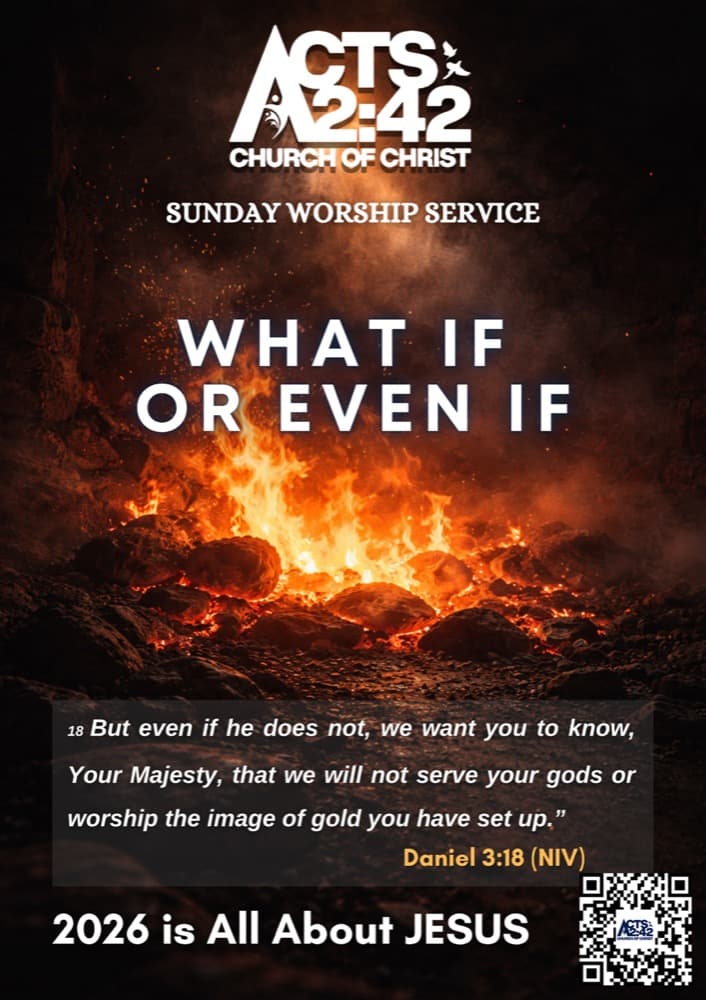
"If we are thrown into the blazing furnace, the God we serve is able to deliver us from it, and he will deliver us from Your Majesty's hand. But even if he does not, we want you to know, Your Majesty, that we will not serve your gods or worship the image of gold you have set up." — Daniel 3:17–18
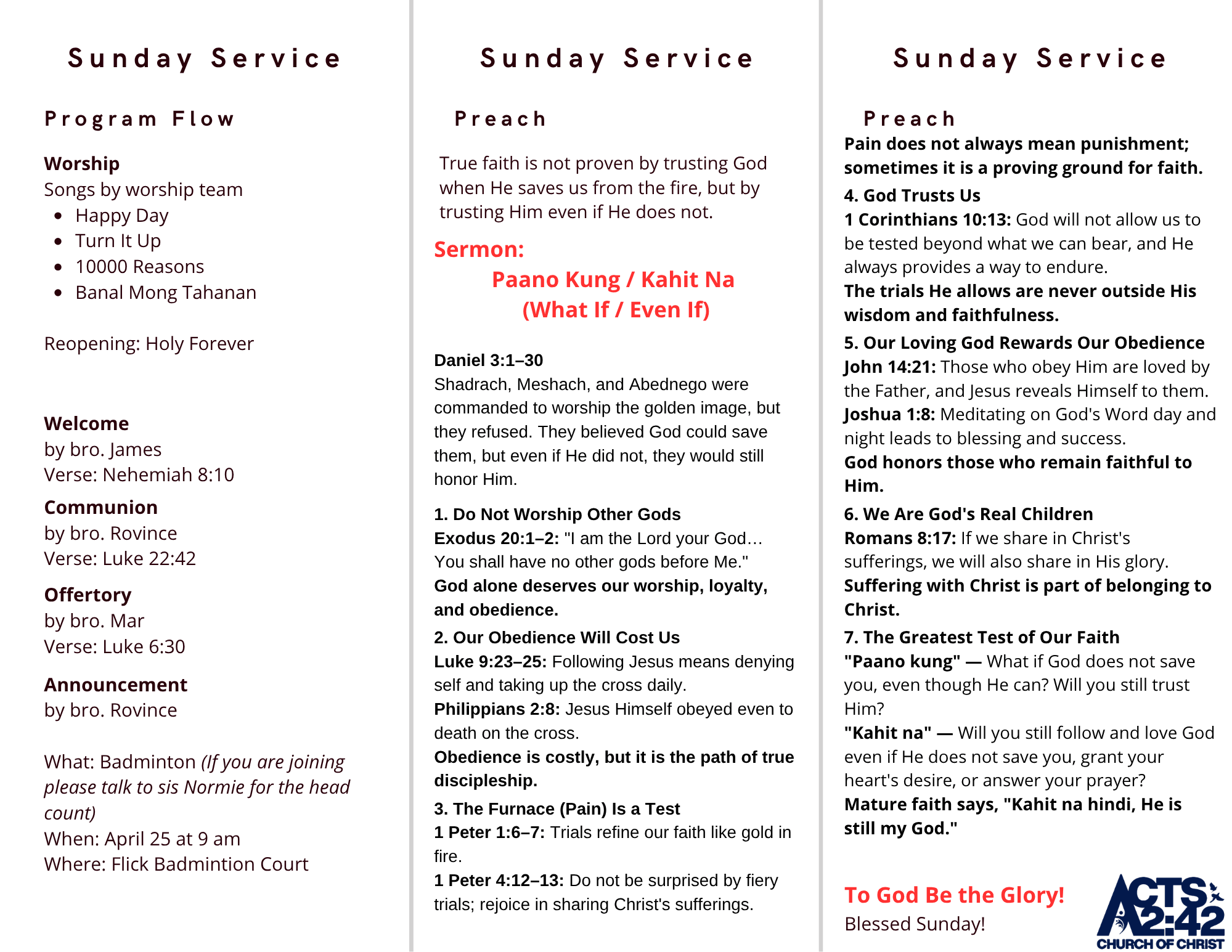
The Two Sentences That Define Faith
There are two sentences every believer eventually has to speak.
The first is easy: "Paano kung..." — What if God does this? What if He opens the door, heals the body, saves the marriage, answers the prayer?
The second is harder: "Kahit na..." — Even if He does not.
Most of us live our spiritual lives in the first sentence. We ask. We hope. We believe for the outcome. And when the outcome comes, we worship louder. But the faith God is actually building in us is the faith that can speak the second sentence — the one Shadrach, Meshach, and Abednego spoke before the fire was ever lit.
Three Men, One Furnace, One Question
In Daniel 3, King Nebuchadnezzar built a golden image sixty cubits high and gave every nation one command: when the music plays, bow. Anyone who refused would be thrown into a blazing furnace. The music played. Everyone bowed. Except three.
When the king confronted them — "What god will be able to rescue you from my hand?" — their answer became one of the most defining declarations in all of Scripture. Our God can save us. And if He does not, we still will not bow.
So the king heated the furnace seven times hotter. He bound them. He threw them in. And when he looked inside, he saw four men walking in the fire — the fourth, he said, looked "like a son of the gods." They came out with no burn, no singed hair, no smell of smoke. The king who sentenced them ended up blessing their God, and the three were promoted in Babylon.
But notice where the faith was proven. Not in the deliverance. In the declaration before the deliverance.
"You Shall Have No Other Gods"
The first commandment God ever gave Israel was this: "I am the Lord your God, who brought you out of Egypt, out of the land of slavery. You shall have no other gods before me." (Exodus 20:1–2)
The golden image in Daniel 3 was not a new problem. It was the oldest problem. Every generation builds its own statue — status, security, a relationship, a dream — and every generation hears the same music and feels the same pressure to bow.
God does not share a throne. He never has.
Obedience Has a Price Tag
Jesus never sold discipleship as a comfortable arrangement. "Whoever wants to be my disciple must deny themselves and take up their cross daily and follow me," He said in Luke 9:23–25. The cross was not a metaphor when He said it. It was an execution device. He was telling people: if you follow Me, plan on dying to something.
And then He walked that road Himself. Philippians 2:8 says He "humbled himself by becoming obedient to death — even death on a cross!" The obedience He asks of us is the obedience He already gave.
Shadrach, Meshach, and Abednego understood this. They did not argue for a loophole. They did not look for a way to bow a little and keep their positions. They counted the cost and stepped into it.
Obedience will cost you. The only question is what you are willing to pay.
The Furnace Is Not Always Punishment
One of the hardest theological mistakes we make is assuming that if we are suffering, we must be outside of God's will. The Bible says the opposite is often true.
Peter wrote to believers in trial: "In all this you greatly rejoice, though now for a little while you may have had to suffer grief in all kinds of trials. These have come so that the proven genuineness of your faith — of greater worth than gold, which perishes even though refined by fire — may result in praise, glory and honor when Jesus Christ is revealed." (1 Peter 1:6–7)
He said it again a few chapters later: "Do not be surprised at the fiery ordeal that has come on you to test you, as though something strange were happening to you. But rejoice inasmuch as you participate in the sufferings of Christ." (1 Peter 4:12–13)
The furnace is a test. Not a rejection. Fire does not destroy gold — it proves gold. And sometimes the pain we are begging God to remove is the exact instrument He is using to show us what our faith is actually made of.
God Trusts You With This
Here is a truth we rarely say out loud: when God allows you into a trial, He is not just testing you. He is trusting you.
"No temptation has overtaken you except what is common to mankind. And God is faithful; he will not let you be tempted beyond what you can bear. But when you are tempted, he will also provide a way out so that you can endure it." (1 Corinthians 10:13)
He measured the furnace before He let you walk near it. He knew what it would demand and He knew what He put inside you. The weight on your shoulders right now is not an accident of heaven. It is a vote of confidence from the One who knows exactly what you can carry with Him beside you.
Obedience Is Seen and Rewarded
God never asks for faithfulness and then forgets it.
Jesus said in John 14:21, "Whoever has my commands and keeps them is the one who loves me. The one who loves me will be loved by my Father, and I too will love them and show myself to them." Obedience is how love becomes visible. And when love becomes visible, Christ reveals Himself.
Joshua heard the same promise on the edge of the Jordan: "Keep this Book of the Law always on your lips; meditate on it day and night, so that you may be careful to do everything written in it. Then you will be prosperous and successful." (Joshua 1:8)
The reward is not always what we picture. Sometimes it is a promotion in Babylon. Sometimes it is a deeper knowing of Christ in the middle of the loss. But God sees. And God answers His faithful.
The Family Resemblance
Paul wrote something to the Romans that sits very close to the heart of this sermon: "Now if we are children, then we are heirs — heirs of God and co-heirs with Christ, if indeed we share in his sufferings in order that we may also share in his glory." (Romans 8:17)
Look carefully at that word — if. Sharing in His sufferings is how the family resemblance shows. The children of God are not the ones who never walk near the furnace. They are the ones who still call Him Father while they are in it.
If Christ suffered, and we are His, we will suffer too. And that suffering is not evidence that we are forgotten. It is evidence that we belong.
The Question You Will Have to Answer
At some point, every believer stands where Shadrach, Meshach, and Abednego stood — not before a literal furnace, but before a real one. A diagnosis. A loss. A closed door. A prayer God has not answered in years.
And in that moment, two sentences wait for you.
"Paano kung" — What if God does not save you, even though He can? Will you still trust Him? Will you still honor Him as your God?
"Kahit na" — Will you still follow and love Him even if He does not save you, does not grant the desire of your heart, does not answer the prayer you have been praying?
The three men answered before the fire. That is the secret. Faith that waits to see the outcome is not yet faith — it is negotiation. The faith that honors God is the faith that says kahit na hindi, He is still my God while the flames are still rising.
Golden Question
Kung alam mong kaya kang iligtas ng Diyos — pero pinili Niyang hindi — susundin mo pa rin ba Siya?
If you knew God could save you — but chose not to — would you still follow Him?
This is the question Shadrach, Meshach, and Abednego answered before they ever saw the fire. And it is the question every believer must answer before their own furnace comes.
Challenge
This week, name your "paano kung." Write down the outcome you are hoping God will give — the healing, the open door, the restoration, the answer. Be honest. God is not threatened by the specificity of your ask.
Then, underneath it, write your "kahit na." Finish this sentence honestly before Him:
"Even if You do not ___________, You are still my God, and I will still serve You."
That sentence is the furnace door. Walk through it before the fire is ever lit. Because the faith that honors God is not the faith that gets out of the fire — it is the faith that would still worship Him inside it.
Kahit na hindi — He is still my God.