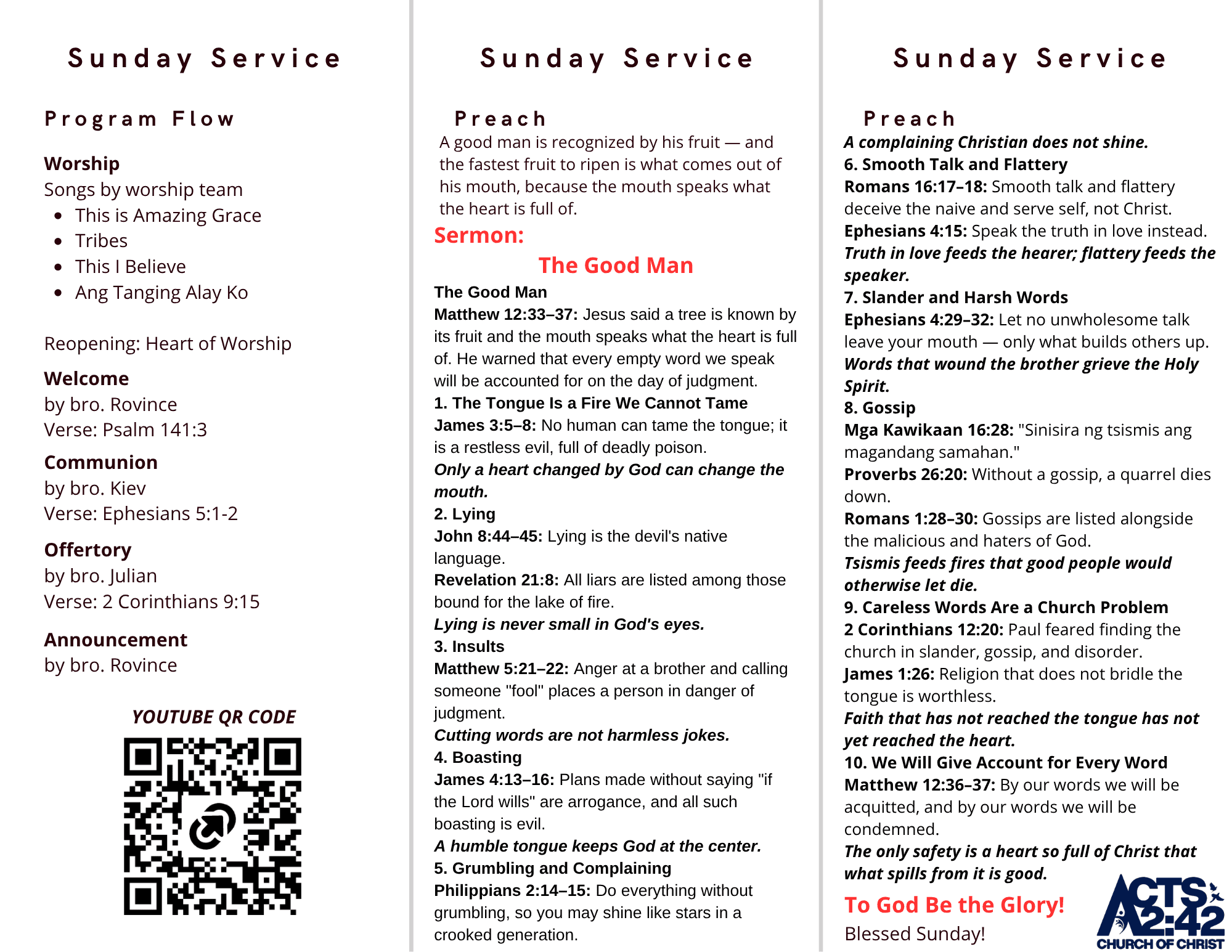

"A good man brings good things out of the good stored up in him, and an evil man brings evil things out of the evil stored up in him. But I tell you that everyone will have to give account on the day of judgment for every empty word they have spoken." — Matthew 12:35–36
How Do You Recognize a Good Man?
We recognize good people by the things they do. We tell stories of their kindness, their generosity, their character under pressure. But Jesus, when He wanted to teach us how to spot a good man, did not point to the hands. He pointed to the mouth.
"Make a tree good and its fruit will be good, or make a tree bad and its fruit will be bad, for a tree is recognized by its fruit. You brood of vipers, how can you who are evil say anything good? For the mouth speaks what the heart is full of" (Matthew 12:33–35).
That last sentence is the test. Whatever fills the heart eventually leaks out of the mouth. The tongue is a window into a place we cannot see — and Jesus is saying, look at the words, and you will know the soul. A good man is not someone with a polished public voice. A good man is someone whose heart is full enough of God that what spills out is good.
This is not a comfortable sermon. Most of us do well when our hands are watched. It is our words that betray us.
The Fire We Cannot Tame
James does not soften the picture. "The tongue is a small part of the body, but it makes great boasts. Consider what a great forest is set on fire by a small spark. The tongue also is a fire, a world of evil among the parts of the body. It corrupts the whole body, sets the whole course of one's life on fire, and is itself set on fire by hell. All kinds of animals, birds, reptiles and sea creatures are being tamed and have been tamed by mankind, but no human being can tame the tongue. It is a restless evil, full of deadly poison" (James 3:5–8).
Read that again slowly. No human being can tame the tongue. Not by willpower. Not by self-help. Not by promising yourself you will do better next time. The tongue is a fire we cannot put out by ourselves — which means the only hope for our words is for our hearts to be changed by Someone stronger than the fire.
That is the entire sermon in one breath. We do not fix our mouths. We let God fix our hearts, and the mouth follows.
The Sins of the Tongue
Jesus and the apostles named seven specific sins of the tongue — seven kinds of fruit that grow on a tree that is not yet good. Walk through them slowly. Some will sting. Let them.
1. Lying
Jesus said something stunning in John 8: "You belong to your father, the devil, and you want to carry out your father's desires. He was a murderer from the beginning, not holding to the truth, for there is no truth in him. When he lies, he speaks his native language, for he is a liar and the father of lies" (John 8:44–45).
Lying is not a small thing. It is the native language of the enemy. Every time we lie — to a parent, a spouse, a boss, a friend, ourselves — we are speaking in a tongue that does not belong to us. And Revelation does not let us treat it lightly: "All liars — they will be consigned to the fiery lake of burning sulfur" (Revelation 21:8). God does not classify liars somewhere far below murderers and the sexually immoral. He lists them in the same sentence.
2. Insults
Jesus raised the standard so high that we are forced to stop comparing ourselves to people worse than us. "You have heard that it was said... 'You shall not murder'... But I tell you that anyone who is angry with a brother or sister will be subject to judgment. Again, anyone who says to a brother or sister, 'Raca,' is answerable to the court. And anyone who says, 'You fool!' will be in danger of the fire of hell" (Matthew 5:21–22).
Calling someone a fool puts a believer in the same category as a murderer in God's courtroom. We laugh off our insults. We frame them as jokes. We call them roasts. Jesus calls them dangerous.
3. Boasting
"Now listen, you who say, 'Today or tomorrow we will go to this or that city, spend a year there, carry on business and make money.' Why, you do not even know what will happen tomorrow. What is your life? You are a mist that appears for a little while and then vanishes. Instead, you ought to say, 'If it is the Lord's will, we will live and do this or that.' As it is, you boast in your arrogant schemes. All such boasting is evil" (James 4:13–16).
Boasting is not just bragging — it is forgetting who holds the next breath. Every plan we make without God in it is a boast. And James says all of it is evil. The cure is one phrase added back into our speech: if the Lord wills.
4. Grumbling and Complaining
This one is quiet. We do not think of complaining as a sin of the tongue — but Paul does. "Do everything without grumbling or arguing, so that you may become blameless and pure, 'children of God without fault in a warped and crooked generation.' Then you will shine among them like stars in the sky" (Philippians 2:14–15).
Notice what stops the shining. Not big sins. Grumbling. The murmured complaint. The under-the-breath sigh. The text to the friend that turns into an hour of tearing down. A grumbling Christian does not shine. A grateful one does.
5. Smooth Talk and Flattery
Paul warned the Romans about a particular kind of dangerous person: "I urge you, brothers and sisters, to watch out for those who cause divisions and put obstacles in your way that are contrary to the teaching you have learned. Keep away from them. For such people are not serving our Lord Christ, but their own appetites. By smooth talk and flattery they deceive the minds of naive people" (Romans 16:17–18).
Flattery is not kindness. Flattery is words used to get something. It looks like love and feels like love but it is not love — it is manipulation wearing love's clothes. The cure is in Paul's instruction to the Ephesians: "Speaking the truth in love, we will grow to become in every respect the mature body of him who is the head, that is, Christ" (Ephesians 4:15). It is better to speak the truth in love than to flatter. Flattery feeds the speaker. Truth in love feeds the hearer.
6. Slander and Harsh Words
"Do not let any unwholesome talk come out of your mouths, but only what is helpful for building others up according to their needs, that it may benefit those who listen. And do not grieve the Holy Spirit of God, with whom you were sealed for the day of redemption. Get rid of all bitterness, rage and anger, brawling and slander, along with every form of malice. Be kind and compassionate to one another, forgiving each other, just as in Christ God forgave you" (Ephesians 4:29–32).
Read that test out loud: only what is helpful for building others up according to their needs. If the words about to leave your mouth fail that test, swallow them. Slander grieves the Holy Spirit. Harsh words grieve the Holy Spirit. The tongue that wounds the brother wounds the Spirit who lives in the brother.
7. Gossip
The Filipino translation of Proverbs 16:28 lands with weight: "Ang taong baluktot ang isipan ay naghahasik ng kaguluhan, at sinisira naman ng tsismis ang magandang samahan" — the crooked-minded person sows trouble, and gossip destroys good fellowship. Solomon said it another way: "Without wood a fire goes out; without a gossip a quarrel dies down" (Proverbs 26:20).
Tsismis is a fire-feeder. Take away the wood, and the fire dies. The gossip is the one who keeps walking up to the smoldering ember and dropping a fresh log on it.
And gossip is not a soft sin in God's eyes. Paul lists it alongside the worst of human evils: "They were filled with all manner of unrighteousness, evil, covetousness, malice. They are full of envy, murder, strife, deceit, maliciousness. They are gossips, slanderers, haters of God, insolent, haughty, boastful" (Romans 1:28–30). Murder and gossip in the same sentence. That is how God sees what we have learned to laugh about over coffee.
Careless Words Are a Church Problem
This is not a sermon for "the world." Paul wrote to the Corinthian church — a believing church — with this fear: "For I am afraid that when I come I may not find you as I want you to be, and you may not find me as you want me to be. I fear that there may be discord, jealousy, fits of rage, selfish ambition, slander, gossip, arrogance and disorder" (2 Corinthians 12:20).
Slander. Gossip. In the church. Paul knew, because every pastor knows, that the most dangerous fire in any congregation is rarely lit by outsiders. It is lit by people who love Jesus but have not yet given Him their tongues.
James puts it as bluntly as any verse in the New Testament: "Those who consider themselves religious and yet do not keep a tight rein on their tongues deceive themselves, and their religion is worthless" (James 1:26). Worthless. Not weakened. Not immature. Worthless. If our religion has not reached our tongue, our religion has not yet reached us.
Every Word Will Be Accounted For
Jesus does not let us pretend our words evaporate. "But I tell you that everyone will have to give account on the day of judgment for every empty word they have spoken. For by your words you will be acquitted, and by your words you will be condemned" (Matthew 12:36–37).
Every word. Not just the cruel ones. The empty ones. The throwaway jokes. The text we sent at midnight. The thing we said about a brother behind his back. The lie we told to escape an awkward moment. All of it, recorded. All of it, weighed.
The good news is not that the record will be smaller than we fear. The good news is that there is a Savior whose blood covers what our tongues have spoken — and a Spirit who is willing to begin, this morning, the long work of changing what comes out of us by changing what is stored up inside us.
Challenge
This week, before you speak, pause for one breath and ask one question: what does this say about what is stored up in my heart?
If the words about to come out are kind, true, building, hopeful — let them out, and thank God for what He is putting inside you. If they are bitter, boastful, gossiping, flattering, complaining, dishonest, or harsh — close your mouth and pray instead. Ask God to remove what should not be there. Ask Him to fill the hollow place with Himself. Then, when you open your mouth again, what comes out will be different — because you will be different.
A good man is not a man with a careful mouth. A good man is a man with a full heart. May God fill ours, until what spills over is good.
For the mouth speaks what the heart is full of.