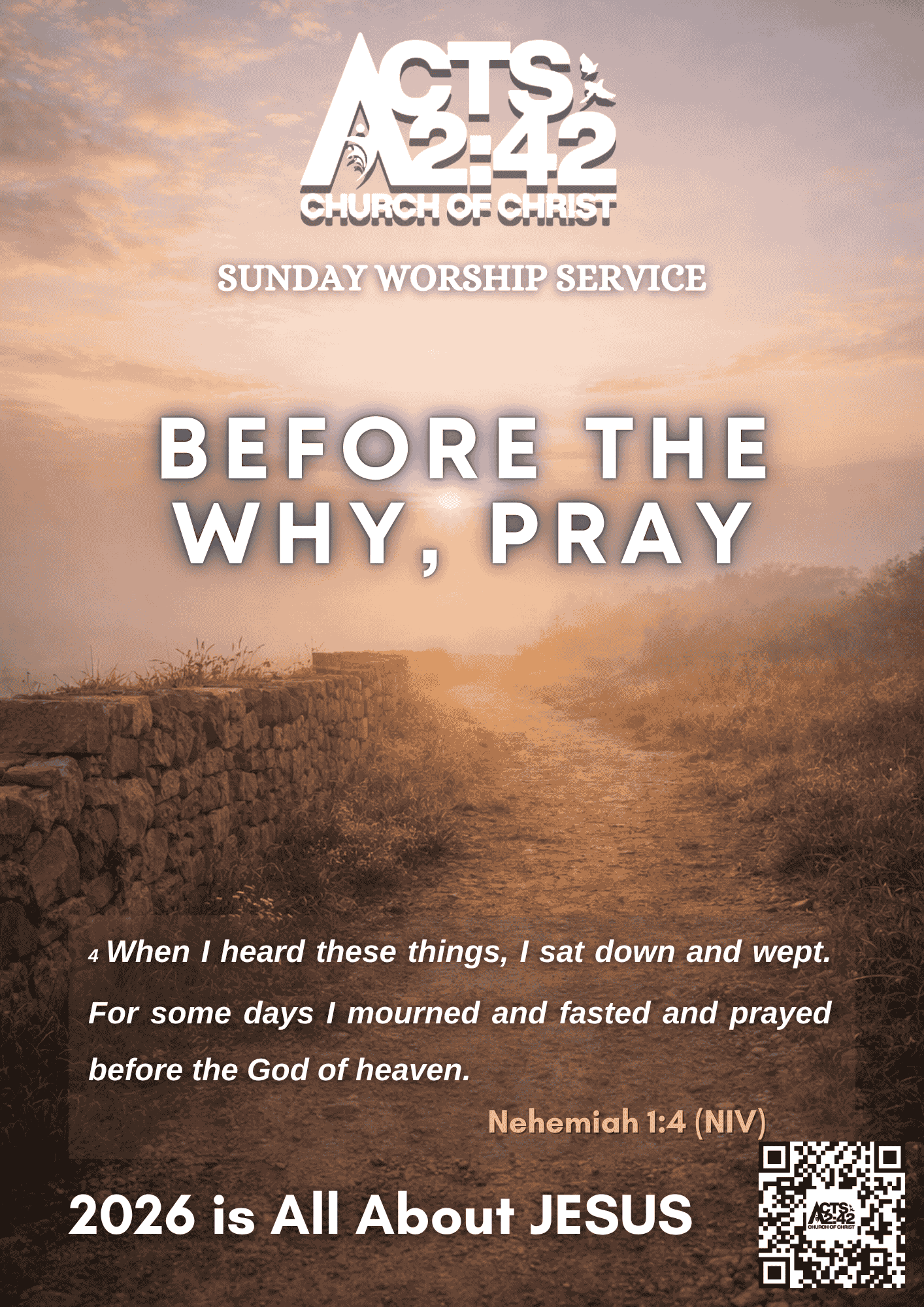
"When I heard these things, I sat down and wept. For some days I mourned and fasted and prayed before the God of heaven." — Nehemiah 1:4
The Order That Changes Everything
Most of us are not short on ideas. We are short on order.
When we hear bad news, we react. When we face a decision, we analyze. When we want something to change, we plan. All of these are good — but when they come first, they come from us. They come out of our anxiety, our reasoning, our timing. And the results tend to look like us too.
Nehemiah shows us a different order. He hears the worst news of his life — and before he acts, before he strategizes, before he even speaks to the king who could help him, he prays. Not for a day. For days. He weeps. He fasts. He mourns. He puts his whole body into asking God before he ever lifts a finger to rebuild.
That order is the sermon. Before the why — pray. Before the plan — pray. Before the answer — pray. Real success does not begin with strategy. It begins on your knees.
What Nehemiah Heard
Nehemiah was living in the citadel of Susa, cupbearer to the king of Persia — a good job, a safe life, far from the ruins he came from. Then his brother Hanani arrived from Judah, and Nehemiah asked about the remnant and about Jerusalem. The answer broke him: "Those who survived the exile and are back in the province are in great trouble and disgrace. The wall of Jerusalem is broken down, and its gates have been burned with fire." (Nehemiah 1:1–3)
The city of his fathers was rubble. The walls that marked God's people as God's people had been torched. And Nehemiah, safe in a palace a thousand kilometers away, did not draft a letter. He did not call a meeting. He sat down and wept.
"For some days I mourned and fasted and prayed before the God of heaven," he writes — and then he prays one of the most beautiful prayers in the Old Testament (Nehemiah 1:4–7). He confesses his sins and the sins of his people. He reminds God of His own promises — "if you return to me and obey my commands, then even if your exiled people are at the farthest horizon, I will gather them" (Nehemiah 1:8–11). And at the end, almost in passing, he drops the line that changes the story: "I was cupbearer to the king."
He did not say, "I will go to the king." He said, "I am near the king." And before he ever used that nearness, he took it to God.
The Prayer Between the Question and the Answer
Four months later, the king noticed. "Why does your face look so sad when you are not ill?" he asked. Nehemiah was terrified — sadness in the king's presence could cost a cupbearer his life. But he told the truth: the city of his ancestors lay in ruins. The king's next question was the one Nehemiah had been praying toward for months. "What is it you want?" (Nehemiah 2:1–4a)
What happens next is easy to miss. Right there, in the throne room, between the king's question and Nehemiah's answer, is one of the shortest prayers in Scripture: "Then I prayed to the God of heaven, and I answered the king..." (Nehemiah 2:4b–7)
No closet. No kneeling. No hours. Just a breath of prayer between a question and an answer — because Nehemiah had already been praying for months. The breath-prayer in the throne room worked because the long prayer in the bedroom had already done its work.
And the king said yes. Yes to going. Yes to letters of safe-conduct. Yes to timber from the royal forest. "Because the gracious hand of my God was on me, the king granted my requests" (Nehemiah 2:8–10). Nehemiah walked out of that room with everything he needed — not because he asked well, but because he had prayed first.
Prayer Gives Courage
One reason we pray before we act is simple: we are afraid. And prayer is where God trades our fear for His courage.
Paul wrote, "Do not be anxious about anything, but in every situation, by prayer and petition, with thanksgiving, present your requests to God. And the peace of God, which transcends all understanding, will guard your hearts and your minds in Christ Jesus" (Philippians 4:6–7). This is the exchange — anxiety out, peace in. You cannot think your way to that peace. You can only pray your way there.
And God's word to Joshua, on the edge of a war he did not want to fight, still stands: "Be strong and courageous. Do not be afraid; do not be discouraged, for the Lord your God will be with you wherever you go" (Joshua 1:9). Courage is not the absence of fear. Courage is what rises up in us when we pray to the One who goes with us.
Prayer Gives Better Decisions
We pray not just to feel better, but to choose better. "Trust in the Lord with all your heart and lean not on your own understanding; in all your ways submit to him, and he will make your paths straight," says Proverbs 3:5–6. The straight path is not promised to the clever. It is promised to the submitted.
And when the decision is heavy and we feel small, Paul's word to Timothy meets us: "For the Spirit God gave us does not make us timid, but gives us power, love and self-discipline" (2 Timothy 1:7). Power for the weight of it. Love for the people inside it. Self-discipline for the long obedience it will take. Prayer is where all three are given.
Prayer Makes Us Christlike
Prayer does not just change what we do. It changes who we are becoming while we do it.
Paul tells the Colossians, "Whatever you do, whether in word or deed, do it all in the name of the Lord Jesus... Whatever you do, work at it with all your heart, as working for the Lord, not for human masters" (Colossians 3:17, 23). Everything. Not just the spiritual things. The emails, the schoolwork, the dishes, the meetings — all of it in His name.
And Micah, centuries earlier, summed up the whole life God wants from us in one line: "He has shown you, O mortal, what is good. And what does the Lord require of you? To act justly and to love mercy and to walk humbly with your God" (Micah 6:8). Justice, mercy, humility. You do not drift into those three. You pray your way into them.
Prayer Changes Our Motive
This is the quietest work prayer does — and maybe the most important.
In Gethsemane, Jesus prayed, "Father, if you are willing, take this cup from me; yet not my will, but yours be done" (Luke 22:42). He did not pray to change the Father's plan. He prayed to align His own heart to it. That is what prayer does in us. It bends our want toward God's will.
And Jesus' words to us carry the same weight: "Let your light shine before others, that they may see your good deeds and glorify your Father in heaven" (Matthew 5:16). Paul said it another way: "Whether you eat or drink or whatever you do, do it all for the glory of God" (1 Corinthians 10:31). Our motive decides whether our obedience is worship or performance. And prayer is where the motive is cleaned.
Prayer Helps Us Fight Sin
Prayer is also warfare. Not against people, but against what lives inside us.
David prayed, "Search me, God, and know my heart; test me and know my anxious thoughts. See if there is any offensive way in me, and lead me in the way everlasting" (Psalm 139:23–24). This is a dangerous prayer. It invites God to find the things we would rather keep hidden. But those are exactly the things that take us down.
Jesus said to His disciples in the garden, "Watch and pray so that you will not fall into temptation. The spirit is willing, but the flesh is weak" (Matthew 26:41). The spirit wants to obey. The flesh does not. Prayer is the hinge between the two.
James goes even deeper: "What causes fights and quarrels among you? Don't they come from your desires that battle within you? ... You do not have because you do not ask God. When you ask, you do not receive, because you ask with wrong motives" (James 4:1–3). The problem is not just what we do. The problem is what we want. Prayer is where God reshapes the wanting itself.
Prayer Resets the Heart
Every week, we need our hearts reset. The world presses in. Our desires drift. Our ambitions quietly take over.
Paul's word to the Galatians: "Walk by the Spirit, and you will not gratify the desires of the flesh" (Galatians 5:16). To the Romans: "Do not conform to the pattern of this world, but be transformed by the renewing of your mind. Then you will be able to test and approve what God's will is — his good, pleasing and perfect will" (Romans 12:2). To the Philippians: "Do nothing out of selfish ambition or vain conceit. Rather, in humility value others above yourselves, not looking to your own interests but each of you to the interests of the others" (Philippians 2:3–4).
These are not three different commands. They are three different angles on the same reset. And the place that reset happens — over and over, until we are finally different — is prayer.
Growth Under God
Here is the framework the whole sermon has been pointing toward. Five movements. Memorize them. Live by them.
First, pray. "Commit your way to the Lord; trust in him and he will do this" (Psalm 37:5). Before the plan, before the ask, before the move — commit it to Him. That is always the first step.
Then God removes. "Let us throw off everything that hinders and the sin that so easily entangles. And let us run with perseverance the race marked out for us" (Hebrews 12:1). Jesus said, "He cuts off every branch in me that bears no fruit, while every branch that does bear fruit he prunes so that it will be even more fruitful" (John 15:2). Paul said, "Put off your old self, which is being corrupted by its deceitful desires" (Ephesians 4:22). Before God builds, He clears.
Then God edits. "Be transformed by the renewing of your mind. Then you will be able to test and approve what God's will is" (Romans 12:2). "In their hearts humans plan their course, but the Lord establishes their steps" (Proverbs 16:9). He does not delete our plans — He corrects them. He rewrites the sentences we got wrong.
Then God adds. "Seek first his kingdom and his righteousness, and all these things will be given to you as well" (Matthew 6:33). "They devoted themselves to the apostles' teaching and to fellowship, to the breaking of bread and to prayer" (Acts 2:42). When the first seat in our life is God's, everything else we actually need gets pulled in behind Him.
Then growth comes. "I planted the seed, Apollos watered it, but God has been making it grow. So neither the one who plants nor the one who waters is anything, but only God, who makes things grow" (1 Corinthians 3:6–7). "Let us not become weary in doing good, for at the proper time we will reap a harvest if we do not give up" (Galatians 6:9). You will not see it every week. But it is happening. The seed in the dark is still a seed doing what seeds do.
Pray. Remove. Edit. Add. Grow. That is growth under God. And it always — always — begins with prayer.
Challenge
This week, before you ask God why, ask Him to pray in you.
Pick one situation in your life right now that is pressing — a decision you need to make, a conversation you have been avoiding, a wall of your own Jerusalem that lies in rubble. Before you plan, before you act, before you even ask "why is this happening" — sit down like Nehemiah did. Weep if you need to. Fast if you can. Pray for days if the weight of it calls for days.
Then, when the moment finally comes — the king's question, the open door, the hard conversation — you will be ready to breathe the throne-room prayer Nehemiah breathed: one quick word to heaven between the question and the answer, because you have already prayed the long prayer in the secret place.
Before the why — pray. Before the plan — pray. Before anything — pray.