"People are destined to die once, and after that to face judgment", and so Christ was sacrificed once "to take away the sins of many." — Hebrews 9:27–28
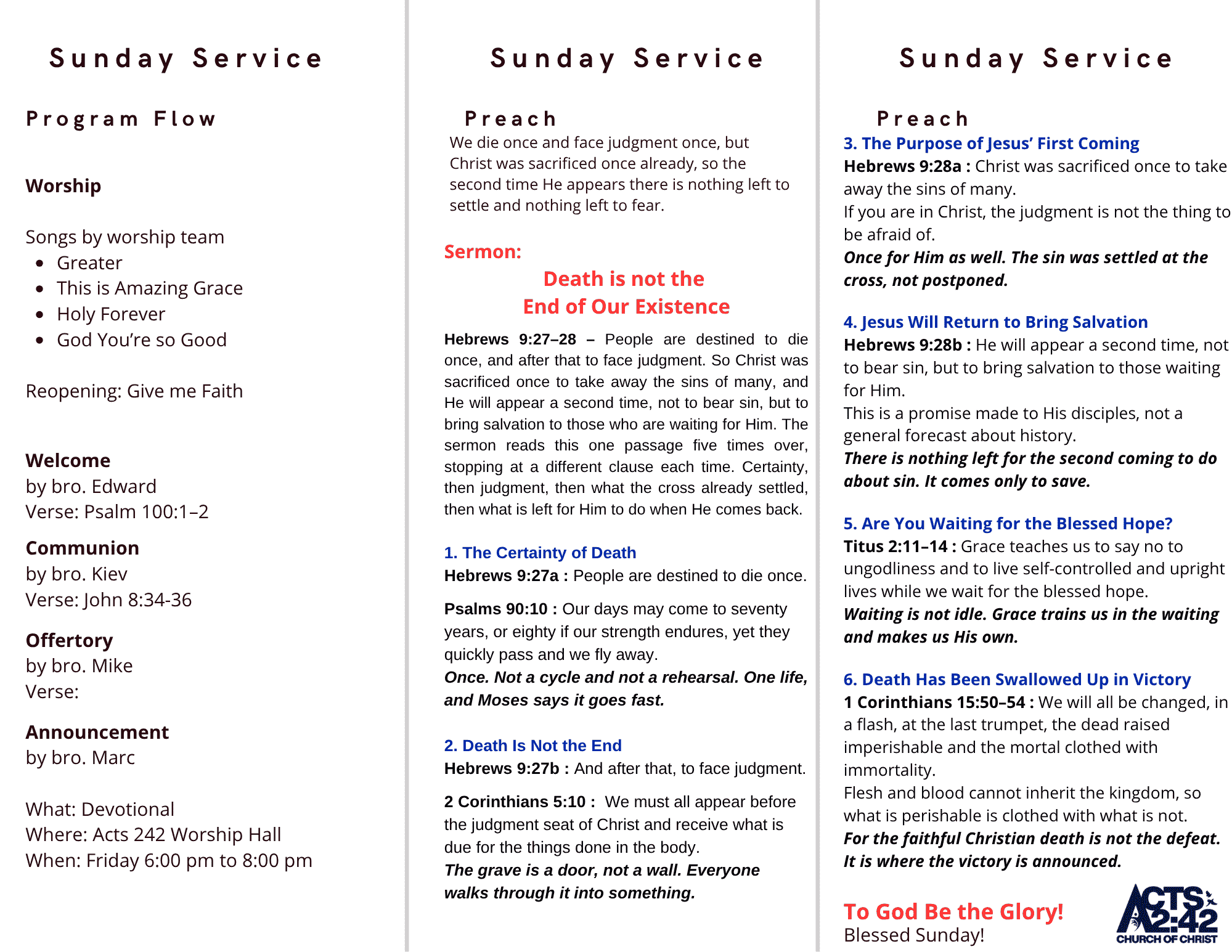
This message does something unusual. It takes a single passage and returns to it again and again, five times, stopping at a different clause each time. Nothing new is introduced. The same two verses are simply read until you cannot avoid what they say.
The Certainty of Death
"People are destined to die once" (Hebrews 9:27).
Destined. Not likely, not eventually, not for most. And once, which rules out the alternatives people comfort themselves with. There is no second attempt at this life and no cycle to return on.
Moses does the arithmetic. "Our days may come to seventy years, or eighty, if our strength endures", and even the best of them are trouble and sorrow, "for they quickly pass, and we fly away" (Psalm 90:10).
Seventy or eighty years sounds generous until you notice how much of it has already gone. The psalm does not say life is bad. It says life is brief, and the honest response is to count it rather than assume it.
Death Is Not the End
"And after that to face judgment" (Hebrews 9:27).
This is the line the whole sermon title rests on. Whatever anyone believes about death, Scripture does not treat the grave as a full stop. Something happens afterwards, and it happens to everyone.
Paul is specific about who appears. "For we must all appear before the judgment seat of Christ", so that each one may receive what is due for the things done while in the body, whether good or bad (2 Corinthians 5:10).
All. Not the notorious. Not the unbeliever only. The grave is a door, and every one of us walks through it into something.
The Purpose of Jesus' First Coming
Now the passage turns, and the turn is the gospel.
"So Christ was sacrificed once to take away the sins of many" (Hebrews 9:28). Once for us, and once for Him. The same word that describes our death describes His sacrifice. It does not repeat and it does not need topping up.
Which is why the message says plainly: if you are in Christ, the judgment is not the thing to be afraid of. The reason anyone would dread standing there has already been dealt with, publicly, at a particular place and time.
That is not a reason for carelessness. It is a reason for confidence, and the difference between the two shows in how a person lives.
Jesus Will Return to Bring Salvation
"And he will appear a second time, not to bear sin, but to bring salvation to those who are waiting for him" (Hebrews 9:28).
Read the exclusion. Not to bear sin. The sin-bearing was the first visit. There is nothing left on that account for the second one. The second appearance has one errand, and the errand is salvation.
Note also who it is for: "those who are waiting for him". This is a promise made to His disciples, not a general forecast about world history.
Are You Waiting for the Blessed Hope?
Which raises the question Paul answers in his letter to Titus. What does waiting actually look like?
"For the grace of God has appeared that offers salvation to all people" (Titus 2:11). And then, surprisingly, grace is described as a teacher. It teaches us to say no to ungodliness and worldly passions, and to live self-controlled, upright and godly lives in this present age (Titus 2:12).
All of that happens "while we wait for the blessed hope", the appearing of the glory of our great God and Savior, Jesus Christ (Titus 2:13), who gave Himself to redeem us and to purify for Himself a people who are His very own, eager to do what is good (Titus 2:14).
Waiting, in Scripture, is never idle. It is training. If a person claims the blessed hope but nothing in their week is being said no to, the waiting described here has not started.
Death Has Been Swallowed Up in Victory
Paul finishes where this sermon finishes. Flesh and blood cannot inherit the kingdom of God, and the perishable does not inherit the imperishable (1 Corinthians 15:50). So something has to change, and it will.
"Listen, I tell you a mystery: We will not all sleep, but we will all be changed" (1 Corinthians 15:51), in a flash, in the twinkling of an eye, at the last trumpet. The dead will be raised imperishable (1 Corinthians 15:52). The perishable clothes itself with the imperishable and the mortal with immortality (1 Corinthians 15:53).
And then the line that this whole message has been walking toward: "Death has been swallowed up in victory" (1 Corinthians 15:54).
For the faithful Christian, death is not the defeat. It is where the victory gets announced.
Challenge
This message lands on a weekend when many of us have been at a graveside, so take it gently and take it seriously.
Count the years honestly. Not morbidly. Moses asks us to notice that the days pass quickly, and the point of noticing is to spend them differently from here.
Settle where you stand before Christ. If the judgment seat is a frightening thought, the answer is not to avoid thinking about it. The answer is in verse 28, and it was completed a long time before you worried about it. If you have never been baptized into Christ, that is the conversation to have this week, with someone, out loud.
Then check your waiting. Grace teaches. Pick the one thing grace has been teaching you to say no to, and say it this week. That is what waiting for the blessed hope looks like in an ordinary Tuesday.
And if you are grieving someone this weekend, hold the last line. The grave did not get the final word on them, and it will not get the final word on you.
To God be the glory!