"A friend loves at all times, and a brother is born for a time of adversity." — Proverbs 17:17
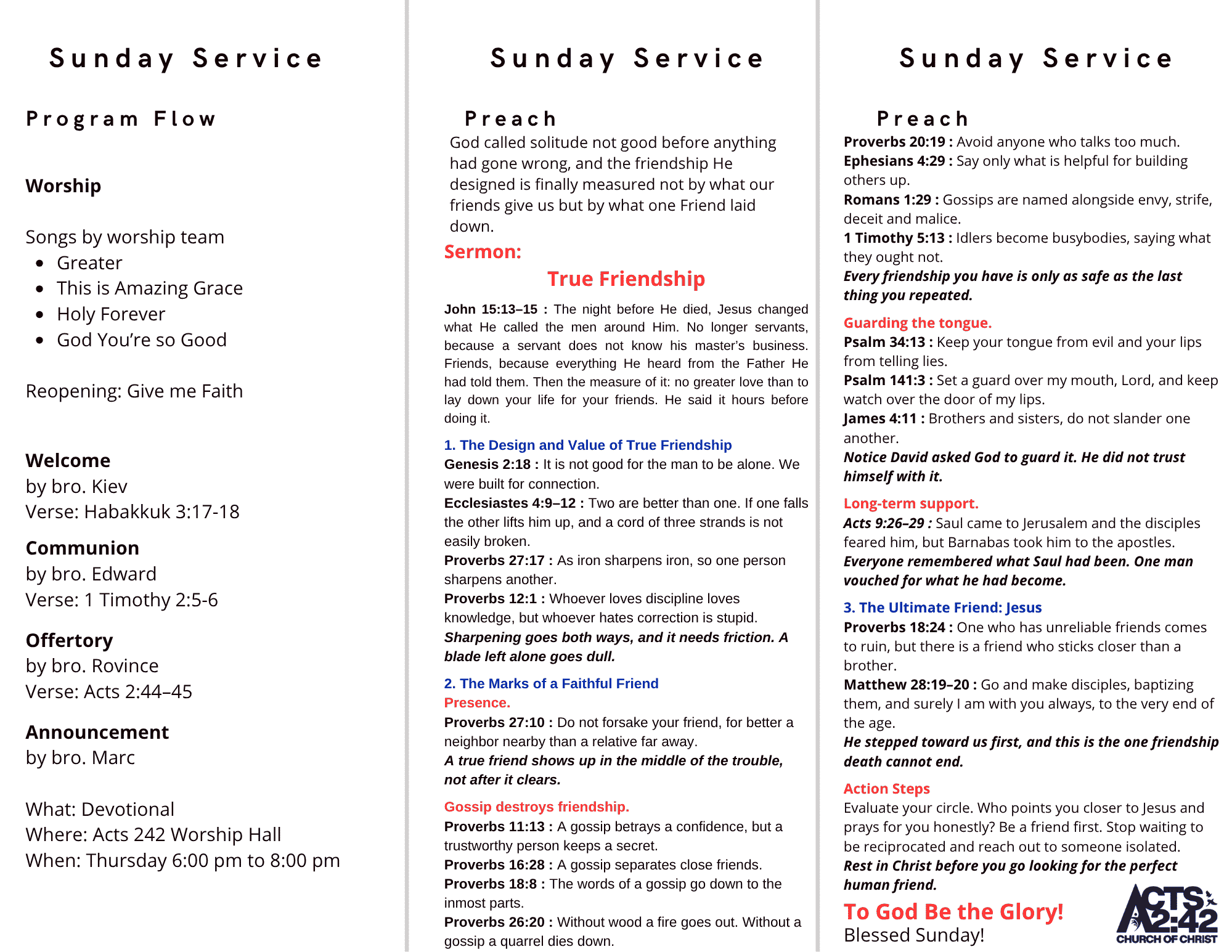
True friendship is a divine design, modeled finally by Jesus Christ, who initiated the relationship with us and then laid down His life for His friends. This message takes it in three parts: why God built us for it, what a faithful friend actually does, and the friend who outlasts all the others.
1 · The Design and Value of True Friendship
It was never good to be alone
The first thing God called not good was not sin. It was solitude. "It is not good for the man to be alone" (Genesis 2:18), said over a world He had already called good seven times. Connection was designed in, not added later.
Ecclesiastes puts the practical case. Two are better than one, because they have a good return for their labor. If either of them falls, one can help the other up, "but pity anyone who falls and has no one to help them up" (Ecclesiastes 4:10). Two lying together keep warm. And "a cord of three strands is not quickly broken" (Ecclesiastes 4:12).
Read that last line carefully. It is three strands, not two. The strongest friendships in Scripture are not two people facing each other. They are two people with God woven through.
Iron sharpens iron
"As iron sharpens iron, so one person sharpens another" (Proverbs 27:17).
Four things are packed into that picture, and they are worth separating.
Mutual growth. Sharpening is not one-way. Both blades are changed by the contact, which means a friendship where only one person does the correcting is not this.
Constructive friction. Blades are not sharpened by agreement. They are sharpened by resistance. Real friendship involves hard truths and accountability, not comfortable nodding.
Removing dullness. A neglected blade goes blunt simply by being left alone. Isolation and unchallenging company do the same thing to a person, slowly, without anything dramatic happening.
Trust and intention. This only works inside committed relationships where the person giving the feedback genuinely cares. The same words from someone who does not love you are just criticism.
Which is why Proverbs is so blunt elsewhere: whoever loves discipline loves knowledge, "but whoever hates correction is stupid" (Proverbs 12:1). The willingness to be corrected is the entry fee for friendship that actually changes you.
2 · The Marks of a Faithful Friend
Presence
"A friend loves at all times, and a brother is born for a time of adversity" (Proverbs 17:17). Not loves when convenient. At all times, with the adversity clause written in specifically.
And Proverbs is practical about proximity: do not forsake your friend or your family's friend, because "better a neighbor nearby than a relative far away" (Proverbs 27:10). Showing up physically still counts for something no message can replace.
Gossip destroys friendship
This is where the message spends the most time, and rightly, because this is the sin that quietly dismantles a church family.
"A gossip betrays a confidence, but a trustworthy person keeps a secret" (Proverbs 11:13). "A gossip separates close friends" (Proverbs 16:28). The words of a gossip are like choice morsels, "they go down to the inmost parts" (Proverbs 18:8), which is exactly why we enjoy them. Without wood a fire goes out, and "without a gossip a quarrel dies down" (Proverbs 26:20). And the instruction is not to manage it but to leave: a gossip betrays a confidence, "so avoid anyone who talks too much" (Proverbs 20:19).
The New Testament does not soften it. "Do not let any unwholesome talk come out of your mouths", only what builds others up according to their needs (Ephesians 4:29). Paul lists gossips in the same breath as envy, strife, deceit and malice (Romans 1:29). And Timothy is warned about those who go from house to house and become "busybodies who talk nonsense" (1 Timothy 5:13).
Every friendship in this room is only as safe as the last thing you repeated about someone.
Guarding the tongue
The remedy in Scripture is not better intentions. It is a guard.
"Keep your tongue from evil and your lips from telling lies" (Psalm 34:13). And David's prayer, which is the honest one: "Set a guard over my mouth, LORD; keep watch over the door of my lips" (Psalm 141:3). He asked God to post the sentry, because he knew he could not be trusted with the door himself.
James makes it a family matter: "Brothers and sisters, do not slander one another" (James 4:11). Not strangers. One another.
Long-term support
Then the example. After Damascus, Saul came to Jerusalem and tried to join the disciples, "but they were all afraid of him, not believing that he really was a disciple" (Acts 9:26). Every one of them had a reason. He had been hunting them.
"But Barnabas took him and brought him to the apostles" (Acts 9:27), and told them what had happened on the road and how Saul had preached fearlessly in Damascus. After that, Saul stayed with them and moved about freely in Jerusalem (Acts 9:28).
Sit with how much that cost. Barnabas put his own standing behind a man everyone else considered dangerous. Half the New Testament exists downstream of one friend being willing to vouch.
3 · The Ultimate Friend: Jesus
Human friendship has a ceiling, and Proverbs names it. "One who has unreliable friends soon comes to ruin, but there is a friend who sticks closer than a brother" (Proverbs 18:24).
Initiative. He did not wait for us to clean ourselves up. "I no longer call you servants, because a servant does not know his master's business. Instead, I have called you friends" (John 15:15), because everything He learned from the Father He has made known to us. That is a change of status, not a change of mood. God stepped across the gap between Creator and creation and did not treat us as distant workers.
Sacrifice. "Greater love has no one than this: to lay down one's life for one's friends" (John 15:13). He said it on the night He was betrayed, and the measure of the friendship was taken the next afternoon.
Unfailing presence. Human friendships fade through distance, time and death. His does not. "And surely I am with you always, to the very end of the age" (Matthew 28:20). They are His last words in Matthew's Gospel, which is the point: He was leaving physically and promising to remain actively present through His Spirit for the whole of human history.
He will not misunderstand you, disappoint you, or leave.
Challenge
Three steps, and the order matters.
Evaluate your circle. Who in your life actually loves you, points you closer to Jesus, and prays for you honestly? Write the names. If the list is short, that is information, not a verdict.
Be a friend first. Stop waiting for someone to reciprocate. Pick one person in this congregation who is on the outside of things and go to them this week. Somebody did this for Saul when nobody else would.
Rest in Christ. Before you go looking for the perfect human best friend, anchor yourself in the friendship that has already been proved. The others will disappoint you eventually. He has already laid down His life, which settles the question of where you stand.
And one practical test for the week. Before you repeat anything about anyone, ask whether you are building them up according to their needs. If not, let the quarrel die for lack of wood.
To God be the glory!