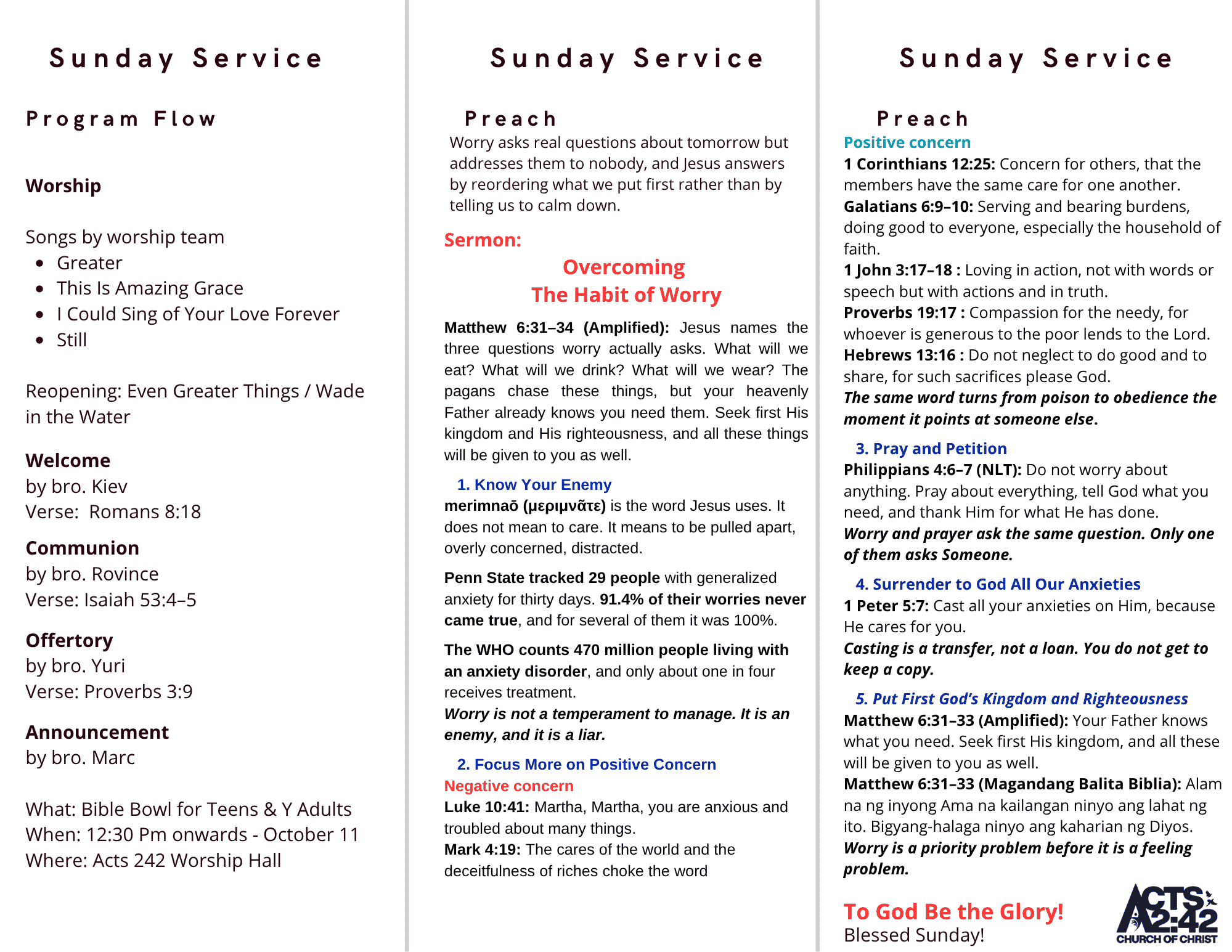
"So do not worry about tomorrow; for tomorrow will worry about itself." — Matthew 6:34 (Amplified) "Kaya nga, huwag ninyong alalahanin ang bukas; sapagkat ang bukas ang mag-aalala sa sarili niya." — Mateo 6:34
Leadership writer John Maxwell once told a story about getting older with his wife, Margaret. They were worried about the senior moments ahead — forgetting names, forgetting where they were going. So they made a deal: "Margaret, you remember our names, and I'll remember where we're going."
We laugh, but notice what it reveals. Even a small worry wants a plan. So let us be honest this morning. Who had at least one worry this week? Hands up. At least three? More than three? Hindi ko na itatanong. We say an apple a day keeps the doctor away. For many of us it is a worry a day — as if the day is not complete without one, as if worry were the spice of life.
Worry is a bad habit. It has bad effects on the mind, on the body, on our health, even on our ability to concentrate. And the title of this message has a word in it worth saying out loud: overcoming.
Scripture says "the one who is in you is greater than the one who is in the world" (1 John 4:4). Who is greater, Satan or Jesus? Jesus. He overcame the power of sin and the power of death. So if you are a child of God, overcoming is in your spiritual DNA. Thank You, Jesus. You won over the power of sin and the power of death. I am an overcomer, and I will overcome the spirit of worry.
Because worry is not only a habit. It is a spirit. And the passage shows us why.
Notice what Jesus does not say. He does not say your situation is not serious. He does not say tomorrow holds nothing. He says tomorrow will handle its own share, and today already has enough.
The Three Questions Worry Asks
Read Matthew 6:31 and you find worry is not vague. It is specific, and it is always about supply. "What are we going to eat?" "What are we going to drink?" "What are we going to wear?"
The Amplified Bible draws out the meaning of the original: to be perpetually uneasy — continuously, non-stop. That is what a habit is.
Look beside each line and you can see what is driving it. Verses 31 and 32 point to fear and ignorance. Verses 33 and 34 point to unbelief. That is a hard reading of a familiar passage, and it is the right one. Worry is not a nervous habit we picked up. It is a belief about God that has gone quietly wrong.
Fear is easy to spot. Someone online predicts a "super El Niño" and claims four hundred thousand people will die. During the pandemic, every new number was broadcast to frighten us. Spirit of fear yan. Ignorance forgets what Jesus said next: "For your heavenly Father knows that you need them" (Matthew 6:32). He knows before we even pray. Unbelief hears the promise and shrugs: talaga, sinabi niya yun? And it insists on solving next week and next year today, when God gives daily bread, one day at a time. We walk by faith, not by sight.
The Gentiles chase these things because they do not have a Father who knows. We do. A pastor friend refuses to call people unbelievers; he calls them not-yet-believers. There is hope in that word.
And notice what God promises when we seek Him first: not only what we need. As Bro. Tony puts it, I ask God for what I need, and something extra, so I can help others who are in need too.
1 · Know Your Enemy
The Greek word matters here. When Jesus says do not worry, the word is merimnaō, μεριμνᾶτε. It does not mean to care about something. It carries the sense of being pulled in pieces, overly concerned, divided, distracted. The Amplified Bible renders it perpetually uneasy.
There is nothing wrong with wondering what we will eat for lunch. The problem is the spiral: what if we run out of money, what if we cannot finish the children's schooling, look at the price of gasoline, what if the businesses close. Concerned is fine. Overly concerned is the enemy.
That is the enemy. Not concern. Division.
And the enemy is a liar, which can be measured. Penn State researchers Lucas LaFreniere and Michelle Newman took 29 university students who met the criteria for generalized anxiety disorder, had them record their worries over a ten-day period, and then tracked those same worries across thirty days to see which ones actually happened.
91.4% of the recorded worries never came true. The most common result per person was 100%. Even among the few that did come true, about three in ten turned out better than people had expected.
The scale of the problem is not small either. The World Health Organization counts 470 million people living with an anxiety disorder, more women than men, with symptoms usually starting in childhood or adolescence. Effective treatment exists, and only about one in four people receive it. Which is also why we should start teaching our children early how to bring their worries to God.
Hold those two facts together. Worry is enormously common, genuinely treatable, and almost always wrong about the future.
2 · Focus More on Positive Concern
Put a glass of water on the table, filled halfway. The negative person sees it half empty; the positive person sees it half full. Talk with people on the street or in a taxi and you will notice most conversations lean negative.
Here is the turn that makes this sermon more than a scolding. The same Greek root appears in the New Testament as a good thing.
The negative use
Martha is "anxious and troubled about many things" (Luke 10:41), and the word is merimnaō. Jesus was the guest in her house, and she made the visit all about what she would do for Him. Performance.
Worry divides the mind and pulls it in many directions at once. Bro. Tony admitted that while preparing this very message — Bible open, notes ready — his mind wandered: the latest sports news, an update on a trial in the headlines, a new online sermon from a pastor he follows, the latest twist in a teleserye. Thirty minutes later he realized he had stopped preparing. We all know that pull, especially online: you search for one thing and you surface an hour later somewhere else entirely.
In the parable of the sower, "the cares of the world and the deceitfulness of riches" (Mark 4:19) choke the word, and the word there is merimna. Think of how many people get scammed because they want to get rich quick. Someone calls claiming to be from a government agency, promising thousands of pesos in cash aid if you will only give them your number. That is a red flag. It is God who gives you the ability to produce wealth (Deuteronomy 8:18), not the person promising you a fortune overnight.
Same root. Pointed at yourself, it strangles.
The positive use
Now watch it turn. Paul writes that there should be no division in the body, but that "the members may have the same care for one another" (1 Corinthians 12:25). The same word. Pointed at someone else, it builds.
The early church learned this the hard way. The Greek-speaking widows complained they were being overlooked in the daily food distribution while the Hebrew widows were cared for. The apostles responded with wisdom and appointed men like Stephen to make sure no one was neglected (Acts 6:1–6). Malasakit for all — not for me only, not only for the people beside me, not only for my favorites.
There are four shapes this takes.
Concern for the welfare of others (1 Corinthians 12:25). Serving and bearing burdens: "let us not grow weary of doing good" (Galatians 6:9), and as we have opportunity, do good to everyone, especially the household of faith (Galatians 6:10).
Many of us say we have no time to help. Bro. Tony and his wife decided to use what was already in their hands. Every weekday morning, starting at six, they join online gatherings with believers from the United States to Hong Kong, then pray, then meet over video with relatives abroad who were going through a hard season, studying the Bible with them. When they later traveled to the States, Canada and Hong Kong, the families they had served online opened their homes to them. Instead of using social media only to say hi or play games, use it to be God's loving hand extended. That phrase came from one of his professors, and he asked the church to do it literally: stretch out your hands to the person beside you. When someone needs help, they will know whose hands to look for.
Loving in action: if anyone has material possessions and sees a brother or sister in need and has no pity, how can God's love be in that person? "Let us not love with words or speech but with actions and in truth" (1 John 3:17–18).
He told of someone he knew whose huge order was suddenly canceled, leaving a crushing debt. Two friends agreed to pray together every morning at five. Not long after, a new order came in — large enough to pay off everything. And when they wanted to bless the children of pastors and missionaries with clothes, a contact connected them with a garment exporter's factory overruns: boxes of brand-new, branded children's clothes. Parang nag-fashion show bigla ang mga bata. When we put God first and truly want to help, provision is not the problem. I am blessed to be a blessing.
Compassion for the needy: "whoever is generous to the poor lends to the Lord" (Proverbs 19:17), and do not neglect to do good and to share, "for such sacrifices are pleasing to God" (Hebrews 13:16). The apostles' one request of Paul was that he remember the poor (Galatians 2:10), and God's heart is for the orphans and widows (James 1:27). Even a business can be used this way — he remembered a company outreach in a Quezon City barangay with food for mothers and children, school supplies, and a storytelling time about Jesus.
And remember where God has placed you. There are people at your work and your school that Bro. Marc will never reach — but you can. Ako lang ang may personal relationship kay Lord sa trabaho namin. Then God put you there on purpose, so they can see what real love looks like: patient when insulted, still loving. So that Christ is what comes out of you.
The practical counsel underneath all four is simple and slightly surprising. One of the cures for anxiety is a brother or sister in need and the decision to go and help them.
3 · Pray and Petition
"Don't worry about anything; instead, pray about everything" (Philippians 4:6, NLT). Tell God what you need, and thank Him for all He has done.
Then the promise: "you will experience God's peace, which exceeds anything we can understand" (Philippians 4:7, NLT), and that peace will guard your heart and mind as you live in Christ Jesus.
Worry and prayer ask exactly the same question. What about tomorrow, what about the money, what about the diagnosis. The difference is that one of them is addressed to Someone who can answer, and the other is just the question, circling.
Bro. Tony and his wife were due to fly back to Hong Kong as a typhoon approached. Signal number one, with the forecast saying it would reach signal number three by the time they got to the airport. They expected the flight to be canceled. So they did what Paul and Silas did in prison: they prayed and worshipped. They remembered that Jesus rebuked the storm on the Sea of Galilee and it went completely calm (Mark 4:39), and that we are seated with Him in the heavenly places (Ephesians 2:6). Jesus told us to speak to the mountain (Mark 11:23). So they spoke to the storm in His name. At the airport it was still raining, but the announcement came: no signal. All flights would go ahead.
We are stronger than we think, because all authority in heaven and on earth has been given to Jesus, and He sends us in it (Matthew 28:18–20).
4 · Surrender to God All Our Anxieties
"Casting all your anxieties on him, because he cares for you" (1 Peter 5:7). Merimna again.
Cast means to throw. In Bible times you threw your load onto the back of a donkey and let it carry the weight. We do not have a donkey here — so throw it to Jesus. He is the best One to hold our problems, and the best One to solve them.
Casting is a transfer of custody, not a loan. The thing about worry is that we will happily tell God about it while keeping a copy for ourselves to work on at two in the morning. Peter's word does not allow that. You throw it, and it lands somewhere else.
And check that you have thrown all of it. Bro. Tony once thought he had fully forgiven people who had shamed him while he was teaching in Hong Kong. Then, at a seminar, the Holy Spirit showed him there was still some unforgiveness left. So he surrendered the rest of it, until nothing remained.
Try it now. Cup your hands and place in them every worry: the child you are anxious about, the marriage, the relative, the job, the studies. Hold them up. Then throw them, all of it, to Jesus — and receive His peace in exchange. Do it again every time the worry comes back.
And the reason given is not that the worry is trivial. It is "because he cares for you". He takes it because He wants you, not because it does not matter.
5 · Put First God's Kingdom and Righteousness
Back to where we started. Do not be anxious about food, drink or clothing, because your Father already knows. "But first and most importantly seek (aim at, strive after) His kingdom and His righteousness" (Matthew 6:33, Amplified), His way of doing and being right, and all these things will be given to you also.
Seek here is not hide-and-seek. It means to pursue with passion.
Sa Magandang Balita Biblia: "bigyang-halaga ninyo ang kaharian ng Diyos" at ang pamumuhay ayon sa kanyang kalooban, at ibibigay niya ang lahat ng kailangan ninyo (Mateo 6:33). In missions they call this a person's heart language — the language the Word reaches you in most deeply.
Read the order. Worry is a priority problem before it is a feeling problem. Jesus does not tell the anxious person to relax. He tells them to put something else first, and promises the rest follows.
We each hold three T's: our time, our talent and our treasure. Put them toward His Great Commission, and trust Him to supply whatever His will requires. Prioritize souls, and make disciples of Christ.
Action Steps
The sermon closes with three, and they are deliberately stronger than advice.
Repent of the sin of worry. The word is metanoia, a change of mind, an inner reorientation — to turn away from sin and return to God. Not an apology for being anxious, but a turn. And when you fall back into it, come back again. There is no condemnation.
Be set free of the spirit of worry. The Spirit God gave us is not a spirit of fear; He gives power, love and a sound mind (2 Timothy 1:7). Name worry as something to be released from rather than managed, and come against it in the name of Jesus every day.
Receive God's faith through grace, and regularly declare and act in the spirit of victory. There is saving grace, and there is empowering grace — grace not only to be saved, but to live the way God wants. Our own faith runs low; ask Him for His. And keep your mind being renewed by the Word (Romans 12:2), because it clears out the negativity, the old patterns, the judgmental thoughts.
Challenge
Do the experiment on yourself this week.
Write down every worry as it arrives, with the date. Do not argue with any of it, just record it. Then put a reminder in your phone for thirty days from now, and on that day read the list back and mark which ones actually happened. The researchers found 91.4% never did. You will probably find something similar, in your own handwriting, which is much harder to dismiss than a statistic from a pulpit.
Then do the second half, which is the part that actually changes things. Pick one person in this church who is in real need and take the worry you were going to spend on yourself and spend it on them instead. Merimnaō pointed outward. Bring the food, make the visit, pay the thing quietly — or open your phone and be God's loving hand extended to someone far away.
And tomorrow morning, before the three questions start, answer them in the right order. Seek first His kingdom. The rest has already been promised.
To God be the glory!