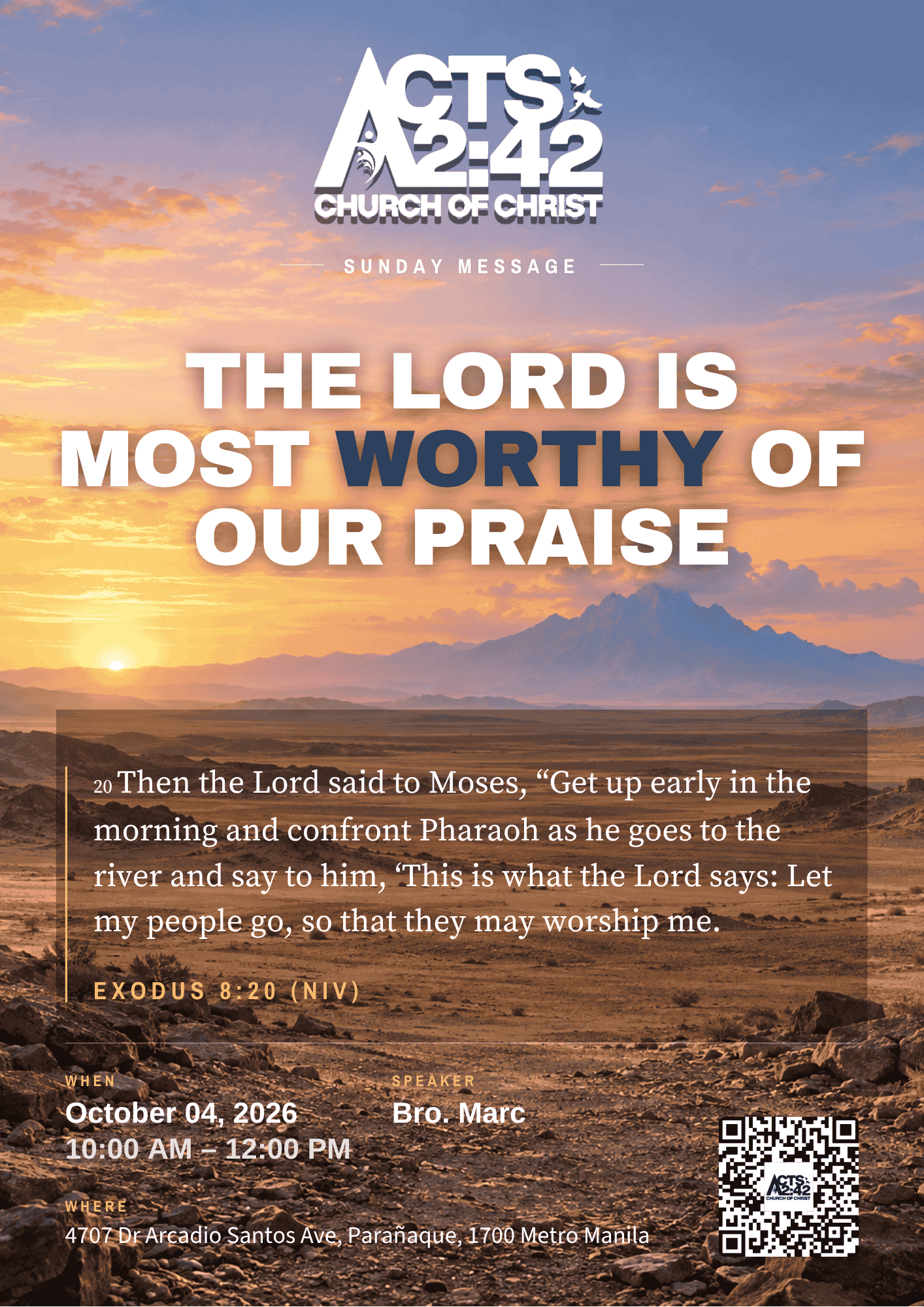
"This is what the Lord says: Let my people go, so that they may worship me." — Exodus 8:20
On a recent trip, the tour guide told our group, you are so lucky — it rained all last week, and now the weather is good. Bro. Marc corrected him: we are not lucky, we are blessed. And as they were leaving, the guide said it again: you are lucky, because a storm is coming next week. Same answer. We are blessed, not lucky. For a Christian, hindi uso ang swerte — uso ang blessing. You have to be convinced of it: God's favor is something you feel in your life.
We know the first half of that verse above. It is on posters and in films. It is the second half that almost nobody quotes, and the second half is the reason the first half happened at all.
Part 1: Why Did God Want to Free the Israelites From Slavery?
Ask most Christians why God freed Israel from Egypt, and the answer comes quickly: to bring them to the promised land, to bless them. True — but when you study the text, that turns out to be only part of the plan. It is not the ultimate reason.
Let My People Go
Count how many times Moses says it, and count what follows it every single time. Some of them are in your brochure; here are all seven.
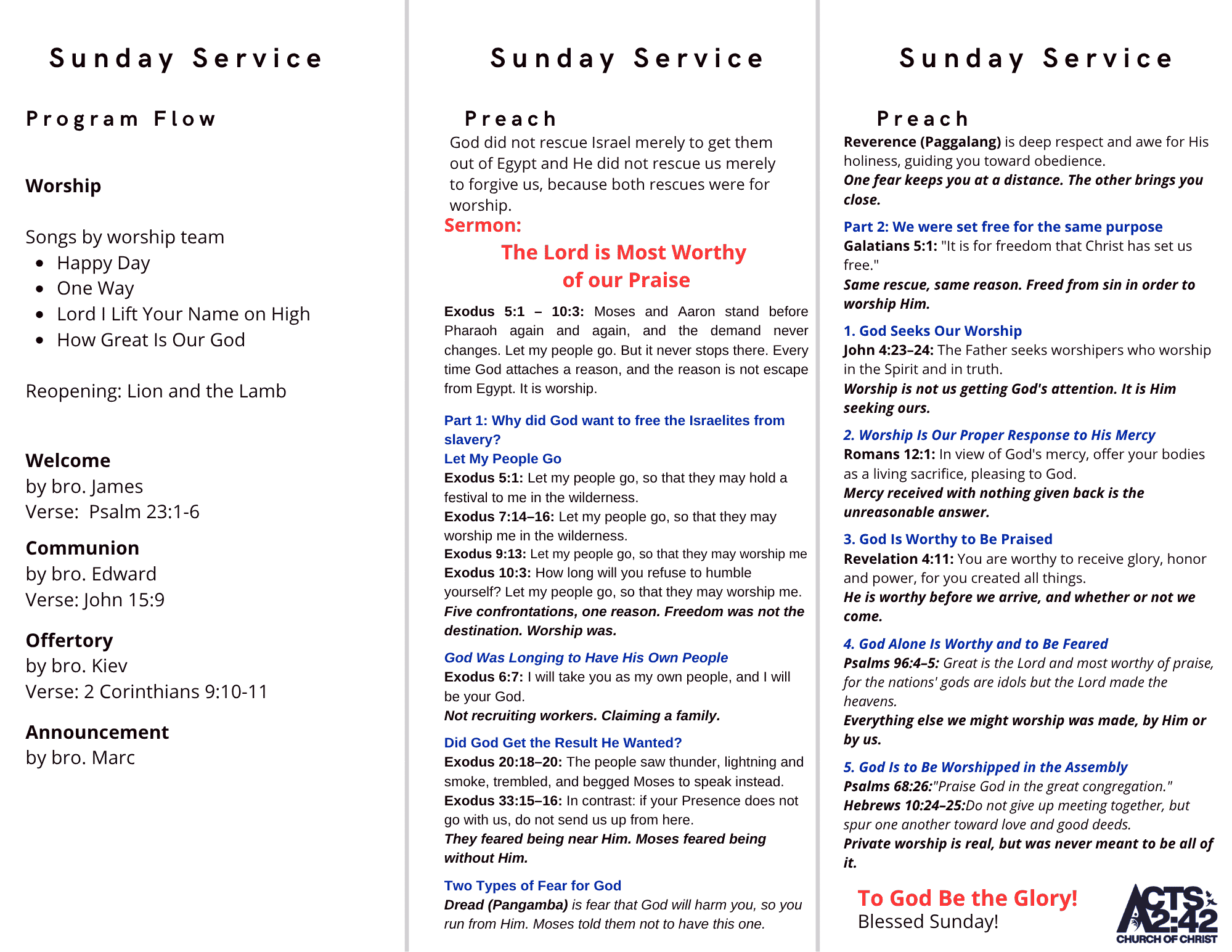
"Let my people go, so that they may hold a festival to me in the wilderness" (Exodus 5:1). Then, at the Nile in the morning, "Let my people go, so that they may worship me in the wilderness" (Exodus 7:16). Again, before the frogs (Exodus 8:1). Again, get up early and confront him: "Let my people go, so that they may worship me" (Exodus 8:20). Again before the livestock die (Exodus 9:1), and again before the hail (Exodus 9:13). And again, with a question attached: "How long will you refuse to humble yourself before me? Let my people go, so that they may worship me" (Exodus 10:3).
Seven confrontations. One unchanging purpose clause.
God never once describes the exodus as merely getting Israel out of Egypt. He describes it as getting Israel to Himself. Slavery was not the main problem. Worshipping the wrong things, in the wrong house, under the wrong master, was the main problem. The ultimate reason was for the Lord to have worshippers.
Let my people go, so that they may worship me.
God Was Longing to Have His Own People
Why go to all that trouble for one nation of brick-makers? He says so plainly: "I will take you as my own people, and I will be your God" (Exodus 6:7).
Read it slowly. This is not an employer acquiring labor. It is a God claiming a family — a people He could call His own, who would know Him and worship Him. He wanted them, and the plagues, the blood on the doorposts and the parted sea were what wanting them cost.
Let my people go, so that they may worship me.
Did God Get the Result He Wanted?
Moses became close to God first. The hope was that the whole people would become close to Him the same way. So did God get the result He wanted? The honest answer is uncomfortable.
They arrive at the mountain and the God who rescued them shows up. Thunder. Lightning. A trumpet. The mountain in smoke. This is not a god you can carry around like a statue. The people "trembled with fear" and stayed at a distance, and their request to Moses was this: "Speak to us yourself and we will listen. But do not have God speak to us or we will die" (Exodus 20:18–19). Moses answered that God had come to test them, so that the fear of God would keep them from sinning (Exodus 20:20).
They had been freed for His presence, and their first instinct was to put distance between themselves and it.
In contrast, set Moses beside them. At one point God, angry with Israel, told them to go on to the promised land without Him. Moses refused to leave the desert. "If your Presence does not go with us, do not send us up from here" (Exodus 33:15). He would rather endure the heat and a nation of complainers — puro reklamador — than go to the promised land without God. "What else will distinguish me and your people from all the other people on the face of the earth?" (Exodus 33:16).
Same God, same mountain, two completely different fears. The people feared being near Him. Moses feared being without Him.
And Moses understood something we need to hear. The presence of God is the sign of His favor. It is what distinguishes His people. Was it coincidence that the rain fell the week before we arrived and the storm waited until the week after we left? Bro. Marc does not believe so. When God's presence is with you, His favor goes with you — and he wants us to be convinced of that this morning.
Two Types of Fear for God
The Filipino words carry the difference better than the English does.
Dread, pangamba. Being scared that God is going to harm or punish you, which makes you run away from Him. Naku, lagot tayo! — and everyone hides. This is the fear Moses told the people at the mountain not to have.
Reverence, paggalang. Deep respect, honor and awe for God's power and holiness. A healthy respect that works as a guide, helping us choose obedience over wrongdoing.
Here is how reverence works in real life. When you are tempted, put on the brakes and ask: am I really going to trade God's presence for this? Esau traded his birthright for a bowl of stew (Genesis 25:29–34). Would you trade God's favor for one sinful pleasure? Think about it. Pray about it. Reverent fear is not afraid of being punished; it is afraid of losing His presence, His favor, His strength to fight temptation.
Both are called fear. One of them sends you to the back of the room. The other brings you to your knees at the front. The difference is not how strongly you feel it. It is which direction it moves you.
Let my people go, so that they may worship me.
Part 2: We Were Set Free for the Same Purpose
What happens in the Old Testament foreshadows what happens in the church age. "It is for freedom that Christ has set us free" (Galatians 5:1).
We were slaves too, not to Pharaoh but to sin, and the rescue was not cheaper. And the purpose clause has not changed. Israel was brought out to worship. So were we. We are set free for the purpose of worship, and here are five reasons that purpose is worth taking seriously.
1 · God Seeks Our Worship
A time has now come when true worshipers "will worship the Father in the Spirit and in truth", because they are the kind of worshipers "the Father seeks" (John 4:23). God is spirit, and those who worship Him must worship in the Spirit and in truth (John 4:24).
Sit with the word seeks. We talk as though worship is us finally getting God's attention. Jesus says the Father is the one doing the looking.
Bro. Marc remembered a nugget he heard from a pastor when he was a new Christian. Why would God need to create people at all? He is God whether we exist or not, and the angels already worship Him. The answer: so that He could display the parts of His character heaven had no occasion for — His mercy, His grace, His compassion, His kindness. There are no sinners in heaven to show mercy to. God knew humanity would fall, and He made us anyway, so that He could love us while we were sinners and make a way to save us. That is the God we worship.
2 · Worship Is Our Proper Response to His Mercy
Paul urges us, "in view of God's mercy, to offer your bodies as a living sacrifice" (Romans 12:1), holy and pleasing to God, which he calls our true and proper worship.
Note the logic. Worship is not the price of mercy, it is the response to it. In view of what has already been given, there is no reasonable answer except to hand yourself over.
So before you worship, settle things. Ask God's forgiveness for what you have done. Make peace with your brother or sister. Then, forgiven, offer yourself — holy and pleasing to Him. That is acceptable worship.
3 · God Is Worthy to Be Praised
"You are worthy, our Lord and God, to receive glory and honor and power" (Revelation 4:11), because He created all things, and by His will they were created and have their being.
That is John's vision of heaven: living creatures who never stop praising Him, day and night; the elders around the throne declaring His worth; and angels beyond counting — thousands upon thousands, and ten thousand times ten thousand — joining in. He was worthy before the congregation arrived and He will be worthy if nobody comes. Our praise does not establish His worth. It acknowledges it. And we were freed to join in.
4 · God Alone Is Worthy and to Be Feared
"For great is the Lord and most worthy of praise; he is to be feared above all gods" (Psalm 96:4). And the reason: "For all the gods of the nations are idols, but the Lord made the heavens" (Psalm 96:5).
Idols are not only religious statues. Watch a crowd at a concert — people losing their minds for a photograph, some even fainting. Watch people kill for money. Some make a god of their own spouse; there is even a love song called Sinasamba Kita. When a whole life revolves around a husband or a wife, then when that person dies, the one left behind wants to be buried too. Everything else is temporary.
That is the whole contest in one line. Everything else competing for our worship was manufactured, either by Him or by us. Only one of them made the sky. And note which fear belongs here: not pangamba, but paggalang.
Put God first — utang na loob — not for the preacher's sake, but for your own. Our goal is for one hundred percent of Acts 242 to enter heaven. In the parable of the ten virgins, five were wise and five were foolish. Two will be working in the field; one will be taken and one left. A fifty percent batting average. We are not aiming for ninety-nine point nine. We are aiming for everyone. That is why these lessons are preparing us for the coming of the Lord. Bro. Marc pointed out that a hundred years ago, readers could not imagine how no one could buy or sell without a mark; today we pay with a tap. And in many places, the Bible and even prayer in schools are now restricted. Keep God first. None of our labor and sacrifice is in vain.
5 · God Is to Be Worshipped in the Assembly of His People
"Praise God in the great congregation; praise the Lord in the assembly of Israel" (Psalm 68:26).
Israel was not brought out one by one to worship privately in the desert. They were brought out as a people. Sa bahay na lang ako. God is everywhere. Manonood na lang ako online, o yung replay. But we are the body of Christ, and Christ is the head. Can you leave your hand at home? Teka, masakit ito, putulin ko muna at iwan sa bahay. No. When the body meets, the Head is here. So do not treat the Sunday service or the Friday devotional lightly. If you consider yourself part of the body, your conviction should be: whenever the body meets, I must be there.
And the instruction to us is the same: consider how we may spur one another on toward love and good deeds, "not giving up meeting together, as some are in the habit of doing" (Hebrews 10:24–25), but encouraging one another all the more as we see the Day approaching. Two thousand years ago, some believers already had the habit of being absent. Do not let the Lord find you cold when He comes.
Remember Left Behind: in the twinkling of an eye the faithful were gone, and the pastor was left. No one is exempt. The church is the bride, and Jesus will present her to Himself without blemish. Think of a bride on her wedding day — the white dress, the radiance, the care she takes to be ready, the only one in the room dressed that way because she is special. That is how special the universal church is to God, and very soon we will be wed to Jesus. He could come at any time.
Private worship is real and necessary. It was never meant to be the whole of it.
Challenge
This week, finish the sentence.
When you tell the story of what God saved you from, you probably stop where Pharaoh stops it, at the escape. The debt, the habit, the fear, the past, whatever it was. Say the second half out loud this week: He brought me out so that I may worship Him.
Remember that we were not called so that God would hand us everything we ask for, as if becoming His child meant every problem would disappear. The ultimate reason is that He called us to worship Him in Spirit and in truth. He wants us as His people. He wants to be close to us, a friend you can bring every burden to: "Come to me, all you who are weary and burdened" (Matthew 11:28).
Then name which fear you actually carry. If the thought of God's full attention makes you want to step back and let someone else do the approaching, that is pangamba, and Moses said do not. Ask God this week for paggalang instead, the kind of fear that walks toward Him and would not trade His presence for anything.
And test it against your Sunday. If you arrive to be fed, encouraged or seen, you have made yourself the point of the gathering. Come to give Him what He is worthy of, and let the encouragement be what happens to you on the way.
We are saved by grace, through faith, by the blood of Jesus. Value the gift. Keep worshipping Him in Spirit and in truth.
To God be the glory!