"Then we will no longer be infants, tossed back and forth by the waves... Instead, speaking the truth in love, we will grow to become in every respect the mature body of him who is the head, that is, Christ." — Ephesians 4:14–15
How Long Have You Been a Christian?
Before the message, a quick census. How many here have been a Christian for one year? Two years? Three years? Four years?
There is a reason for that question, and we will come back to it before the end.
This morning we are talking about spiritual maturity. Because if we mature physically with age, we ought to be maturing spiritually as well. Sometimes a person grows older in years but stays childish in character and attitude — tumatanda, walang pinagkatandaan.
What Is Spiritual Maturity?
Three things define it.
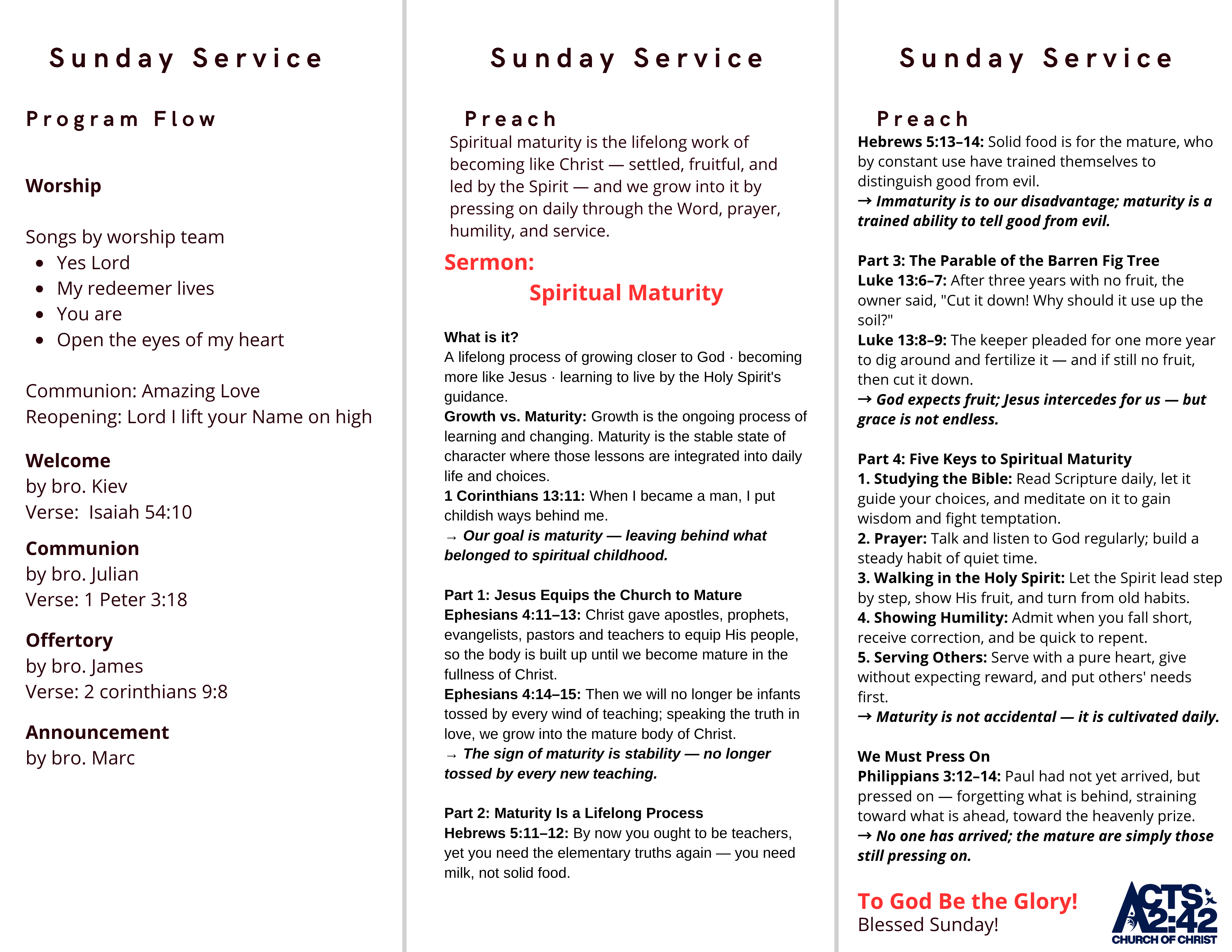
First, it is a lifelong, continuous process of growing closer to God. Maturity cannot be attained instantly. It is a process that may take our whole life.
Second, it is becoming more like Jesus Christ. When people look at us and begin to see Jesus in us — that is a sign of maturity.
Third, it is learning to live by the guidance of the Holy Spirit. The more we mature, the more discerning we become about what the Spirit is leading us to do.
And we should distinguish two things. Spiritual growth is the active, ongoing process of learning, changing, and developing faith — gathering knowledge of the Word, slowly being changed by it. Spiritual maturity is the advanced, stable state of character where those lessons are deeply integrated into daily life and choices.
Do you see the difference? Growth is learning. Maturity is applying. It is no different from physical growth: as a child you learn, you receive advice, you grow — and when you mature, you apply it to your life. That is the most important part.
"When I was a child, I talked like a child, I thought like a child, I reasoned like a child. When I became a man, I put the ways of childhood behind me" (1 Corinthians 13:11).
When a Christian is newly baptized and new in the faith, we expect them to be unsteady. They will stumble. Sometimes they will not know right from wrong. We all went through that. But we should not stay there. The goal of a Christian is to mature — not to be a baby Christian forever, always being fed, always being carried.
Part 1 — Jesus Equips the Church to Mature
If God expects us to mature, He does not leave us to figure it out alone.
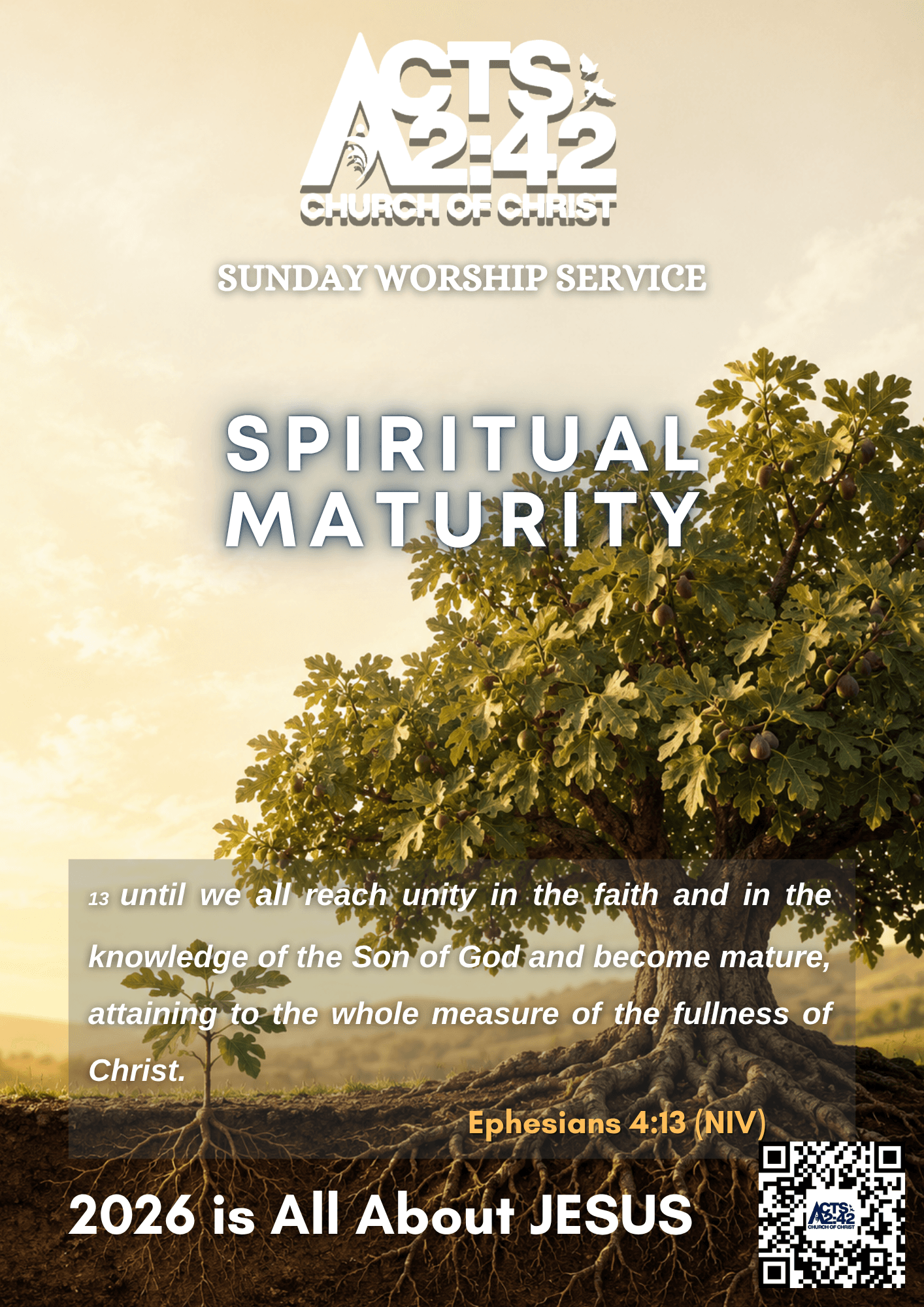
"So Christ himself gave the apostles, the prophets, the evangelists, the pastors and teachers, to equip his people for works of service, so that the body of Christ may be built up until we all reach unity in the faith and in the knowledge of the Son of God and become mature, attaining to the whole measure of the fullness of Christ" (Ephesians 4:11–13).
Notice the chain: Christ gives leaders → to equip His people → so the body is built up → until we reach unity in faith and knowledge → and become mature, attaining the whole measure of the fullness of Christ.
And what does that fullness look like? It means seeing Jesus in us. Suddenly your heart becomes compassionate toward those who have no relationship with Jesus — because that was His heart. God wants all people to be saved, and a maturing believer starts to want the same thing. Suddenly you can forgive your enemy. Suddenly you become prayerful, the way Jesus rose early to be with the Father.
Then comes the mark of maturity: "Then we will no longer be infants, tossed back and forth by the waves, and blown here and there by every wind of teaching and by the cunning and craftiness of people in their deceitful scheming. Instead, speaking the truth in love, we will grow to become in every respect the mature body of him who is the head, that is, Christ" (Ephesians 4:14–15).
When you are a young Christian without the knowledge of the Word, you are easily swayed.
I ran into a brother named Arnel some time ago in Subic — he used to attend with us occasionally. I asked how he was, and whether he was still attending church. He said, "Nagmuslim ako. Pareho lang naman." I said, no — it is not the same. And immediately he was offended and hurried away.
That is what happens without foundation. If you are mature and someone tells you Islam and Christianity are the same, you know there is a problem there. But when you are an infant, a new teaching comes along and you are easily blown off course.
This is why we have first principles. This is why we study the Bible before baptism. Because in the church there must be one faith, one hope, one baptism. We cannot each believe something different — that is not unity. Someone hands you a pamphlet, and it sounds nicer than what you have been taught, and off you go. Do not be so easily deceived.
Part 2 — Maturity Is a Lifelong and Continuous Process
"We have much to say about this, but it is hard to make it clear to you because you no longer try to understand. In fact, though by this time you ought to be teachers, you need someone to teach you the elementary truths of God's word all over again. You need milk, not solid food!" (Hebrews 5:11–12).
Read that rebuke carefully. By this time you ought to be teachers — but instead they needed the elementary truths taught all over again.
We have this problem too. When an issue comes up in the church about relationships, or when we find it hard to forgive, what do I have to do? Go back to teaching repentance. Back to grade one.
When I see the church not maturing, I cannot teach the deeper things — because you cannot graduate from grade one to grade two, three, four while the basics are unlearned. So I weigh what to teach. Baka ipakain ko sa inyo ang karne, hindi niyo pa kaya. And sometimes we cannot graduate because we still have a back subject. What is your back subject? Forgiveness? Gratefulness?
Paul had an expectation. You cannot be fed Sunday after Sunday for four years and still only be receiving. Some of us should be teaching by now, so the church grows. If only a few are growing, the whole body stalls.
"Anyone who lives on milk, being still an infant, is not acquainted with the teaching about righteousness. But solid food is for the mature, who by constant use have trained themselves to distinguish good from evil" (Hebrews 5:13–14).
That is the definition of spiritual maturity: you are now able to distinguish good from evil. You have discernment.
Here is a simple example. There is a flood outside. And someone says, "Hindi ako makakaattend, baha kasi." But that same person will wade through the flood to go buy food. If there is a will, there is a way. A spiritually mature Christian says: nothing can stop me — unless I am genuinely bedridden. Because a mature believer knows the obligation: do not give up meeting together, as some are in the habit of doing, but encourage one another daily.
And sometimes we wonder why we are not being blessed — when we ourselves are contradicting basic biblical principles. God already gave us the secret: "Seek first his kingdom and his righteousness, and all these things will be given to you as well" (Matthew 6:33). If we will not put God's kingdom first and then wonder why life feels so heavy — that is a lack of maturity.
A mature Christian knows the biblical principles about prosperity, about peace, about how not to worry, how not to be anxious. Because he is now able to apply what he has learned.
Take one concrete case: unforgiveness blocks your prayers. Scripture says God's hand is not too short to save nor His ear too dull to hear — but your iniquities have separated you from God. And Jesus said plainly: if you cannot forgive those who sin against you, your heavenly Father will not forgive you. A mature believer reasons it through: I need to forgive, because otherwise I will not be forgiven.
Part 3 — The Parable of the Barren Fig Tree
"Then he told this parable: 'A man had a fig tree growing in his vineyard, and he went to look for fruit on it but did not find any. So he said to the man who took care of the vineyard, "For three years now I've been coming to look for fruit on this fig tree and haven't found any. Cut it down! Why should it use up the soil?"'" (Luke 13:6–7).
Understand the picture. God the Father owns the vineyard. We are the planting. And Jesus is the gardener.
And God the Father is looking for fruit.
"Cut it down! Why should it use up the soil?" That makes sense, does it not? If you had a garden where six plants bore fruit and four did not, what would you do? Cut down the four — they are stealing nutrients from the six that are producing.
Our God is gracious, but there is an extent. He is patient, but to a certain extent. And He is looking for fruit in us.
What fruit? The fruit of the Spirit. Are we growing in love, joy, peace, patience, kindness, goodness, gentleness, self-control? Or does our temper still flare instantly — someone bumps you, steps on your foot, cuts into the line, and you react immediately?
God is looking at each of us and asking: does this child of mine have fruit yet? Has he changed? Is she loving now? Is he kind now? Is he gentle now?
"'Sir,' the man replied, 'leave it alone for one more year, and I'll dig around it and fertilize it. If it bears fruit next year, fine! If not, then cut it down'" (Luke 13:8–9).
Now you know why I took a census. Three years. If you have been a Christian for three years or more, you should be bearing fruit by now. Think of all the messages you have heard — Friday, Sunday, Friday, Sunday, and whatever you listen to on your own. The Word should be having its effect on your heart and your character by now.
Of course we will never reach the perfection of Jesus — He is God. But we should be Christ-like in some areas, especially in our weaknesses. Nakokontrol mo na ba ang dila mo? In tearing others down? In gossip? In lying? In cursing?
I will be honest with you — I am not being self-righteous here. I used to curse too, and colorfully. But when you attain maturity you know it is not right for a Christian, and you learn to hold it back. We were playing basketball once, just three of us, and one missed a shot and let out something I could not repeat — and the two of us were genuinely startled. If he were not a Christian it would not have been surprising. But when you call yourself a brother or a sister, it does not fit.
This parable is a warning: there is a limit to the grace of God. It is not literally three years or four years. But if our hearts stay hard, the Lord will not tolerate it forever.
Part 4 — Five Keys to Spiritual Maturity
1. Studying the Bible. Read and study Scripture every day. Use God's Word to guide your choices. Meditate on biblical truths to gain wisdom and fight temptation. Notice — not just reading but studying, trying to understand it and asking how do I apply this to my life? Application is what matters.
2. Prayer. Talk and listen to God regularly. Share your needs, your fears, your thanksgiving. Build a steady habit of quiet time. As Bro. Kiev put it, it should become almost automatic — you glance up at the sky, and you talk to God. I do this myself; sometimes I must look strange, standing there looking up with my hand raised, because I am talking with the Lord. There was a season when I was still commuting, and I would be walking down the street practically skipping, worshiping God. Make God real in your life — not an idea you imagine, but a genuine relationship you are developing.
3. Walking in the Holy Spirit. Let the Spirit lead your daily life step by step. Show the fruit of the Spirit. Turn away from old habits and let your heart change. Do not let the old character keep leading. Do not let the hard heart stay hard. Huwag natin hayaan na lalabas tayo sa kwartong ito na hindi tayo nagbabago.
4. Showing humility. Let go of pride and admit when you fall short. Stay open to correction from God and from others. Be quick to repent and ask forgiveness. When you are rebuked, may your heart be soft rather than defensive — huwag yung pride ang ipaglalaban.
Look at Jesus. Even at the cross, while dying, He said: "Father, forgive them, for they do not know what they are doing." The very people who tortured Him — and that was His prayer. And we cannot forgive? If humility becomes the first fruit in our hearts, it will carry us a long way, because God exalts the humble and brings down the proud.
Before you sleep at night, examine your heart. If you remember someone you have quarreled with — Lord, forgive me for what came into my mind. Do not let the sun go down while you are angry, and do not give the devil a foothold.
5. Serving others. Help the people around you with a pure and kind heart. Give your time and love without expecting reward. Look out for the needs of others before your own desires. When you start serving others, the focus comes off yourself.
And look what Jesus did: He washed His disciples' feet. Remember what feet were like then — no shoes, no socks, only sandals, and roads that were filthy with dust and animal dung. Those were the feet Jesus washed. That is humility. And we think so highly of ourselves.
The psalmist looked at the stars, at the mountains, at all creation, and asked: "What is man that you are mindful of him?" Why would God love these stubborn creatures so much? Instead of being struck down for how hard-headed I am, I am loved and pursued. When one sheep wanders, He goes looking for it.
And yet we act as if God owes us — "Pasalamat ka nga, Lord, dumating pa ako." It should be the reverse: thank You, Lord, that I have another chance to gather, to worship, to sing to You. We should be excited — instead we sometimes wait for the rain to get heavier so we have a reason not to come.
We Must Strive to Mature
"Not that I have already obtained all this, or have already arrived at my goal, but I press on to take hold of that for which Christ Jesus took hold of me. Brothers and sisters, I do not consider myself yet to have taken hold of it. But one thing I do: Forgetting what is behind and straining toward what is ahead, I press on toward the goal to win the prize for which God has called me heavenward in Christ Jesus" (Philippians 3:12–14).
This is the Apostle Paul speaking — and he says he has not yet attained it. But he presses on.
Notice his method. When he falls, he asks forgiveness, and then he forgets it — erase, erase, erase — and strains forward toward what is ahead. That is where his focus stays.
May we be the same. Forget what is behind — the laziness about quiet time, the selfishness, the years of only receiving. Start serving. Start with your own family. Serve one another, love one another.
God is expecting fruit from us. Three years, and still nothing — and Jesus says, one more year. Let us not test the patience of God. While it is called today, do not harden your hearts — because today can be a new beginning.
Challenge
This week, answer the census question honestly: how long have you been a Christian, and what fruit is on the tree?
Pick one fruit of the Spirit where you know you are still an infant — patience, self-control, kindness, forgiveness — and make that your one back subject to clear this week. Not five. One.
Then pick one of the five keys and actually practice it daily until Sunday. Study rather than skim. Talk to God at odd hours. Let the Spirit lead one decision you would normally make on autopilot. Receive one correction without defending yourself. Serve one person with no expectation of return.
And before you sleep each night, examine your heart. If there is anger there, deal with it before the sun goes down.
Tama na ang paglalaro. Tama na ang gatas. Let us move on to solid food.
Forgetting what is behind, let us press on toward the goal.