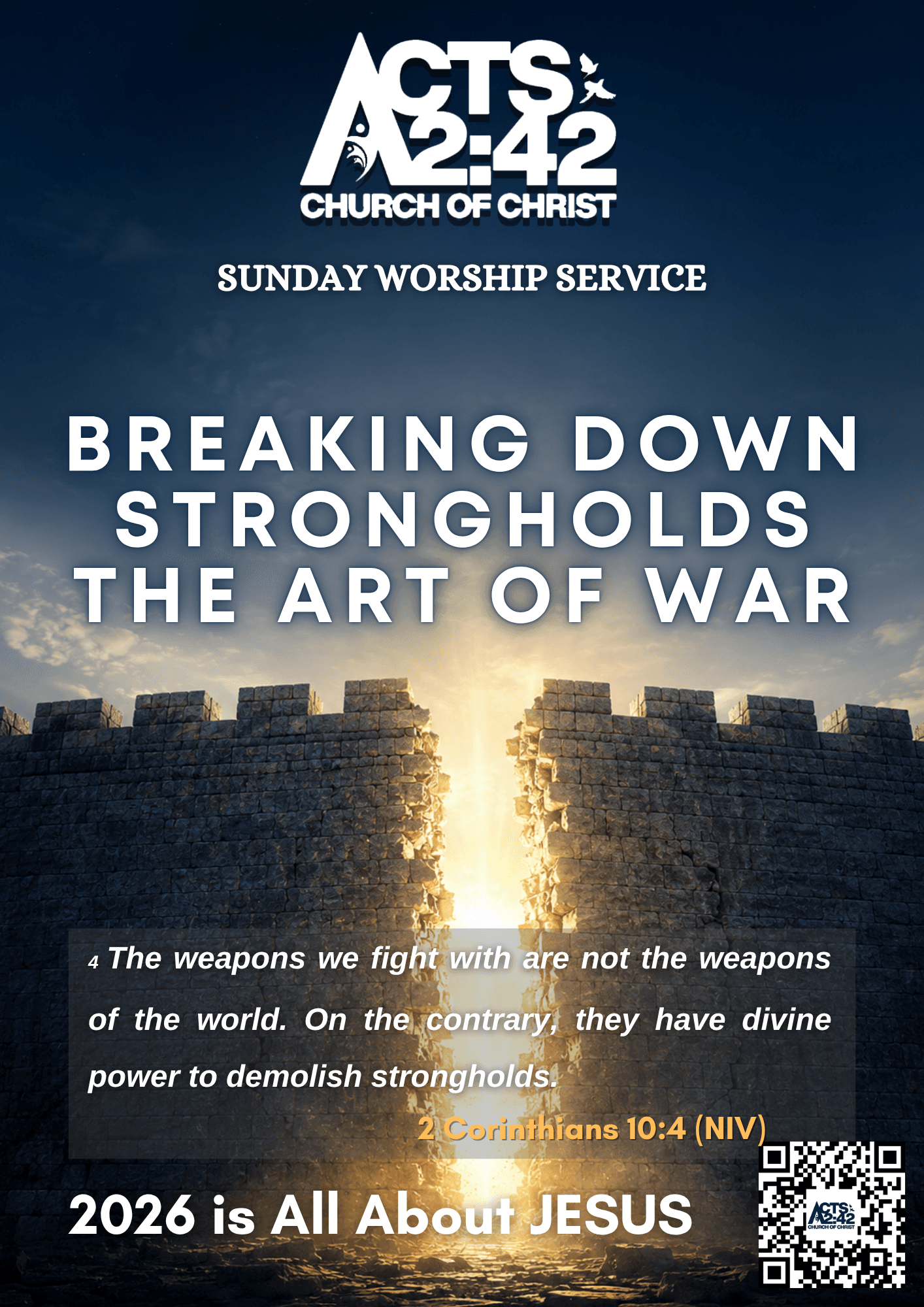
"For though we live in the world, we do not wage war as the world does. The weapons we fight with are not the weapons of the world. On the contrary, they have divine power to demolish strongholds." — 2 Corinthians 10:3–4
The Fortress in Your Mind
There is a war going on that you cannot see, and most of us are fighting it badly — not because we lack strength, but because we do not know what we are fighting or who we are.
The Bible has a word for the ground the enemy occupies in a person's life: a stronghold. In biblical terms, a spiritual stronghold is a deeply entrenched pattern of thinking — pride, doubt, unforgiveness, worldly imaginations — that acts like a heavily fortified fortress in the mind, resisting truth and resisting obedience to Christ.
Notice that a stronghold is not a demon standing in your living room. It is a way of thinking that has been fortified over years until it feels like simply who you are. That's just my temper. That's just how I see myself. I'll never forgive that. Those sentences are walls. And walls have to come down.
There is an ancient book on warfare, The Art of War by Sun Tzu, that contains three lines worth putting beside Scripture this morning:
If you know neither the enemy nor yourself, you will lose every battle. If you know yourself but not the enemy, for every victory gained you will also suffer a defeat. If you know the enemy and yourself, you need not fear the result of a hundred battles.
That is exactly the shape of this message. Many Christians are losing because they know neither. Some are winning half the time because they know themselves but not the enemy. God wants us in the third category — knowing who we are and knowing who he is — so that we need not fear the result of a hundred battles.
So we begin with ourselves.
Part 1 — Know Who You Are
Before you can win a battle, you have to know who is fighting. And the enemy's first strategy is always to make you forget.
You Are a Child of God
"Yet to all who did receive him, to those who believed in his name, he gave the right to become children of God — children born not of natural descent, nor of human decision or a husband's will, but born of God" (John 1:12–13).
Read the phrase carefully: he gave the right. This is not something you earned by attendance or good behavior. It was given the moment you received Him. And notice how you were born into this family — not of natural descent, nor of human decision. No human being made you a child of God, which means no human being, and no accusation, can unmake it.
When the enemy whispers you don't really belong to God, that is a lie aimed at your birth certificate.
You Are a New Creation
"Therefore, if anyone is in Christ, he is a new creation; old things have passed away; behold, all things have become new. Now all things are of God, who has reconciled us to Himself through Jesus Christ, and has given us the ministry of reconciliation" (2 Corinthians 5:17–18).
Old things have passed away. The old self — the one who was ruled by those old patterns — is no longer the one in charge. When the enemy replays your past to convince you nothing has changed, he is arguing with a verse. You are not the old you fighting to become new; you are already new, learning to live like it.
And notice what comes with it: God gave us the ministry of reconciliation. You are not just rescued — you are commissioned.
You Are Forgiven and Loved
"When you were dead in your sins and in the uncircumcision of your flesh, God made you alive with Christ. He forgave us all our sins, having canceled the charge of our legal indebtedness, which stood against us and condemned us; he has taken it away, nailing it to the cross" (Colossians 2:13–14).
There was a legal record standing against you, and it condemned you. That is court language. And God did not reduce the charge or negotiate the sentence — He cancelled it and nailed it to the cross.
This matters enormously in warfare, because the enemy's favorite weapon is accusation. But you cannot be convicted on a charge that has already been cancelled. When guilt rises up and says look at what you've done, the answer is: yes — and it was nailed to the cross.
Child of God. New creation. Forgiven and loved. That is who walks into this battle.
Part 2 — Know Your Enemy
Now the other half. Sun Tzu said knowing yourself but not the enemy still costs you a defeat for every victory. So who are we actually up against?
He Is a Liar
"You belong to your father, the devil, and you want to carry out your father's desires. He was a murderer from the beginning, not holding to the truth, for there is no truth in him. When he lies, he speaks his native language, for he is a liar and the father of lies" (John 8:44).
Look at that phrase — when he lies, he speaks his native language. Lying is not one tool among many for the enemy. It is his mother tongue. It is the language he thinks in.
Which means every stronghold is built out of lies. You are worthless. God has forgotten you. You will never change. Nobody would forgive that. Those are not observations — they are sentences spoken in the native language of the father of lies. And a fortress made of lies is demolished by truth.
He Disguises Himself as an Angel of Light
"And no wonder, for Satan himself masquerades as an angel of light. It is not surprising, then, if his servants also masquerade as servants of righteousness" (2 Corinthians 11:14–15).
This is why discernment matters so much. We expect temptation to arrive looking ugly — but the enemy's most effective work arrives looking good. An opportunity that feels like a blessing. A teaching that sounds spiritual. A relationship that feels like an answer to prayer. Even servants of righteousness can be a masquerade.
So we test everything against the Word. Not everything that shines is light.
He Wants to Consume Us
"Be alert and of sober mind. Your enemy the devil prowls around like a roaring lion looking for someone to devour. Resist him, standing firm in the faith, because you know that the family of believers throughout the world is undergoing the same kind of sufferings" (1 Peter 5:8–9).
Understand his goal. He is not looking to inconvenience you or make your week slightly harder. He is looking to devour. That is predator language.
But notice the two commands attached: be alert, and resist him, standing firm in the faith. And notice the comfort at the end — the family of believers throughout the world is going through the same thing. You are not uniquely targeted and you are not uniquely weak. This is the common experience of the church, and you are not fighting it alone.
Part 3 — The Scheme: How a Stronghold Was Built in Judas
We do not have to theorize about how the enemy builds a fortress. Scripture shows us the blueprint in the life of one man, in three stages.
Stage One — A Wrong Desire
"But one of his disciples, Judas Iscariot, who was later to betray him, objected, 'Why wasn't this perfume sold and the money given to the poor? It was worth a year's wages.' He did not say this because he cared about the poor but because he was a thief; as keeper of the money bag, he used to help himself to what was put into it" (John 12:4–6).
Notice where it starts. Not with betrayal — with a desire quietly left unsurrendered. Judas loved money, and he had access to money, and he had been helping himself for a long time before this scene.
And look how respectable the sin sounded. Why wasn't this given to the poor? His words were about compassion; his heart was about theft. A stronghold almost always begins in a place we have justified.
Stage Two — The Power of Suggestion
"The evening meal was in progress, and the devil had already prompted Judas, the son of Simon Iscariot, to betray Jesus" (John 13:2).
The devil prompted. He did not force. He suggested — planted the thought, and let Judas carry it.
This is how it works with us. The enemy plants a thought long before he demands an action. You could just take it. You could just say it. Nobody would know. The thought arrives, and if we entertain it, turn it over, dwell on it, we are giving ground we did not intend to give.
Stage Three — He Gains a Stronghold
"Then Satan entered Judas, called Iscariot, one of the Twelve. And Judas went to the chief priests and the officers of the temple guard and discussed with them how he might betray Jesus. They were delighted and agreed to give him money. He consented, and watched for an opportunity to hand Jesus over to them when no crowd was present" (Luke 22:3–6).
The desire became a suggestion. The suggestion became an occupation. And now Judas is planning — negotiating a price, watching for an opportunity. The fortress is built and occupied.
That is the progression: desire entertained → suggestion accepted → stronghold established. And it is worth asking honestly this morning: where am I in that sequence right now? Because the easiest place to stop it is at stage one.
Part 4 — How to Defeat the Enemy
So how do the walls come down?
"Submit yourselves, then, to God. Resist the devil, and he will flee from you. Come near to God and he will come near to you. Wash your hands, you sinners, and purify your hearts, you double-minded" (James 4:7–8).
Look at the order — submit first, then resist. We often try to resist the devil without submitting to God, and it does not work. Submission comes first, and then resistance sends him running. And the promise attached is beautiful: come near to God and he will come near to you.
"In your anger do not sin: Do not let the sun go down while you are still angry, and do not give the devil a foothold" (Ephesians 4:26–27).
That word foothold is the whole doctrine of strongholds in miniature. A foothold is a small piece of ground — and the enemy does not need a fortress to start, only a foothold. Unresolved anger carried overnight is exactly that piece of ground. Do not hand it to him.
"For though we live in the world, we do not wage war as the world does. The weapons we fight with are not the weapons of the world. On the contrary, they have divine power to demolish strongholds. We demolish arguments and every pretension that sets itself up against the knowledge of God, and we take captive every thought to make it obedient to Christ" (2 Corinthians 10:3–5).
Take captive every thought. That is the counter-offensive. The enemy takes thoughts captive to build strongholds; we take thoughts captive to demolish them.
The Five Divine Weapons
God has not sent us into this unarmed. Here are the weapons.
1. The Word of God — the sword of the Spirit. The only offensive weapon in the armor of God. Strongholds are built of lies, so the Word is what tears them down. This is why we read it, memorize it, and preach it to ourselves.
2. Prayer and Fasting. These break heavy spiritual resistance and align the believer with God's will. Some walls do not fall to ordinary effort. Fasting denies the body so the spirit grows strong, and when joined with prayer it moves what will not otherwise move.
3. Faith and Truth. Believing God's promises acts as a shield and a foundation. Faith is what absorbs the incoming attack; truth is what you stand on while it lands.
4. Praise and Worship. Exalting God shifts your focus from the problem to His power, creating an atmosphere of faith. This is why worship in a hard season is not denial — it is warfare. You are re-sizing the problem by looking at God.
5. Obedience and Capturing Thoughts. Actively rejecting negative ideas and making every thought obedient to Christ. This is the daily, unglamorous work: catching the thought at the door instead of arguing with it after it has moved in.
Part 5 — We Will Come Out Victorious
And here is where the whole message lands. We are not fighting toward a victory. We are fighting from one.
"The sting of death is sin, and the power of sin is the law. But thanks be to God! He gives us the victory through our Lord Jesus Christ" (1 Corinthians 15:56–57).
Notice the verb: He gives us the victory. It is a gift, not an achievement. Sin had a sting and the law gave sin its power — and Christ dismantled both.
"For everyone born of God overcomes the world. This is the victory that has overcome the world, even our faith. Who is it that overcomes the world? Only the one who believes that Jesus is the Son of God" (1 John 5:4–5).
Everyone born of God overcomes. Not the strongest, not the most disciplined — everyone born of God. And the victory that overcomes the world is our faith, resting on the one confession that Jesus is the Son of God.
So put the pieces together. You know who you are: a child of God, a new creation, forgiven and loved. You know who he is: a liar, a masquerader, a prowling lion — and a defeated one. You know his scheme: desire, suggestion, stronghold. And you have five divine weapons in your hands.
If you know the enemy and yourself, you need not fear the result of a hundred battles.
Challenge
This week, name one stronghold and take one wall down.
Ask honestly: what pattern of thinking in me resists the truth of God? A pride I defend. A doubt I nurse. An unforgiveness I have justified for years. Something I have called just how I am that God calls a fortress.
Then trace it back through the three stages. Where did it start? What desire did I leave unsurrendered? What suggestion did I entertain until it moved in?
Then pick up the weapons deliberately. Find one specific verse that contradicts the lie holding that wall up, and preach it to yourself every day this week. Give the Lord a meal — fast and pray over that one thing. Worship in the middle of it. And when the thought comes, take it captive instead of following it.
And do not let the sun go down on your anger this week. Do not hand the enemy a foothold he can build on.
You are not fighting to become victorious. You already are — thanks be to God, who gives us the victory through our Lord Jesus Christ.
The weapons we fight with have divine power to demolish strongholds.