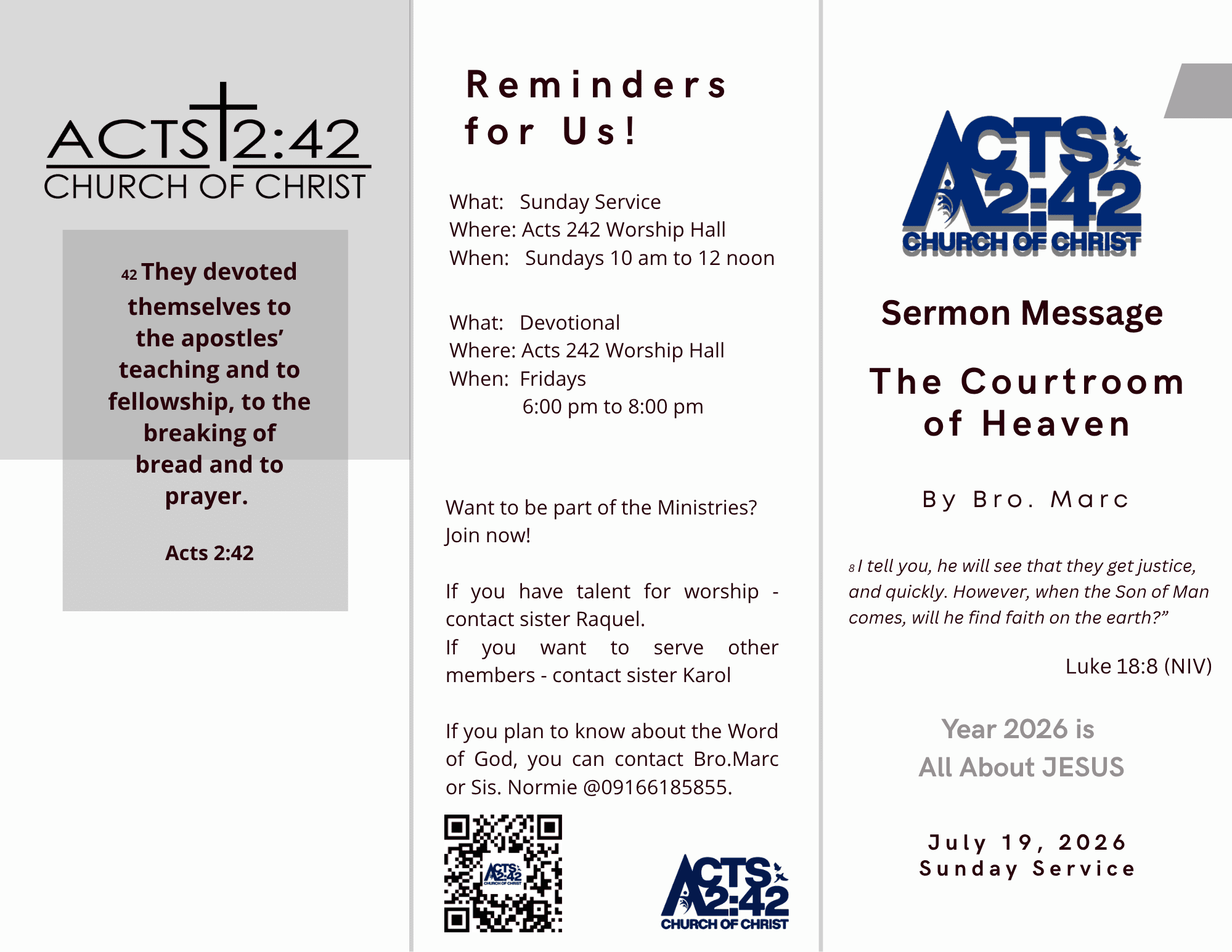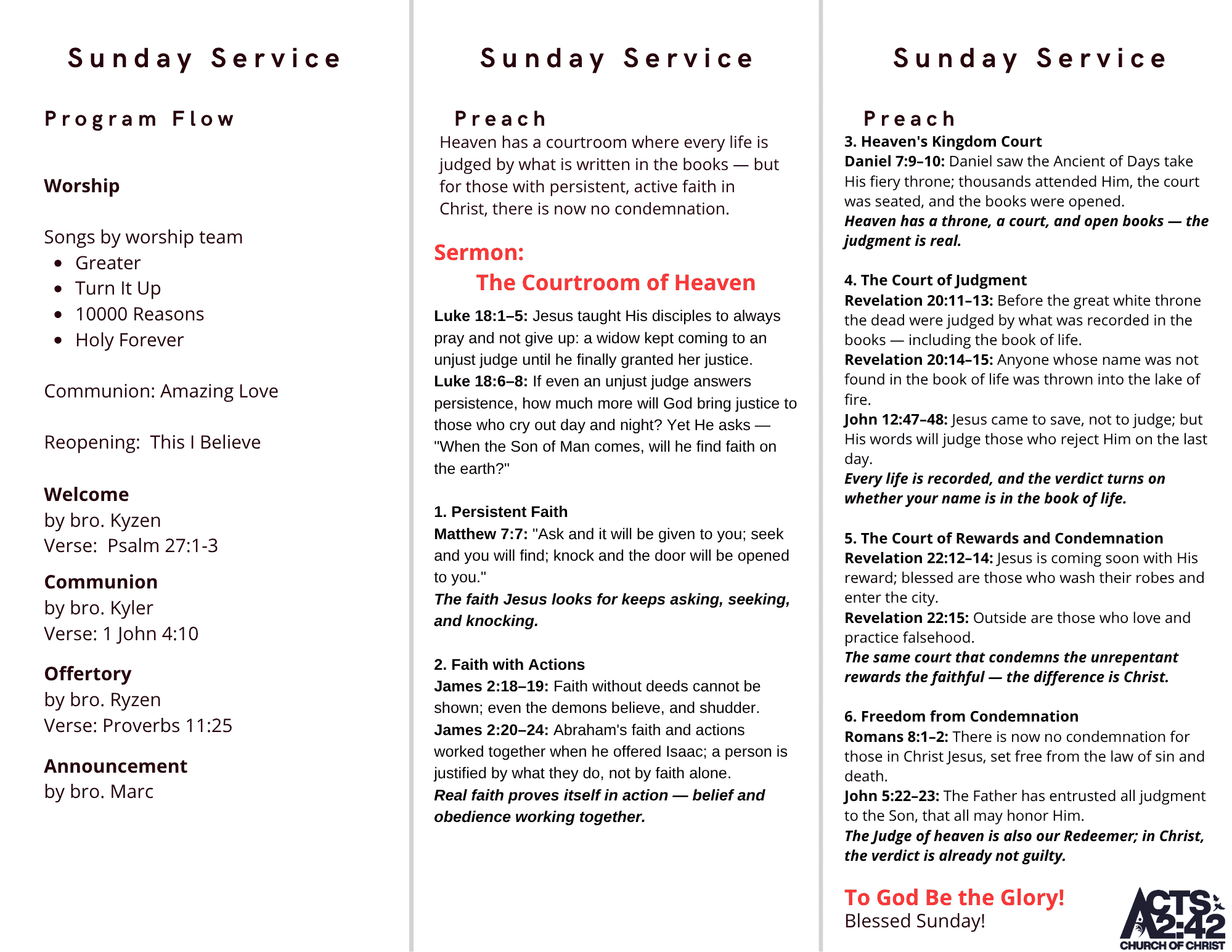
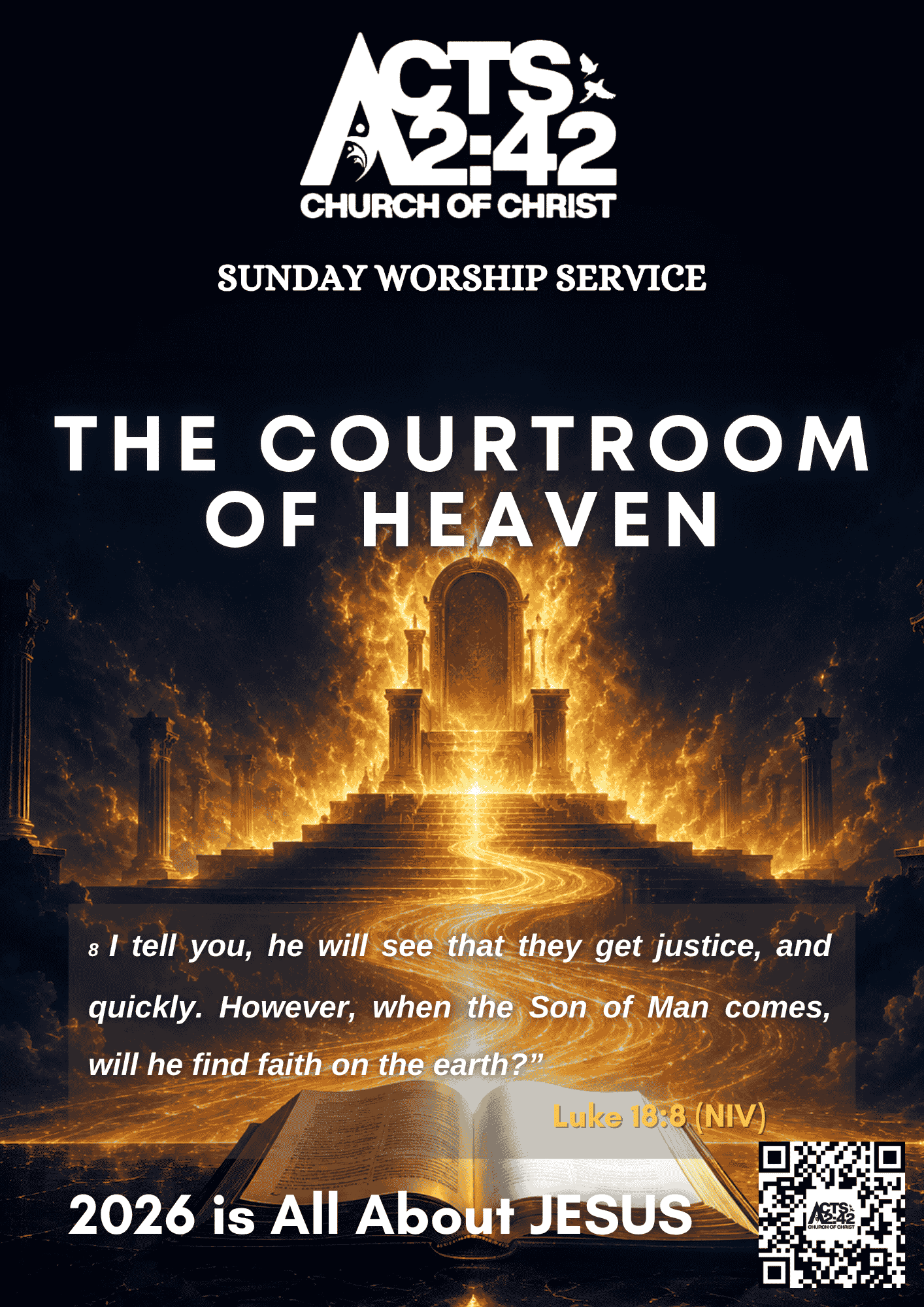
"And will not God bring about justice for his chosen ones, who cry out to him day and night? ... However, when the Son of Man comes, will he find faith on the earth?" — Luke 18:7–8
A Trial on Every Screen
If you have been following the news in our country, the impeachment trial has been everywhere. And there is something worth noticing in it. You have the judge. You have the prosecutors. You have the defendants and the accused.
It is actually instructive to watch — the court proceedings, the way they speak. You can tell these people know what they are doing.
But the irony is hard to miss. They are debating 125 million pesos of alleged corruption, while the Senate reportedly costs around 25 million pesos a day to operate. Compute a ninety-day trial and the cost of the proceedings exceeds the amount being chased.
That is politics, and politics is not our subject this morning. But watching it made me think about courts — and it led me to this message: The Courtroom of Heaven.
Because there is also a courtroom in heaven. Were you aware of that? And every one of us will stand trial before God.
I have broken this into three parts, because they come from slightly different angles: the courtroom of prayer, the court of judgment, and the courtroom of rewards.
Part 1 — The Courtroom of Prayer
Jesus told a parable "to show them that they should always pray and not give up" (Luke 18:1).
Let me ask honestly: are we always praying? And: do we easily give up? When I asked the congregation that second question, the "no" came back weak. Which means this lesson is for us.
"In a certain town there was a judge who neither feared God nor cared what people thought" (Luke 18:2). In short, this judge was not a people-pleaser. He decided whatever he wanted and was accountable to no one. You could not bribe this judge. You could not win him with gifts. In our courts, unfortunately, corruption and bribery exist — but this judge could not be bought, precisely because he cared about nothing and no one.
"And there was a widow in that town who kept coming to him with the plea, 'Grant me justice against my adversary.' For some time he refused. But finally he said to himself, 'Even though I don't fear God or care what people think, yet because this widow keeps bothering me, I will see that she gets justice, so that she won't eventually come and attack me!'" (Luke 18:3–5).
Notice something important about this widow: she does not confront her adversary. That is a lesson for us. When someone wrongs us, when we have been mistreated — huwag niyong ilagay ang paghihiganti sa kamay ninyo. Do not take vengeance into your own hands. Go to God and ask for justice. Let God do the battle for you. Like this persistent widow, keep coming, keep pleading — until the answer comes.
And then Jesus makes the comparison: "Listen to what the unjust judge says. And will not God bring about justice for his chosen ones, who cry out to him day and night? Will he keep putting them off? I tell you, he will see that they get justice, and quickly" (Luke 18:6–8).
Follow the logic. If a judge who fears no God and cares for no one will finally give in just because he is worn down — how much more will a loving God grant the pleas of His own children who cry out to Him day and night? God is nothing like that judge. That is the whole point.
So Jesus is telling us: when we appear in the courts of God, do not easily give up. Because that is exactly what happens to us. When we see prayers going unanswered, or the answer looks unlikely, discouragement creeps in. The joy gets stolen. Nagtatampo tayo sa Panginoon. "Lord, hindi mo naman ako pinagbigyan, eh nagsisimba naman ako linggo-linggo."
And that raises a question worth sitting with. Which is more important — the thing you are asking God for, or your longing for God Himself, to love Him and praise Him and worship Him? Sometimes the request becomes bigger than the Giver. When God says wait, or says no, our tendency is to drift away from Him. Is what we are asking for really more important than our love for the One who loves us and redeemed us?
Then Jesus ends the parable with the question that hangs over this whole message: "However, when the Son of Man comes, will he find faith on the earth?"
Will He find the kind of faith He is looking for — the faith of a persistent widow who cries out day and night? So what kind of faith is Jesus going to look for?
Persistent Faith
"Ask and it will be given to you; seek and you will find; knock and the door will be opened to you" (Matthew 7:7).
We usually read that verse as three separate things. But what if we read it in continuity — as degrees of persistence?
First you ask. But the answer seems unclear. So you seek Him more — you kneel down, you cry out to God, tears come. And still nothing. So what do you do? You knock. Maybe that means fasting. Another level of intensity.
Remember when the disciples could not drive out an evil spirit and asked Jesus why. He told them, this kind comes out only through prayer and fasting. Sometimes the spirit is strong enough that prayer alone does not move it. That is why Jesus Himself fasted regularly — and notice how He said it to His disciples: "When you fast" — not if you fast. It is the Lord's expectation for us.
Have you tried fasting? Not fasting for diet purposes. Fasting means denying your body so that your spirit will grow stronger. And it must be accompanied by prayer. Pag nag-fast ka na walang prayer, walang worship — nagda-diet ka lang. Try it — the power of prayer and fasting.
Still nothing? Then knock at the door of heaven, and the door will be opened to you. That is persistent faith, and that is what Jesus is looking for. Not praying once, hearing nothing, and quietly accepting defeat. God does not want that.
I have personally experienced the power of prayer and fasting many times in my life. And I want the same for you — so that you can say with David, "Taste and see that the Lord is good." We all say God is good all the time, but I hope we are not just repeating what others say. I hope you will personally taste His goodness, because once you have, the more you fall in love with the Lord. What you fought for in prayer tastes sweeter. What you contended for in faith means more.
That is part of why God does not always give immediately. If He gave everything the moment we asked, we would turn out like spoiled brats. Ask, receive. Ask, receive. That is exactly how spoiled children are made — parents giving everything instantly. If God treated us that way, we would become spoiled children of God. But when we ask, and we persist, and we keep believing even when circumstances are not favorable — God is developing our faith.
So fight for your faith. Because when Jesus comes, will He find faith on the earth? Will He find children praying for big things? Because we have a big God who can provide.
Faith with Actions
The second kind of faith Jesus looks for is faith that does something.
"But someone will say, 'You have faith; I have deeds.' Show me your faith without deeds, and I will show you my faith by my deeds. You believe that there is one God. Good! Even the demons believe that — and shudder" (James 2:18–19).
Read that carefully. When you say I believe in God and there are no deeds, there is no difference between you and the devil. In fact, when demons come into the presence of Jesus, they tremble — "Lord, have mercy on us. Don't throw us into the abyss." They believe, and they shudder.
And what about us? When we come into the presence of God, is there a holy fear in us? Is there submission? Faith is not the whole of it — there should be deeds.
"You foolish person, do you want evidence that faith without deeds is useless? Was not our father Abraham considered righteous for what he did when he offered his son Isaac on the altar? You see that his faith and his actions were working together, and his faith was made complete by what he did" (James 2:20–22).
Think about what Abraham actually did. He was promised a son around the age of eighty — and he waited twenty years. Sarah gave birth at ninety, far beyond childbearing age. It was a genuine miracle, because nothing is too hard for God.
And then one day God came and said: offer your son Isaac.
If you were Abraham, could you fulfill that? Lord, I waited twenty years. I saw the miracle. But because of his faith, Abraham did not question God's order. They went up the mountain, and Isaac carried the wood that would burn him — which is itself a foreshadow of Jesus carrying His cross up a hill. When Isaac asked where the offering was, Abraham answered: God will provide.
He bound his son, laid him down, and was about to strike — and God stopped him.
That is faith with actions. It means you do not only believe God; you are willing to obey Him. Obedience is better than sacrifice. That is the faith Jesus will look for in us. Are we willing to obey?
And here is a warning: the Bible explicitly says that in the last days, the love of most will grow cold. As life gets harder, as people and governments get worse, the love of many Christians will cool. So let us be careful. Let us continue to obey the Lord despite what is happening around us — despite the evil in the government, despite our circumstances. Keep the focus on the Lord and keep obeying.
"And the scripture was fulfilled that says, 'Abraham believed God, and it was credited to him as righteousness,' and he was called God's friend. You see that a person is considered righteous by what they do and not by faith alone" (James 2:23–24).
Notice that last phrase carefully — not by faith alone. There are teachings that say faith by itself is enough; that once you are saved, you are always saved, and nothing you do afterward matters. But Scripture here says the opposite: a person is considered righteous by what they do, and not by faith alone.
If your faith says that you are a child of God, then live as a child of God. If you now belong to the family of God, behave like a member of that family. Does a child of God get drunk? Does a child of God steal? Does a child of God commit adultery? Hindi, diba? Anak ka ng Diyos — mabuhay ka bilang anak ng Diyos.
Part 2 — The Court of Judgment
Now to a different court. This is how the courtroom of judgment appears, according to Daniel's vision of heaven.
"As I looked, thrones were set in place, and the Ancient of Days took his seat. His clothing was as white as snow; the hair of his head was white like wool. His throne was flaming with fire, and its wheels were all ablaze" (Daniel 7:9).
His throne was flaming with fire. In the Bible, our Lord is a consuming fire. Can you imagine looking upon that throne in heaven?
"A river of fire was flowing, coming out from before him. Thousands upon thousands attended him; ten thousand times ten thousand stood before him. The court was seated, and the books were opened" (Daniel 7:10).
In a court, what comes out? Evidence. That is exactly what is happening in the impeachment trial right now — witnesses, cross-examination, documents. And in the courts of heaven there is evidence too. The books were opened — meaning everything we have done in our lives is written down and recorded. Nobody will be able to deny anything.
John saw the same court. "Then I saw a great white throne and him who was seated on it. The earth and the heavens fled from his presence, and there was no place for them. And I saw the dead, great and small, standing before the throne, and books were opened. Another book was opened, which is the book of life" (Revelation 20:11–12).
Understand who stands at this white throne judgment: those who did not receive Jesus — those who refused to surrender their lives to Him. And this has not happened yet; it is still in the future.
"The dead were judged according to what they had done as recorded in the books... The sea gave up the dead that were in it, and death and Hades gave up the dead that were in them, and each person was judged according to what they had done" (Revelation 20:12–13). Even those who drowned at sea will be raised for this judgment. And Hades here is the temporary place where the unsaved dead are held, waiting for the judgment.
"Then death and Hades were thrown into the lake of fire. The lake of fire is the second death. Anyone whose name was not found written in the book of life was thrown into the lake of fire" (Revelation 20:14–15).
Are we included among those thrown into that fire? No — because our names are written in the Book of Life. That is why we should not be afraid to die. We are not going to hell. We will not be part of this Court of Judgment. Believers face a different court, which we will come to.
But do not miss this: everything is recorded — even your motivation. Why do you attend? Why do you worship? All of it is written. Wala tayong maitatago sa Panginoon Diyos.
And Jesus tells us exactly what will judge those who reject Him: "If anyone hears my words but does not keep them, I do not judge that person. For I did not come to judge the world, but to save the world. There is a judge for the one who rejects me and does not accept my words; the very words I have spoken will condemn them at the last day" (John 12:47–48).
If anyone — no exceptions. Jesus did not come the first time to judge; He came to save. But for those who will not accept Him as Lord and Savior, what will judge them is the very words He has spoken. And where do we find the words Jesus spoke? In the Bible. The Word we were given to save us is the same Word that will judge those who refused it.
Part 3 — The Courtroom of Rewards
But there is another side to the same court. For those who belong to Christ, the courtroom is not a place of terror — it is a place of reward.
"Look, I am coming soon! My reward is with me, and I will give to each person according to what they have done. I am the Alpha and the Omega, the First and the Last, the Beginning and the End. Blessed are those who wash their robes, that they may have the right to the tree of life and may go through the gates into the city" (Revelation 22:12–14).
Jesus comes with His reward. And those who have washed their robes — cleansed by His blood — are given the right to the tree of life and welcomed through the gates.
"Outside are the dogs, those who practice magic arts, the sexually immoral, the murderers, the idolaters and everyone who loves and practices falsehood" (Revelation 22:15). The same court that rewards the faithful shuts the door on those who loved falsehood and would not repent. The verdict goes two ways — and the difference is Christ.
Freedom from Condemnation
So when your name is called and the books are opened, what will the verdict be?
"Therefore, there is now no condemnation for those who are in Christ Jesus, because through Christ Jesus the law of the Spirit who gives life has set you free from the law of sin and death" (Romans 8:1–2).
No condemnation. Not less. Not survivable. None — for those who are in Christ. The record of our deeds would condemn us, but the blood of Jesus washed the robe and our name is written in the book of life.
And look at who sits on that bench: "Moreover, the Father judges no one, but has entrusted all judgment to the Son, that all may honor the Son just as they honor the Father" (John 5:22–23).
The Judge of the courtroom of heaven is Jesus Himself — the same Jesus who went to the cross to save us. For those who belong to Him, the One holding the gavel is the One who already served our sentence.
Challenge
This week, live as someone preparing for a courtroom you cannot avoid — but without fear, because of whose court it is.
First, take the widow's persistence back up. What have you quietly stopped praying about? Return to it. Ask. If the answer is unclear, seek — kneel, cry out, go deeper. If it is still unclear, knock — try prayer with fasting, denying the body so the spirit grows strong. Do not accept defeat on the first silence.
Second, check whether your faith has deeds attached. Is there an obedience God has been asking of you that your belief has not yet obeyed? Anak ka ng Diyos — mabuhay ka bilang anak ng Diyos.
And third, settle the only question that finally matters: is my name written in the book of life? If it is, walk this week in the freedom of no condemnation — gratefully, honoring the Son who took your verdict. If you are not yet sure, do not wait for the last day to find out. Come to the Judge now, while He is still the Savior.
The court will be seated, and the books will be opened — but in Christ, there is now no condemnation.