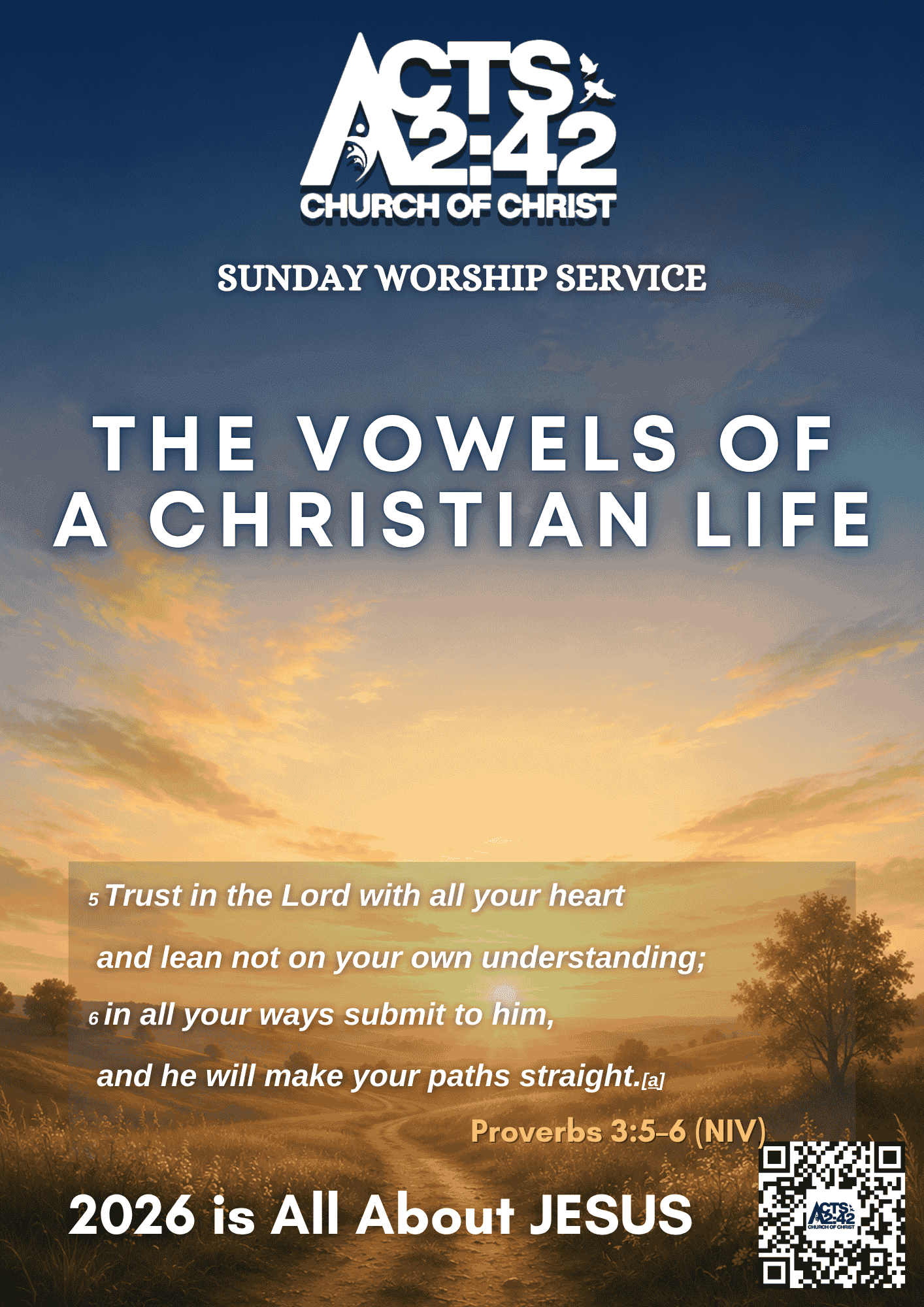
"Trust in the Lord with all your heart and lean not on your own understanding; in all your ways submit to him, and he will make your paths straight." — Proverbs 3:5–6
Back to Grade One
Back to grade one. What are the vowels? A, E, I, O, U. Five letters — and each one has a word beside it that helps us understand the Christian life.
I paired each with a Filipino word too — Ang Limang K — and there is a reason for that. I did not want a barrier between English and Tagalog. I wanted this to land in one heart, not in two languages.
Here is the thing about vowels. You cannot form a word without them. Consonants give a word its structure, but the vowels are what let it be spoken. Try saying a word with no vowels at all — you cannot.
And that is a picture of many Christian lives. Many people have the structure of Christianity: church attendance, Bible knowledge, the right words. All the consonants are in place. Yet something essential is still missing from how they actually live. Nagpe-pray naman ako, nag-woworship naman ako — bakit parang kulang pa rin?
It is easy to look faithful when everything is comfortable. But what happens when you are pressured, influenced, misunderstood, disappointed, and confused? Each of those moments has a letter. Five tests. One life.
A · Kilos — Action: What Pressure Reveals
Nobody talked a bigger game than Peter. Jesus Himself had recognized him — he was going to be the gatekeeper, one of the closest of the apostles. Peter had done his part.
But before the arrest, Jesus told him plainly: you will deny me three times before the rooster crows. And Peter said never. Lord, never kitang tatalikuran. Never kitang itatanggi. His intentions were sincere. His mind said yes, I am with You, Lord.
Then the pressure came, and actions speak louder. Under pressure he denied the Lord three times — probably out of fear that he would be crucified too (Matthew 26:31–35, 69–75).
Put that in the context of our own lives. Look at the pattern: before, during, and after.
Before the pressure — that is where we are confident. After church, you say: hindi na ako mandadaya. Hindi na ako magsisinungaling. Magbibigay na ako. Magpapatawad na ako. It is so easy to say here, because you have just recharged with the Holy Spirit. Full ka ng battery. Ganado ka.
During the pressure — something happens. Someone provokes you at work, or at home. A need presses in. And suddenly you forget to run to the Lord first; you run to a loan, or you think of selling something, or fear takes over. As Christians we have the Holy Spirit, so we feel it — pag may ginagawa kang kasalanan, hindi ka mapakali. There is a restlessness, a fear. But we let the fear win instead of going to God first.
After the failure — Peter wept bitterly. There was repentance.
So the important thing, brothers and sisters, is this: what we say is not always what we do. We need to be aware of our kilos, not just our words.
"Every good tree bears good fruit, but a bad tree bears bad fruit... by their fruit you will recognize them" (Matthew 7:17–20). The fruit is the action, not the words.
It is easy to say nagbabago na ako. Easy to promise. But your action can be different. You tell your boss sisipag na ako — and you are still late every morning. You tell your mother sorry, hindi na ako pasaway — and when it is time to wash the dishes, nagtago ka.
Think about first impressions. You observe someone: are their clothes clean? How do they dress? How do they speak? How do they move? Because actions tell people a lot about you. Itong tao, lagi itong late. Itong tao, lagi nangungutang. That is what stays in people's minds. They do not remember your words — they remember your actions. Naalala ko yung boss ko dati, lagi akong pinapagalitan. Naalala ko yung kaibigan ko, matulungin yan. Si Sister Janice, masarap ang luto. Your action remains, because your action defines who you are.
So for us as Christians, it is not enough to say the Word of God over and over. Huwag natin hayaan na memorize lang natin. Let us put those words into action. Saying God is good repeatedly does not by itself show that we trust He is truly good.
But here is the grace. Jesus did not define Peter by his worst moment. Three times Peter denied Him; three times Jesus asked, "Do you love me?" (John 21:15–17). Peter's failure exposed him; grace restored him. Christian action is not flawless performance — it is repentance and transformation.
I have lived this. After a service I would tell myself, hindi na talaga ako iinom — because I used to drink a lot. And you confirm it to yourself, you promise it. And then sometimes you still fall. Does that mean God no longer loves you? No. Sometimes our promises are just words spoken in excitement, because we are so happy in the presence of the Lord that promises come easily.
So when you break one, do not hide. Instead of saying "Lord, baka hindi mo na ako tanggap, nahihiya na akong magdasal," use it as a way to repent and be transformed. Lord, patawarin niyo ako. Nangako ako sa inyo, pero nagawa ko pa rin. Transform me, Lord. Itong weakness ko, baguhin niyo ako.
E · Kapaligiran — Environment: What Shapes You
Your environment has a voice. It is always discipling you — teaching you what to desire, what to normalize, what to laugh at, and what to tolerate.
There are three environments to watch.
First, people. The people around you actually define you — not just friends, but family, your boss, your co-workers, where you live. Why? Because once something is normalized in a place, it stops feeling wrong. If everyone gossips, it becomes hard not to listen. If everyone borrows money, borrowing becomes normal. If everyone drinks or smokes, that becomes normal too. My old friends cursed in every sentence — nasanay din ako ganun. Our actions are often just what we picked up from our surroundings.
Second, place. Sometimes you were raised well at home, but the neighborhood was different. Or home was fine, but at school someone was bullying you. The place drives the actions too.
Third, our virtual environment — the digital feed. Open your phone and what appears first? Maybe online gambling, sabong, lotto, or the thirst traps on TikTok. There are studies that say people spend three to four hours a day on their phones on average. Whatever you take in there — even fake news — affects your actions. We say cellphone lang yan, but what we do online is often our innate action, the thing we would not do in person. Because online, it is easy to hide.
I know this personally. I used to have several accounts just to pick fights online — Twitter, Reddit. Kasi nakatago yung username mo doon. Nobody knew who I was, so I could provoke people and enjoy watching them get angry. Those environments shape actions.
Even the wisest man fell to this. Solomon was the wisest king of his generation — he asked God for wisdom and received it. Yet through repeated compromise and accommodation, his heart was turned away from God (1 Kings 11:1–13). Seven hundred wives, three hundred concubines — sanlibo yun. No matter how good your heart is, when you are surrounded by what pulls you away, it is hard to stay good.
True or false: many people enter politics wanting to help, and come out corrupt. Because even if you do not want it, the money is handed to you, the chance is handed to you. It is really hard to be different when your environment has normalized wrongdoing.
Every one of us knows a person or a place that pulls us away from God. And we cannot always avoid them — which is exactly why we need the church. Every week, every Sunday, someone checks on us: okay ka pa ba? So that we do not drift.
Now, the good side. In Mark 2:1–12, a paralyzed man could not reach Jesus — the crowd was too thick, and he could not line up on his own. But his friends tore open a roof and lowered him down, and Jesus saw their faith and healed him. Think about it: he was paralyzed. What could he do but wait for people? And because of his friends, the miracle happened even when it looked impossible.
Jairus was the same (Mark 5). He came to Jesus for his daughter, and through his faith she was raised even after she had died.
So choose the people around you carefully — the ones who will help you, teach you, and believe for you. Kung ikaw ay nahihirapan magdasal ngayon, dapat may mga taong magdadasal para sa iyo. And remember: "Do not be misled: Bad company corrupts good character" (1 Corinthians 15:33).
Conduct an environment audit. Who strengthens my faith? Who makes compromise feel normal? What content keeps occupying my mind? Because environment affects the mind first, then the actions. Maybe you are sitting in church already thinking, pagkatapos nito, makakapagsigarilyo na ako. Pagkatapos nito, manonood na ako ng sabong. And ask: where am I most tempted to become someone else?
Choose people who carry you toward Jesus — and become someone who carries others to Him.
I · Kalooban — Intention: What God Sees in the Heart
Samuel came to anoint a king. He saw Eliab — tall, impressive — and thought surely this is the one. But God said no, and chose David: the overlooked youngest son, still out in the field with the sheep (1 Samuel 16:1–13).
"The Lord does not look at the things people look at. Man looks at the outward appearance, but the Lord looks at the heart" (1 Samuel 16:7).
There is a saying worth remembering: we judge others by their actions, but we judge ourselves by our intentions. We describe other people by how they act — ganito siya, ganyan siya. But we describe ourselves by what we meant. That is where so much conflict in life begins.
Parents know this. You discipline your child — your intention is to teach them right from wrong. But to the child, that action feels like being hurt. Sometimes our intention is good and it looks bad from outside. And sometimes the reverse: the action looks good but the intention is not.
The same action, different hearts. Two people pray — one wants God, the other wants attention. Remember the ones praying loudly in the synagogues? Nagdadasal ba tayo para makita ng tao na magaling tayong magdasal? Or because we want the presence of God? Do we pray for others, or only for ourselves? Maybe we pray so someone will say, ang galing mo palang mag-pray, Brother Vince. Or do we pray so that someone is genuinely touched?
Two people give — one gives in love, the other wants recognition. Look at foundations set up by corrupt people: is it out of love for their people, or for the return? Punta ka sa basketball court, puro pangalan nila. You cannot tell whether it was donated from a pure heart or so that you remember them every time you play.
Two people serve — one serves God, the other wants control. Nandito ka ba sa church para masabi na nagsisimba ka? Or you're here for the service of God?
So we cannot judge someone purely by their actions. We have to consider intention. Why do you want to be rich? Maybe because you grew up poor — your environment shaped your intention. Why do you want a car? Kasi dati nagmomotor ako, naulanan ako. Why do you want to help the people on the street? Kasi nakaramdam din ako ng gutom. Or maybe someone helps only so it can be vlogged. We do not know.
God wants both. He is not asking you to choose between right actions and a right heart. He wants obedience that flows from a surrendered heart (Matthew 6:1–18).
Right action + wrong motive = performance. Often we do good things for our pride or our greed. Working overtime not because the work needs it, but so the boss notices. Wanting to be successful — but the motive underneath is revenge.
Good motive + wrong action = excuse. These are the people full of promises. Huwag kang mag-alala, pag yumaman ako, bibilhin ko lahat ng gusto mo — but for now, isaw at itlog. Or: Ma, nakikita kong nahihirapan ka, gusto kitang tulungan — but when it is time to wash dishes or clean the house, nawawala ka na. Then we say, ganun talaga ang buhay. That is just an excuse.
The right way is right action plus a surrendered heart. And note the difference — a right motive means what you want is good. A surrendered heart yearns for what God wants. There is a difference between what you want, your intention, and God's intention.
Halftime
Let us take a break. Grab some water.
Here is why I put a halftime here. Action, environment, and intention are all things you can control. Your actions — you are the one moving. Your environment — if you do not like the place, you can leave; if the friends are pulling you down, you do not have to keep them; if your feed is the problem, delete the apps. Your intention — you can ask the Lord to change how you think.
Those three, we can control. The last two, we cannot. Ready?
O · Kinalabasan — Outcome: What Actually Happens
Picture the diagram: action is in the middle. Action has two driving forces — environment and intention. And after the action comes the outcome. Put the three together, and an outcome results.
But here is the point: no matter how much action, intention, and environment we put in, we can never control the outcome.
Think about sports. Everyone who enters a competition wants to win. Thirty-two teams, all wanting the championship. They all put in the work, all have the mentality and the intention, all train in the right environment. Does everyone become champion? No. They control the effort. They never control the outcome.
The same is true for us. You can work hard every day, study every day, do all the right actions, surround yourself with the right people — and still not end up where you planned. There is an intervention behind it.
Look at Joseph. He did nothing wrong. Sold by his own brothers, enslaved, then jailed for refusing to sin. The right choice cost him everything — yet every closed door positioned him to save nations from famine. "You intended to harm me, but God intended it for good" (Genesis 50:20).
Now ask this: if Joseph had known his brothers would throw him into that pit out of envy, would he still have done the same things? Probably not. If he had known the accusation in Potiphar's house would land him in prison, would he have made the same decision? Probably not. But if he had known he would end up second only to Pharaoh — could he have endured the prison? Maybe.
The point is: we do not know. Maybe you are struggling right now. Maybe your life feels like a mess. We do not know tomorrow. We do not know the outcome. The classmate who slept through class turns out to be the wealthy one. The quiet one becomes the model. Baka si Boss Mike, balang araw, Big Boss Mike na siya. We cannot call the outcome. So let us not limit people — or ourselves — by judging only the actions, intentions, and environment we can see. As long as God intervenes in your life, the outcome changes.
And when the outcome is not what you expected, consider what God may be doing:
God may be correcting your direction. You lost the job — maybe that job was not pleasing to God.
God may be protecting you from something unseen. The relationship ended — and maybe you were spared discovering, after the wedding, a debt of two million pesos that would have become conjugal.
God may be developing your character. Anak, hindi ka pa bagay maging mayaman — baka maging mayabang ka lang. So He lets you struggle first, to build you.
God may be working through timing you cannot control. Too early and you become arrogant; too late and you no longer appreciate Him. Even with our salary — let us not question why it is small. If it were too much, you might forget God. If it were too little, you might curse Him.
Think of it like an oven. God keeps adjusting the temperature so that what He is baking comes out perfect. That is your situation right now. It is never too much and never too little — because the Lord is baking you for the perfect outcome. So be patient.
"Many are the plans in a person's heart, but it is the Lord's purpose that prevails" (Proverbs 19:21).
There is a saying: pray like everything depends on God, and act like everything depends on you. We work and do our best; and when we pray, we pray for everything. Not only for the shortfall. Do not just pray, Lord, I am short this much. Pray the whole thing: Lord, provide for me, provide for my lifestyle, provide for everything. Not Lord, give me one client because I need money, but Lord, abundance in clients — give me a network of people who trust me. Pray for the whole outcome, not just our shortcomings.
"Whoever wants to save their life will lose it, but whoever loses their life for me will save it" (Luke 9:24). The practical principle is simple: we are responsible for obedience; God is sovereign over the outcome. Our one job is to stay with God, believe Him, and practice His Word. Si God na bahala sa outcome. Let us not try to over-direct Him — Lord, gusto ko ganito ang asawa ko, gusto ko ganito ang mangyari.
And then there are Shadrach, Meshach, and Abednego. They believed God could rescue them from the fire — but their faith did not depend on the outcome. "But even if he does not..." (Daniel 3:16–18).
Think about that. They were already being thrown into the furnace. If it were us: Lord, naniwala ako sa iyo — di mo man lang pinatay yung apoy? Andiyan na sila, dadakpin na kami — bakit hindi mo pa kami iniligtas? But that is exactly the point — the miracle happened inside the fire, not before it.
I have prayed that prayer myself. Lord, may utang ako — pwede naman sana nabayaran agad. Pwede naman sana nabenta ko lang yung gamit ko. But it went further down — the house and the car foreclosed. And only there, at the bottom, did I see God's outcome. Sometimes things have to be lost before we see the outcome of our prayer.
It is like praying about a flood. Lord, keep us safe from the flood. And you think — Lord, pwede naman hindi mo na lang paulanin. Or hindi mo na lang bahain yung lugar namin. Or mababaw lang sana. But the flood comes anyway, and you are kept safe, even if some things are lost. It is still the outcome that matters. It does not mean the Lord abandoned you. There is something He wants to happen. And the only thing that can answer that is the last vowel.
U · Kaunawaan — Understanding: What Only God Fully Sees
Look at this room. However bright the lights are, if you stand up, there is still a shadow beneath you. However clear our understanding gets, a shadow of uncertainty always remains.
The light is your understanding, your wisdom, your grasp of a thing. No matter how bright it is, no matter how knowledgeable you are, there is always a shadow. Always something missing. You think you understand why a person acts a certain way — but there is still uncertainty there.
Job is the example. He lost everything and demanded to know why. God never explained. He simply revealed Himself — His wisdom, His power, His presence — and Job trusted what he could not understand (Job 1–2; 38–42).
Sometimes God answers the question. And sometimes God changes the one asking it.
Lord, bakit ako nagkasakit? Lord, bakit ako naghihirap ngayon? Lord, bakit nawala yung taong mahal ko? Bakit ngayon pa, kung kailan wala na ako?
But look at who He is: "God is light; in him there is no darkness at all" (1 John 1:5); the Father of lights, "who does not change like shifting shadows" (James 1:17). Nothing produces a shadow in God's light. It means God understands everything, has wisdom over everything. There is no uncertainty in Him. He is certain about what is happening to you. He is certain about the outcome He gives you.
And here is something humbling. Sometimes we cannot even explain ourselves. Bakit kaya ganun? Hindi ko maiwasan. Alam ko namang mali, nagagawa ko pa rin. We have uncertainty inside us — we do not fully understand our own hearts. But God knows you more than you know yourself. Whatever is happening to you, He knows it is right, He knows it is perfect, He knows it is what should be happening — because God knows who you truly are. That is why the verse says He will not give you more than you can bear. Nandiyan ka kasi alam niyang kaya mo.
So: "Trust in the Lord with all your heart and lean not on your own understanding" (Proverbs 3:5–6). We trust Him because God is certain about everything — not just some things.
What I know when I don't know why: I may not know why this happened. I may not know how long it will last. I may not know what God will do next. But I know who He is — God is good. God is present. God is wise. And God is faithful.
Hold on to this line: Mature faith says, "God can." Deeper faith says, "Even if He does not — He is still my God."
When we are mature Christians, we no longer doubt that God is able. We know He can. But sometimes there is a reason He does not — and that is where deeper faith is formed. That is where a deeper relationship grows. God does not want us to think of Him only in terms of what He is able to do. He wants us to understand that even when He does not give it, He is still God.
Because as Christians it is so easy to share the good news — we were blessed, we were promoted, this happened. It is easy to claim, akala ko hindi ko kakayanin, pero kinaya ko pala. That is maturity, and it shows we believed God. But we rarely hear the other testimony — the deeper faith, the one that came from a life that turned 180 degrees.
I know a brother and a sister whose lives changed completely. From a successful career, they went down. If their maturity had only reached God can, then in the hardship they might have lost their understanding of Him: God, akala ko ba all-knowing ka — bakit kami naghihirap? They could have let go. But they stayed. They kept going to church. They could no longer attend the church in Makati, so they attended nearby. And what they showed was this: even if You do not provide, even if You do not fix our problem right now — You are still my God.
Because it is easy to say you love God when you have everything. When He shows you what He can give, it is easy to believe and easy to love. It is when you have nothing — when you feel like everything has gone wrong — doon mo mapapakita na mahal mo Siya.
God is good. It does not matter where you are in life — whether He seems to be giving you everything, or whether you feel He is withholding. God is always good. He is not withholding from you. He is teaching you. God is good, and God is wise.
The Five Vowels
A, E, I, O, U — Ang Limang K.
Everything begins with our action, which is fueled by our environment and by our mind, which is our intention — and which leads to an outcome. And in the end, none of it matters most, because what matters is our understanding. Understanding the people around us. Understanding our own actions. Understanding our own thoughts. Understanding why the outcome came out as it did.
A · Kilos — a Christian life is revealed by our actions. Nagpe-pray ka ba? In church it is easy to pray. Alone at home, quiet time is hard — and we forget. E · Kapaligiran — shaped by our environment. I · Kalooban — examined through our intentions. O · Kinalabasan — surrendered in its outcomes. U · Kaunawaan — sustained by trusting God beyond our understanding.
Every aspect of our life — our actions, our surroundings, our intentions, our outcomes — God is in every part. Every part is a test. Every part is a way to show that you are a Christian.
Jesus at the Center
And here is the most important thing: this is not a five-step program for self-improvement.
We cannot transform our actions, environment, intentions, outcomes, and understanding by willpower alone. We need Jesus to change the heart that all of it flows from.
In the end, it comes back to the heart. Kapag hindi mo kontrolado ang kilos ng iba, ang kapaligiran, o ang kinalabasan — o kapag hindi mo maintindihan ang nangyayari — maisusuko mo pa rin ba ang iyong kalooban kay Cristo?
Even when you cannot control other people, your environment, or the outcome — even when you cannot understand — you can still surrender your heart to Christ. That one vowel is always within reach, and it is the one that matters most.
So brothers and sisters: always check your heart.
Golden Question
Aling patinig ang kinakausap sa iyo ng Diyos ngayon?
Which vowel is God speaking to you today?
A · Kilos — Is there an action that must change? A habit you cannot let go of, that you return to the moment you get home? E · Kapaligiran — Is there an influence you must confront? A person, a place, or the phone in your pocket? I · Kalooban — Is there a motive you must surrender? A hurt, a revenge, a hidden reason underneath a good deed? O · Kinalabasan — Is there an outcome you are trying to control? Something you keep forcing even when the Lord has already signaled otherwise? U · Kaunawaan — Is there a question you must entrust to God? Lord, bakit nangyari ito sa amin? Lord, bakit hinayaan mo?
Challenge
This week, do not try to fix all five at once. Pick the one God just put His finger on, and bring it to Him.
Huminto. Makinig. Sagutin sa harap ng Diyos. Stop. Listen. Answer it before God — not to fix by willpower, but to surrender to the One who changes the heart it all flows from.
And when you cannot see the outcome, remember the oven. It is never too much and never too little. He is baking you for something perfect, and He is certain even when you are not.
A Christian life, from A to U, is only ever spoken by a heart surrendered to Christ.