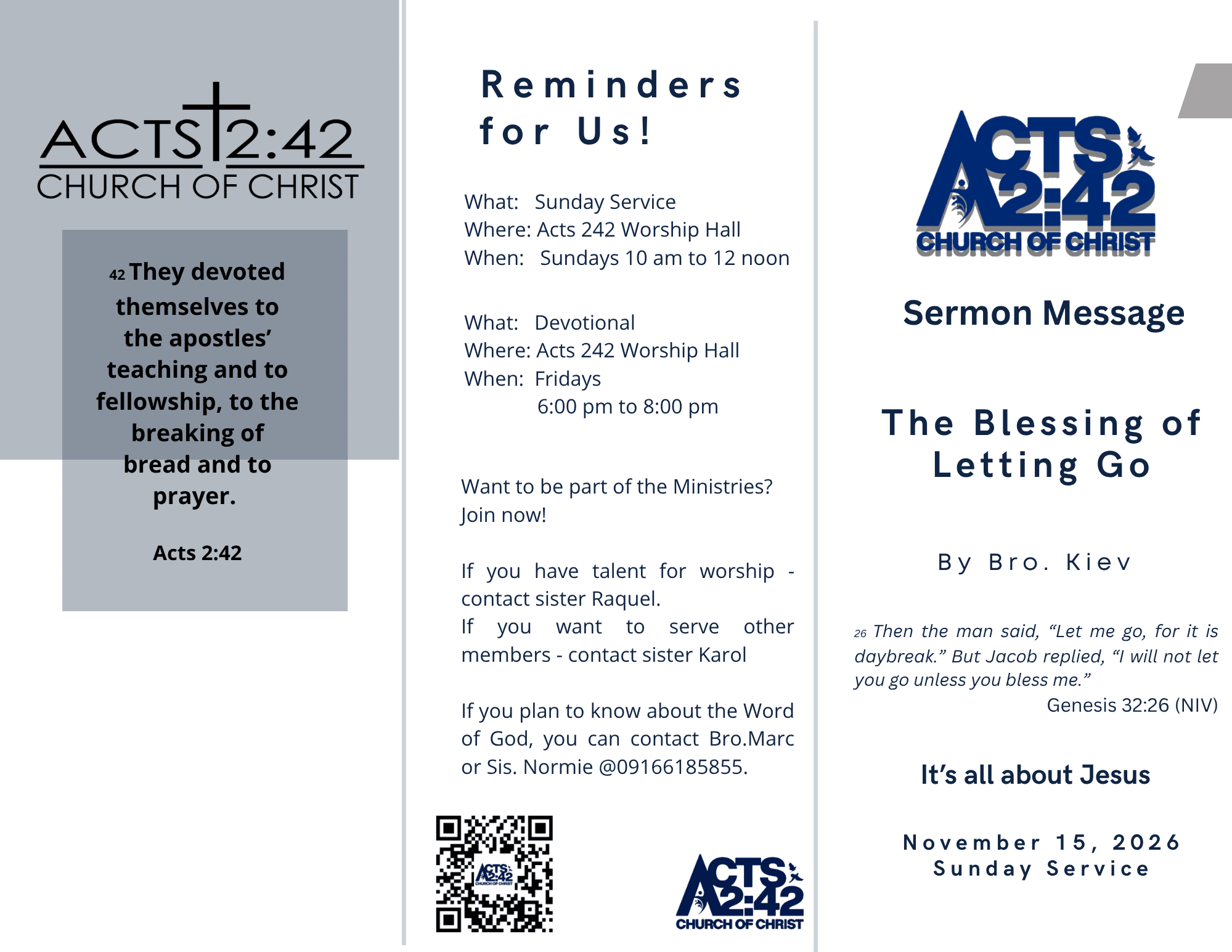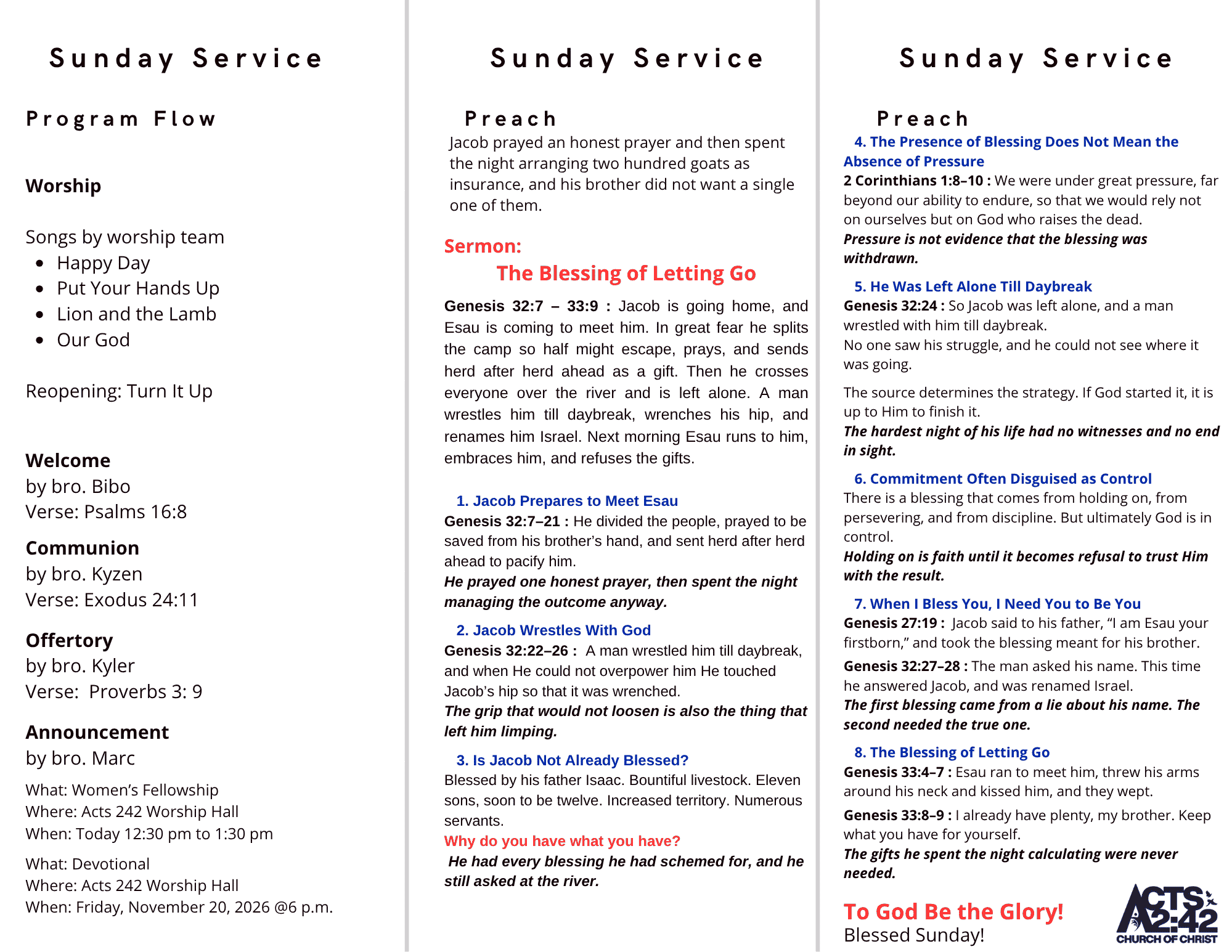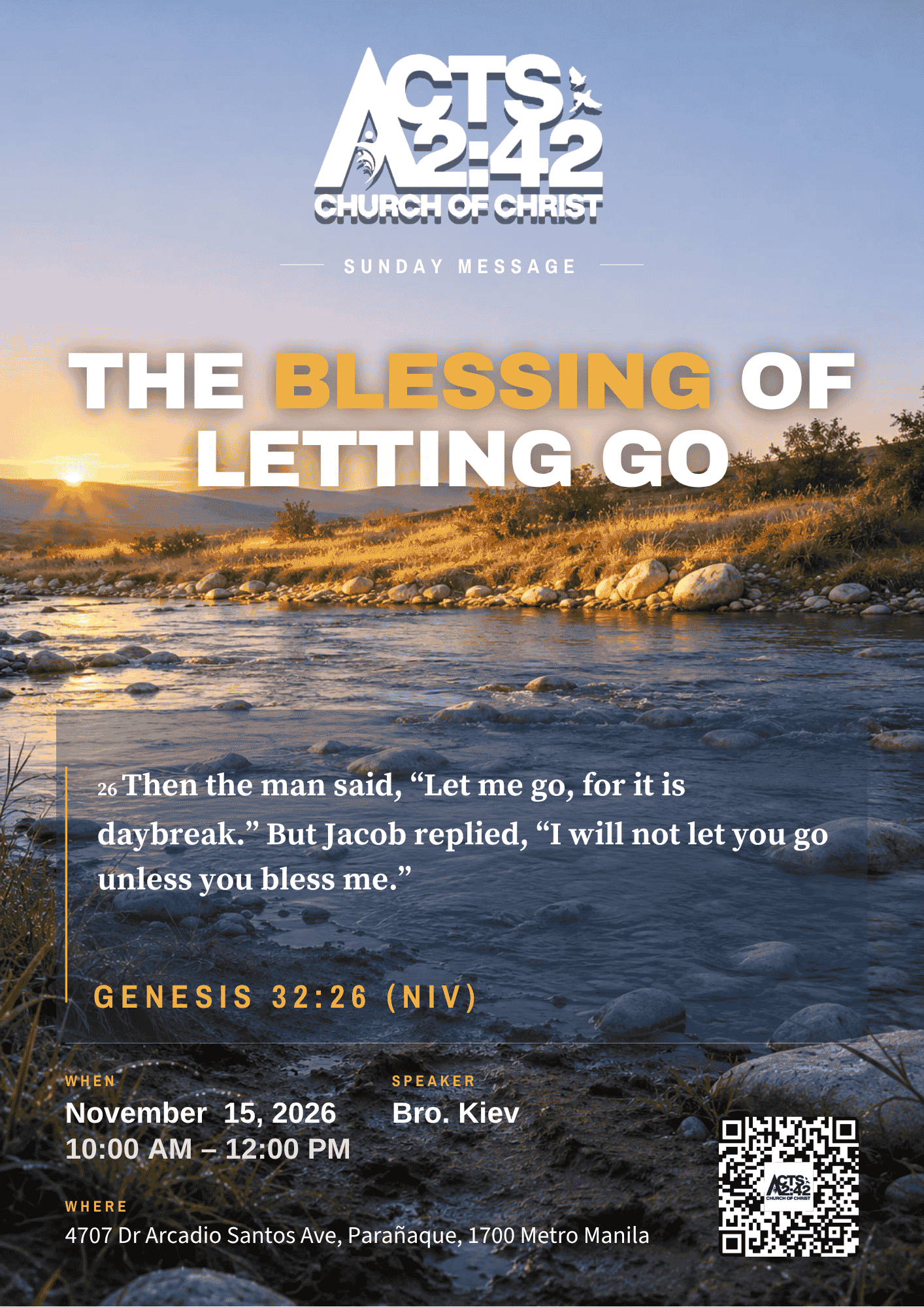
"I will not let you go unless you bless me." — Genesis 32:26
Before the message began, Bro. Kiev stopped to honor the youth who had led parts of the service that morning. He asked them beforehand whether they were nervous, and admitted he was too: it is not easy to stand up here and handle the Word of the Lord. But conquering your fear to serve God is an act of worship, and the church thanked them for it.
Then the sentence above. Hold it next to the title of this message. Jacob's most famous line is a refusal to let go, and the sermon is called The Blessing of Letting Go. That tension is the whole thing. By the end of the next chapter, everything he was gripping turns out to have been unnecessary.
This is Part 2 of a story Bro. Kiev began at the Friday devotional with Jacob and Esau. And it is a family drama. Kung gusto mo ng soap opera, basahin mo ang Bible — action, drama, even comedy, it is all in there. Just read your Bible. You will learn more, and you will come closer to God.
The Family Tree
Worth setting out before anything else, because this is a family story before it is a theology lesson. Abraham and Sarah, who waited and prayed for their only son. That son, Isaac, married to Rebekah. Their twin sons, Esau and Jacob.
When Isaac grew old and his eyes grew dim, he was about to bless his firstborn, Esau. In Hebrew custom, the firstborn received the inheritance. But Rebekah's favorite was Jacob, and she sent him in first. He went in costume: Esau was hairy, so Jacob wore goatskins. Isaac was deceived, and Jacob walked out with his brother's blessing. Esau was so angry that he swore: the next time we meet, I will kill you.
Two brothers, one stolen blessing, and twenty years of silence. That is the wound this chapter walks back into.
1 · Jacob Prepares to Meet Esau
Jacob is going home, and the news is that Esau is on his way. "In great fear and distress" Jacob divided the people with him into two groups along with the flocks and herds, reasoning that if Esau attacked one group the other might escape (Genesis 32:7–8). He is already making a strategy.
Then he prays, and it is a good prayer. He appeals to the God of Abraham and Isaac who told him to go back. He admits "I am unworthy of all the kindness and faithfulness you have shown your servant" (Genesis 32:10). He remembers that he once crossed the Jordan with nothing but a staff. He asks plainly to be saved from his brother's hand, and he holds God to His own promise about descendants like the sand of the sea (Genesis 32:11–12). In effect: Lord, You promised my grandfather and my father. If I die here, that promise dies with me.
Bro. Kiev sees himself in that prayer. He prays the same way: Lord, You promised me plans to prosper me and not to harm me, plans to give me hope (Jeremiah 29:11). And still, I am afraid. Afraid of my future. Afraid I might become a failure. Many of us pray exactly like Jacob.
And then, having prayed all that, Jacob spends the rest of the night organizing. Two hundred female goats, twenty male goats, two hundred ewes, twenty rams, thirty camels with their young, forty cows, ten bulls, twenty female donkeys, ten male donkeys. Sent in separate herds with instructions to the servants, spaced out so Esau meets wave after wave of gifts before he meets the man (Genesis 32:13–20).
His own reasoning is given to us: "I will pacify him with these gifts I am sending on ahead; later, when I see him, perhaps he will receive me" (Genesis 32:20).
Perhaps. He prayed honestly and then went straight back to managing the outcome himself, which is a thing most of us can recognize without much help.
2 · Jacob Wrestles With God
He sends his wives, his servants and his eleven sons across the Jabbok, and then sends over everything he owns. "So Jacob was left alone, and a man wrestled with him till daybreak" (Genesis 32:24). The man, we learn, is God Himself.
When the man saw that He could not overpower him, He touched the socket of Jacob's hip so that it was wrenched (Genesis 32:25). Then: "Let me go, for it is daybreak." And Jacob's reply, the line everyone remembers: "I will not let you go unless you bless me" (Genesis 32:26).
Notice what that grip costs. The same night that earns him a new name leaves him limping (Genesis 32:31).
3 · Is Jacob Not Already Blessed?
Before answering, the congregation said it together, with conviction: I am blessed. We believe it. We thank God for it. But let us be honest: at some point, we are all Jacob.
So here is the question the message stops to ask, and it is the right one.
Blessed by his father Isaac. Abundant livestock, in the hundreds. Eleven sons, soon to be twelve, and in Hebrew culture many children were a sign of prosperity; those twelve would become the twelve tribes of Israel. Increased territory: he arrived with only a staff, and now his camp had become two. Numerous servants.
By any measure available, the man at that river was already blessed. He had everything he had schemed for, deceived for and worked fourteen years for. And he was still at the river at daybreak asking for more.
We do the same. Lord, give me this job. This business. This profit. My dream car. My dream house. Are we not already blessed?
Years ago, at an entrepreneurship seminar in senior high school, Bro. Kiev heard a speaker open with a question that stayed with him: "Why do you have what you have?" Why do I have good clothes, branded shoes, the toys I had as a child? Why do I have a phone, the latest model, fully paid? Why do I have a scholarship, an allowance, parents who work hard for me, a roof over my head, when so many of our own countrymen have no home, no decent clothes, and cannot eat three meals a day? Is it because I am good? Because we are rich? Because I am smart?
Surely we are very blessed. This church is blessed, so blessed that Bro. Kiev declared it will grow, it will expand, and the kingdom of the Lord will reach the whole earth.
So why did Jacob still say I will not let you go unless you bless me? Because there was fear. Esau was coming to kill him, and he thought death would be the end of everything. But as we learned two Sundays ago, death is not the end of us. A child of God has nothing to fear from whoever comes to threaten, harm or deceive. You are blessed. You are a child of God.
Put the seminar's question to Jacob, and he could answer it honestly for almost nothing he owned. The birthright came by a bowl of stew. The blessing came by goatskins and a lie. The flocks came by six years of out-maneuvering Laban. Which tells us the thing he actually wanted at that river was never on the inventory, because the inventory was the problem.
4 · The Presence of Blessing Does Not Mean the Absence of Pressure
Listen to how we say it. Yes, I am blessed — but the bills keep going up. Yes, I am blessed — but work is hard. Yes, I am blessed — but my studies are hard.
The presence of blessing does not mean the absence of pressure. Often God blesses us and we are afraid of the responsibility that comes with it. He gives you a car, and now the oil change is expensive and you are afraid of a scratch. He gives you a ministry, and you say I'm not ready to lead. Next time. He gives you a big house, and it is hard to clean. You get into the university you prayed for, and the studies are hard.
But it is not up to you to decide whether you are ready. It is up to Him. Just say yes to the Lord. He will sustain you, empower you and provide for you. That is exactly what our youth did this morning: they were nervous and afraid, and they said yes anyway. The pressure is what builds you up. It makes you steadfast. It is how you grow.
Paul says it as directly as it can be said. "We were under great pressure, far beyond our ability to endure", so much that they despaired of life itself (2 Corinthians 1:8). They felt they had received the sentence of death.
Then the reason: "But this happened that we might not rely on ourselves but on God, who raises the dead" (2 Corinthians 1:9). He has delivered, He will deliver again, and on Him the hope is set (2 Corinthians 1:10).
Pressure is not evidence that the blessing has been withdrawn. Sometimes it is the means by which self-reliance is taken out of our hands, so that our strength comes from Him and not from our own ego or pride.
5 · He Was Left Alone Till Daybreak
"So Jacob was left alone" (Genesis 32:24).
The message draws two things out of that, and both are pastoral.
No one saw his struggle. His family was across the river. The hardest night of his life had no witnesses, and nobody in the camp knew what was happening in the dark. Many of us carry struggles like that, problems that play only in our own minds. Someone asks kumusta ka? and we say okay lang, even when we are not.
He could not see where it was going. It was night. He had no idea the wrestling would end, how, or what it would make of him. He only knew it was still going on.
If you are in that position now, understand that this is not a sign of abandonment. It is where the name change happened.
And there is a principle attached that decides how you fight a night like that. The source of the struggle determines the strategy. If your struggle comes from other people, from vices or addictions, from material things, your strategy will be found there too. But if God started it, it is up to Him to finish it. He will see you through to the finish line. And what did Jacob do? He held on to God, to His promise, to His faithfulness, to God alone. Keep holding on to Him until daybreak.
6 · Commitment Often Disguised as Control
There is a real blessing that comes from holding on. There is a blessing that comes from persevering. There is a blessing that comes from discipline. The message affirms all three before it turns the corner.
But ultimately, God is in control.
That is the line worth sitting with, because holding on and taking control look identical from the inside. You say yes to God and lead a ministry, and somewhere along the way you start to feel ako ang nasusunod — I am the one in charge. You are committed, but you are still not in control. Not of your life, your future, your career, your business, or your wealth. You can steer your car, but not everything that happens on the road.
A manipulative Christian is an oxymoron. Once you are a Christian, you have handed Him the purpose of your life, and He paves the way. Our lives will never be perfect. We will stumble and we will make mistakes, and that is okay. God is still in control.
Jacob prayed and then arranged two hundred goats. The praying was faith. The goats were insurance. Most of us are much better at the second one.
7 · When I Bless You, I Need You to Be You
Now the message does something clever. It reaches back to the first blessing — and to Jacob's name. At birth he came out grabbing his twin's heel (Genesis 25:26), and all his life he grabbed: every opportunity, every blessing, held tight.
"Jacob said to his father, 'I am Esau your firstborn'" (Genesis 27:19). The blessing he took as a young man was obtained by giving a false name.
Now, at the river, the man asks him the same question. "What is your name?" And this time: "Jacob." No disguise, no goatskins, no borrowed identity. The honest answer, which in Hebrew means grasper, supplanter, the one who takes the heel.
And immediately: "Your name will no longer be Jacob, but Israel, because you have struggled with God and with humans and have overcome" (Genesis 32:28).
The first blessing required a lie about who he was. The second required the truth. When God blesses you, He needs you to be you. It is okay if you are weak. It is okay if you are tired. It is okay if you are a sinner who keeps making mistakes. You do not need to pretend to be perfect before Him.
This world rewards being performative: the right drink in your hand and a book under your arm, a good reputation outside, and shouting at home. With God, be genuine. If you are struggling with temptation, with an addiction, with discipline, with your family, your friends or your classmates, tell Him the truth. It is okay to cry before Him. It is okay to look weak, because He will strengthen you.
8 · The Blessing of Letting Go
The morning comes and Jacob limps toward four hundred men.
With a brother's help, Bro. Kiev acted it out at the front: the man Jacob had dreaded for twenty years, running toward him. "But Esau ran to meet Jacob and embraced him; he threw his arms around his neck and kissed him. And they wept" (Genesis 33:4). No speech. No negotiation. No reckoning for twenty years of theft.
What you have dreaded for years, once surrendered to God, can turn out completely differently.
Esau asks what all the herds were for. Jacob says they were to find favor in his eyes. And Esau answers: "I already have plenty, my brother. Keep what you have for yourself" (Genesis 33:9).
Every animal was unnecessary. The entire night of calculation, the waves of gifts, the splitting of the camp, the rehearsed speeches for the servants to deliver. Esau did not want the goats. He wanted his brother. God had already changed Esau's heart.
Let Go and Receive
Let go of your Esau. Let go of your worries. Let go of your agonies. God is moving in your life and changing your path toward a brighter tomorrow.
Let go of hate, and receive love. Let go of comfort, and receive growth. Let go of bitterness, and receive happiness. Let go of sin, and receive His grace.
Let go, and let God.
Challenge
Name your Esau. The person you have been preparing for rather than approaching. The conversation you have rehearsed so many times that you have never had it. Go this week, without the goats.
Then look at what you have been sending on ahead. Most of us have a version of Jacob's herds, the effort we put between ourselves and an outcome we have already prayed about. Name one of them and stop sending it. Pray, and then do not arrange the result.
Say yes to the responsibility He gives you. If He has put a ministry, a role or a hard season in front of you and you keep saying next time, say yes now, and let Him carry the pressure with you.
And answer the question honestly when it is asked. He got the first blessing by claiming to be someone else. He got the real one by saying his own name out loud. If you have been in church for years under a borrowed identity, better than you are, holier than you are, more settled than you are, the blessing is waiting on the true answer.
You may come out of it limping. Israel did, and he kept the name.
To God be the glory!