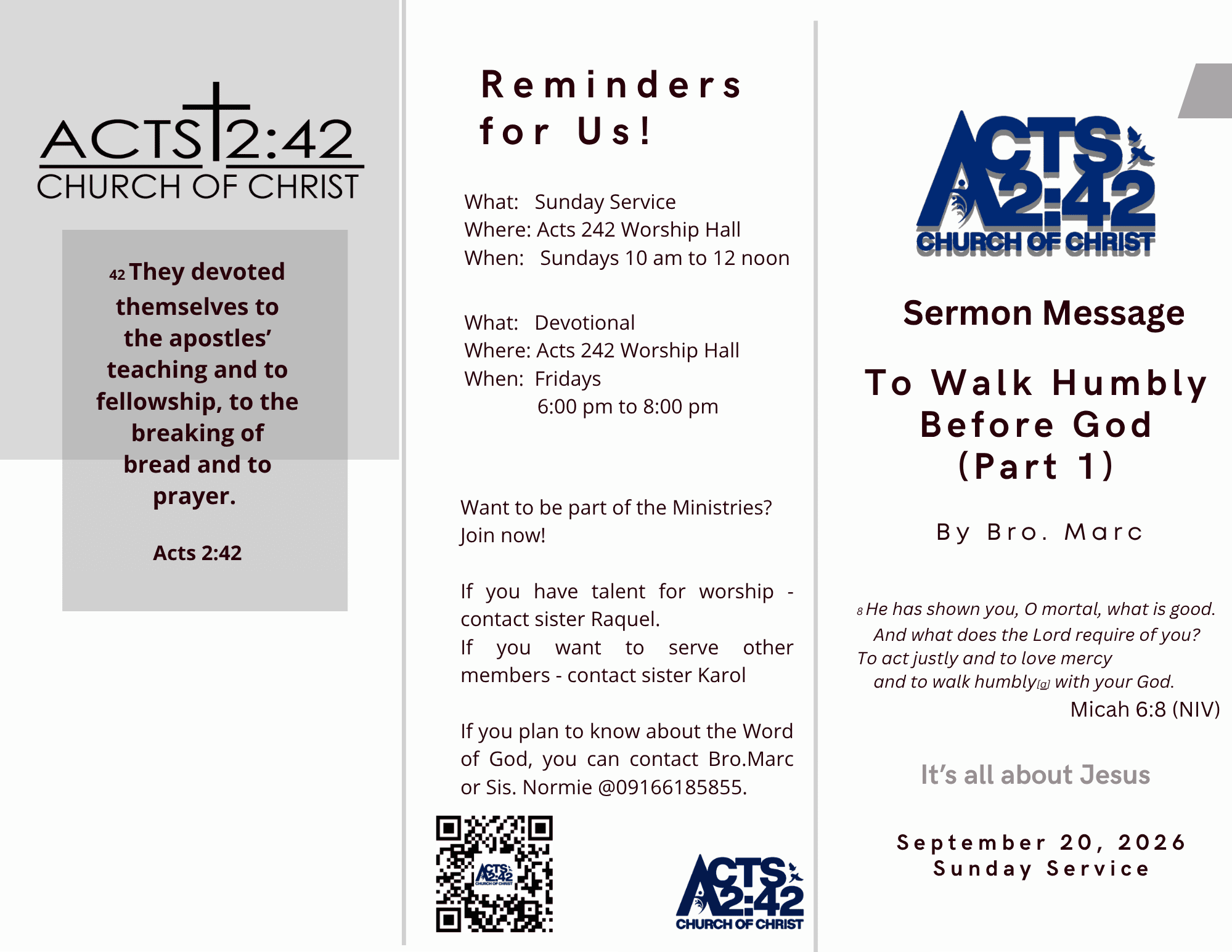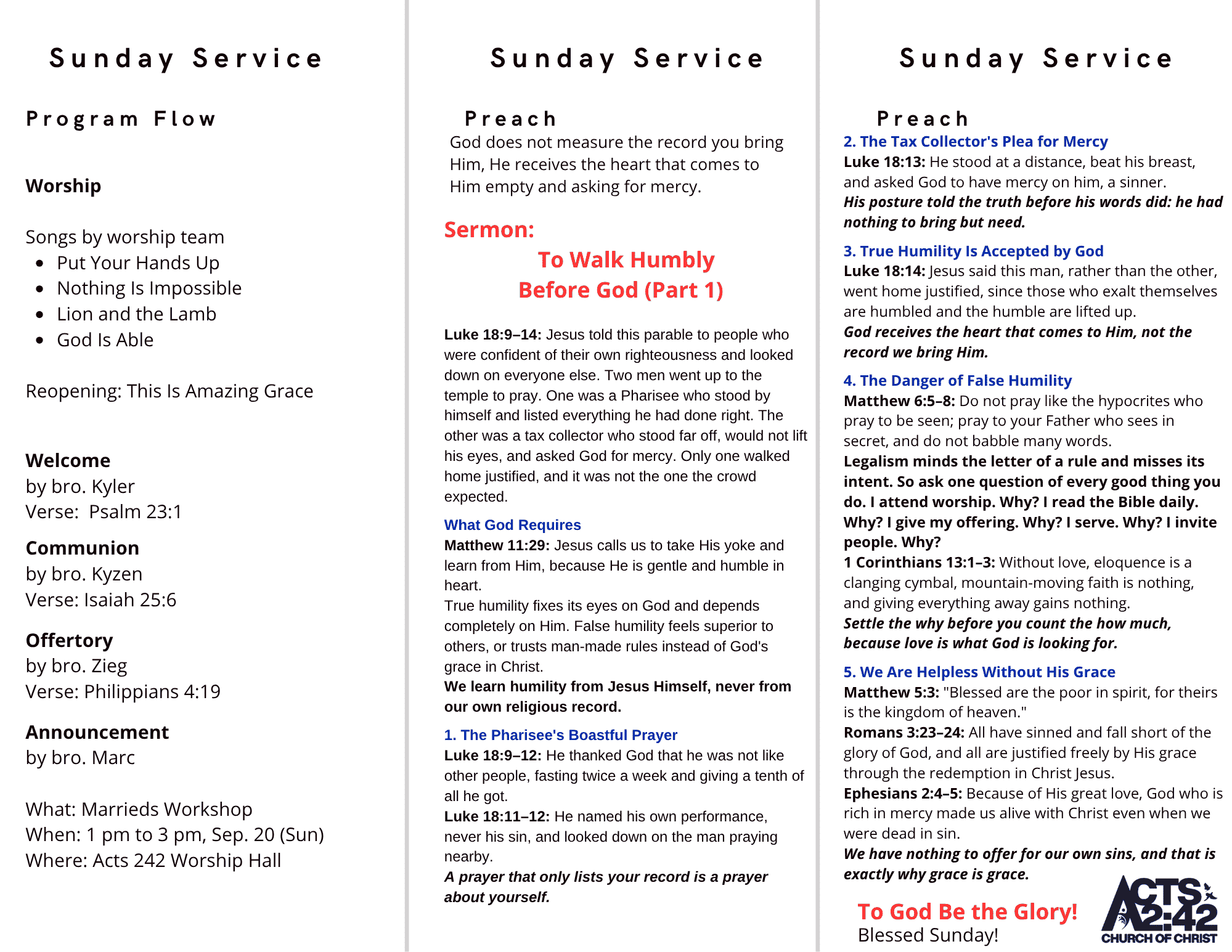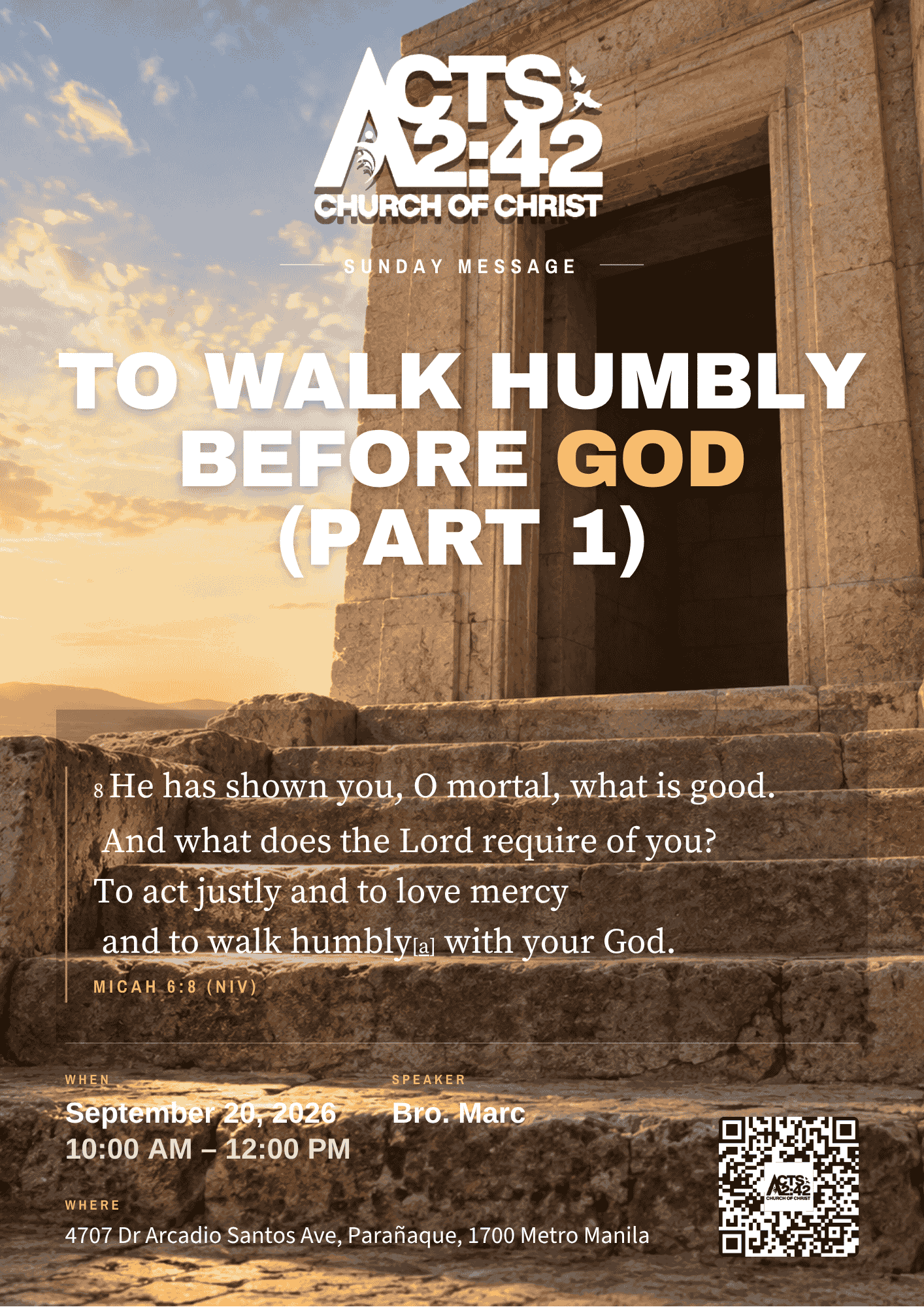
"He has shown you, O mortal, what is good. And what does the Lord require of you? To act justly and to love mercy and to walk humbly with your God." — Micah 6:8
What Does God Actually Require?
Humility is one of those words that sounds gentle until you try to live it. We can picture it easily enough — a quiet voice, a lowered head, someone who does not push to the front. But Jesus told a story about two men praying in the same building on the same day, and the one who looked humble was not, and the one everybody had written off went home right with God.
This is Part 1 of a two-part message on what God requires of us, and on the counterfeit that can grow quietly inside a sincere believer without ever announcing itself.
Micah's summary is short enough to memorize and long enough to spend a life on. Act justly. Love mercy. Walk humbly with your God.
God does not want us coming into His presence proud. And honestly, how could we? We are His creatures. There is nothing we bring before Him to boast about. Yet pride is sometimes our favorite sin, because we start to see ourselves as if we were very important in this world. Scripture says otherwise: our days are like grass that springs up, withers, and is blown away by the wind (Psalm 103:15–16). That is how quickly a human life passes.
Notice the order in Micah. Justice and mercy are things we do toward other people. Humility is the posture we hold toward God — and it is the one that keeps the other two honest. A person can be scrupulously fair and still be proud of how fair he is.
So where is it learned? Not from a technique. "Take my yoke upon you and learn from me, for I am gentle and humble in heart, and you will find rest for your souls" (Matthew 11:29).
Humility is learned from a Person — our Teacher and Master — by walking near enough to Him to be shaped by Him. It is not a quality we develop on our own and then present to God as evidence.
Two Kinds of Humility
Here is the line the whole message keeps returning to.
True humility focuses on God. It recognizes your complete dependence on Him and gives Him the glory.
Sometimes we start to think we are something. Ang gwapo ko. Ang ganda ko. We stand in front of the mirror and admire — and it is a mercy the mirror does not crack. True humility has nothing to boast about.
And it depends on God even for the body. We think we are strong because we eat well. But we all know people who were careful with every meal and still died young. Health is not only about what you eat, though that matters; it rests on God's will for your life. Knowingly and unknowingly, the Lord takes care of us. For all you know, He has already healed you of something you never even knew you had. And when He sees that He can still use you for His mission, He extends your life — the way He added fifteen years to King Hezekiah's life after he wept and prayed (2 Kings 20:1–6). That is how humility walks: grateful for what God is doing that we cannot see.
False humility feels superior to others — because you believe you are more humble than they are, or because you are leaning on man-made religious rules rather than on God's grace through our Lord Jesus Christ.
So — who here is humble? Naku, may nagtaas ng kamay. The moment you say humble ako, you have already lost to pride.
Read those two definitions twice. From the outside, they can look identical. Same attendance, same giving, same service, same words. Only one of them is actually a walk with God.
The Parable of the Pharisee and the Tax Collector
Luke tells us exactly who this parable is aimed at: "To some who were confident of their own righteousness and looked down on everyone else, Jesus told this parable" (Luke 18:9). That is the target. Not the openly wicked — the religiously secure.
Two men went up to the temple to pray. One was a Pharisee, a man whose entire life was ordered around the law of God. The other was a tax collector — and in that day, tax collectors were ranked with prostitutes and murderers. They had sold out their own people to collect for Rome, and many padded the amount. Nobody in that crowd would have needed help deciding which of the two was the better man.
1 · The Pharisee's Boastful Prayer
"The Pharisee stood by himself and prayed: 'God, I thank you that I am not like other people — robbers, evildoers, adulterers — or even like this tax collector. I fast twice a week and give a tenth of all I get'" (Luke 18:11–12).
Count the Is. I thank you. I am not. I fast. I give. The whole prayer circles around himself. He even singles out the tax collector standing some distance away.
And every line of it is true. He probably did fast twice a week. He almost certainly did tithe. This is not a story about a hypocrite living a secret double life. It is worse than that. His record was real, and his record was the problem.
Two things went wrong, and they are worth naming separately.
He relied on his own moral performance. There is no confession anywhere in that prayer, because a man who has kept the rules sees nothing to confess. It reads almost like he is reminding God of what he is owed.
He carried prejudice toward other sinners. He measures himself against the man standing at a distance and comes out ahead. Be honest — have we felt it? Surrounded by people who are always out drinking: buti pa ako, hindi ako ganito. Bahala na kayo, pumunta kayo sa impyerno. Or the classmates copying answers: sige, ituloy niyo lang. Basta ako, hindi ako kokopya. That comparison is the engine of false humility — it always needs someone below you.
And it forgets something basic. You were forgiven too. Your good works cannot offset your sins. There is no doctrine that says if you do enough good, your sins are buried under it. The wages of sin is death. Jesus does call us to do good — because we carry His name, and because the Holy Spirit lives in us. Think about that: whatever you watch, the Holy Spirit is watching with you.
2 · The Tax Collector's Plea for Mercy
"But the tax collector stood at a distance. He would not even look up to heaven, but beat his breast and said, 'God, have mercy on me, a sinner'" (Luke 18:13).
His posture reveals his heart before his words do. The temple had courts, and he would not even come close. Standing at a distance. Eyes down. Hand striking his own chest. He did not feel worthy to approach.
That is how we should come to God when we ask forgiveness — sincerely. Not "Lord, sorry ha, okay na tayo", the way you would brush it off with a friend. With respect. With brokenness. And not sorry today and back at it tonight. We do fall, and God understands that the weakness of the flesh can overwhelm us. What matters is that you are fighting.
Temptations are like birds flying over your head. You cannot stop them from landing; you can stop them from building a nest. When you entertain a temptation, it is as if the bird is laying eggs in your mind. Shoo it away. Alis ka diyan! Resist the devil, and he will flee from you (James 4:7). Resist — do not entertain.
And remember why it matters. It was our sins that put Jesus on the cross. Scripture warns against deliberately going on sinning (Hebrews 10:26), and speaks of those who fall away as crucifying the Son of God all over again (Hebrews 6:6).
And the tax collector brings no record, because he has none worth bringing. He relied on God's mercy for his forgiveness. That is not low self-esteem — that is an accurate reading of his own condition and an accurate reading of God's character at the same time. God's mercy is new every morning (Lamentations 3:22–23). It does not run out. It only needs a sincere heart asking for it.
3 · True Humility Is Accepted by God
"I tell you that this man, rather than the other, went home justified before God. For all those who exalt themselves will be humbled, and those who humble themselves will be exalted" (Luke 18:14).
That verdict reverses everything the crowd expected. One man walked in with a résumé and walked out unchanged. The other walked in with nothing and walked out justified.
When you humble yourself before God, He restores you to your rightful place as His child. You are clean again. You receive His grace again — unmerited favor. And when we repent, times of refreshing come (Acts 3:19).
Bro. Marc shared what that looks like in ordinary life. There was a neighbor who always seemed to be scowling, and the resentment was real. So he prayed: Lord, help me, so that when I see our neighbor, the anger is gone. The next time he ran into the husband outside, he smiled — and the man smiled back. Before long, the neighbor's wife and Sis. Normie were standing outside chatting so long that they knew each other's whole life story. Humility opened a door that pride had kept shut.
The difference was never the quality of their lives. It was what each of them thought he was bringing to God. And God is rich in mercy. Grace upon grace. Mercy upon mercy.
4 · The Danger of False Humility
Here the message turns toward us, because the Pharisee is far easier to spot in a parable than in a mirror.
Listen to the Lord's own instruction on prayer, and notice how much of it is about audience: "And when you pray, do not be like the hypocrites, for they love to pray standing in the synagogues and on the street corners to be seen by others" (Matthew 6:5). Being seen is the whole reward they will get. Instead — "go into your room, close the door and pray to your Father, who is unseen" (Matthew 6:6). Close the door: close your eyes, shut out the noise, and go into the room of your heart where God dwells. And do not babble on like pagans who imagine that a volume of words earns a hearing, "for your Father knows what you need before you ask him" (Matthew 6:8).
Remember how short the tax collector's prayer was. God, have mercy on me, a sinner. No long speech. No blaming the classmate or the boss for why he fell. When we sin, we sin against God, and it is to Him we bring it.
Bro. Marc knows how short a prayer can be. He once nearly drowned. Underwater, unable to speak, he prayed in his mind: Jesus, save me! At that moment someone passed in front of him, he grabbed hold, and he was pulled up. A short prayer from the heart, and God heard it. He sees the heart. He knows we did not mean to hurt Him. And because He knew we could never live without sin, He made a way Himself — He died on the cross so we could be justified. That is how much God loves us. It is why the Bible calls us saints — not because of our own righteousness, but because Jesus washed our sins away.
The danger has a name. The danger of false humility is when we become legalistic in our walk with God.
Legal term ba yan, Brother Marc? Legalistic means paying too much attention to minor rules and to the literal wording of a law, rather than looking at its true intent, its context, or its spirit. It is a failure only devoted people can commit — you cannot be legalistic about something you are not doing.
Which is why this message puts one question to every good thing we do — and listen to how easily the wrong answers come.
I always attend Sunday worship. Why? Because if I'm absent, someone will notice.
I read the Bible every day. Why? Because someone might ask if I had my quiet time.
I always give my offering. Why? So that God will bless me.
I serve in the church. Why? Because he serves, and I was here before him.
I always invite people to church. Why? Because Bro. Marc told me to.
That is doing the right thing without its meaning — because it was said, so it was done. Now hear the right answers.
I attend because I love God. Jesus is the One we come here for. I read the Bible because I want to know Him more — when you read, God speaks to you, and when you pray, you speak to Him. I give to honor God with the fruit of my labor. I serve because I love my brothers and sisters — if God gave you a voice, lead the worship so others are encouraged to worship too; if you can usher or serve, serve, because Jesus commanded us to love one another, and by this all people will know we are His disciples (John 13:34–35). I invite because I love the lost, and I do not want them to perish.
None of those five is under attack. Every one of them is good, and this church would be poorer without people doing all five. The question is never whether you do them. The question is what is underneath them.
And Scripture settles that in the strongest terms it has. Speak in the tongues of men or of angels without love, and you are "only a resounding gong or a clanging cymbal." Have prophecy, fathom all mysteries and all knowledge, hold "a faith that can move mountains," and without love "I am nothing." Give everything you own to the poor, hand your body over to hardship, and without love "I gain nothing" (1 Corinthians 13:1–3).
Not less. Nothing. In basketball terms: you made the shot, but it does not count. Our love for God is what motivates us to serve Him, and where that love is absent, the activity does not accumulate into anything at all.
5 · We Are Helpless Without His Grace
So if my record cannot justify me, what can?
"Blessed are the poor in spirit, for theirs is the kingdom of heaven" (Matthew 5:3). Poor in spirit means spiritually bankrupt — holding nothing, owing everything, with nothing left you can do to save yourself. And Jesus does not tell such people to go and accumulate something first. He tells them the kingdom already belongs to them. When God sees that emptiness and that longing for Him, the Holy Spirit can dwell there.
"For all have sinned and fall short of the glory of God, and all are justified freely by his grace through the redemption that came by Christ Jesus" (Romans 3:23–24).
So do not make other people your standard of righteousness. Buti pa ako — these people do nothing but scroll TikTok, or drink, or gamble. Bro. Marc confessed that he has watched people play poker online and caught himself envying how easy their life looked. Do not condemn them; we are sinners just as they are. The only difference is that your sin has already been paid in full by the Lord Jesus.
Everyone starts in the same place. The Pharisee and the tax collector were equally short of God's glory that morning. Only one of them knew it.
And then what God did about it: "But because of his great love for us, God, who is rich in mercy, made us alive with Christ even when we were dead in transgressions — it is by grace you have been saved" (Ephesians 2:4–5).
Dead people do not improve themselves. They are raised. That is why humility is not an optional refinement on the Christian life but the door into it — you cannot receive as a gift what you still believe you have earned.
Where This Leaves Us
We have nothing to offer God to atone for our own sins. That sounds like bad news until you see what it protects you from.
It means no one here is competing. The brother with thirty years of faithful service and the person who walked in for the first time this morning come to God the same way — with empty hands and an honest heart.
And it means we can be glad. You owe God nothing anymore. Look at the people among us who have lived long and come through many trials — they are still joyful. Worry is useless; envy is useless. Work as if you are working for the Lord. Enjoy the meal you have been craving. Simple joys, received with thanks, from a God who is rich in mercy.
True humility is not thinking poorly of yourself. It is looking honestly at yourself and clearly at God's mercy, and then walking with Him on those terms.
Challenge
This week, take the Pharisee's prayer and the tax collector's prayer and ask which one yours sounds like. Count the Is.
Then take the five questions and answer them honestly, one at a time. I attend worship — why? I read the Bible — why? I give — why? I serve — why? I invite — why? Do not change what you are doing yet. Just find out what is underneath it.
And if the answer that comes back is because it is what good people do, or because someone would notice if I stopped — that is not a reason to quit. That is a reason to come back to the temple with empty hands and ask for mercy, like the one who went home justified.
When a temptation lands this week, shoo it away before it nests. When resentment rises toward someone, pray for the smile before you meet them.
God does not measure the record you bring Him. He receives the heart that comes to Him asking for mercy.
To God be the glory.