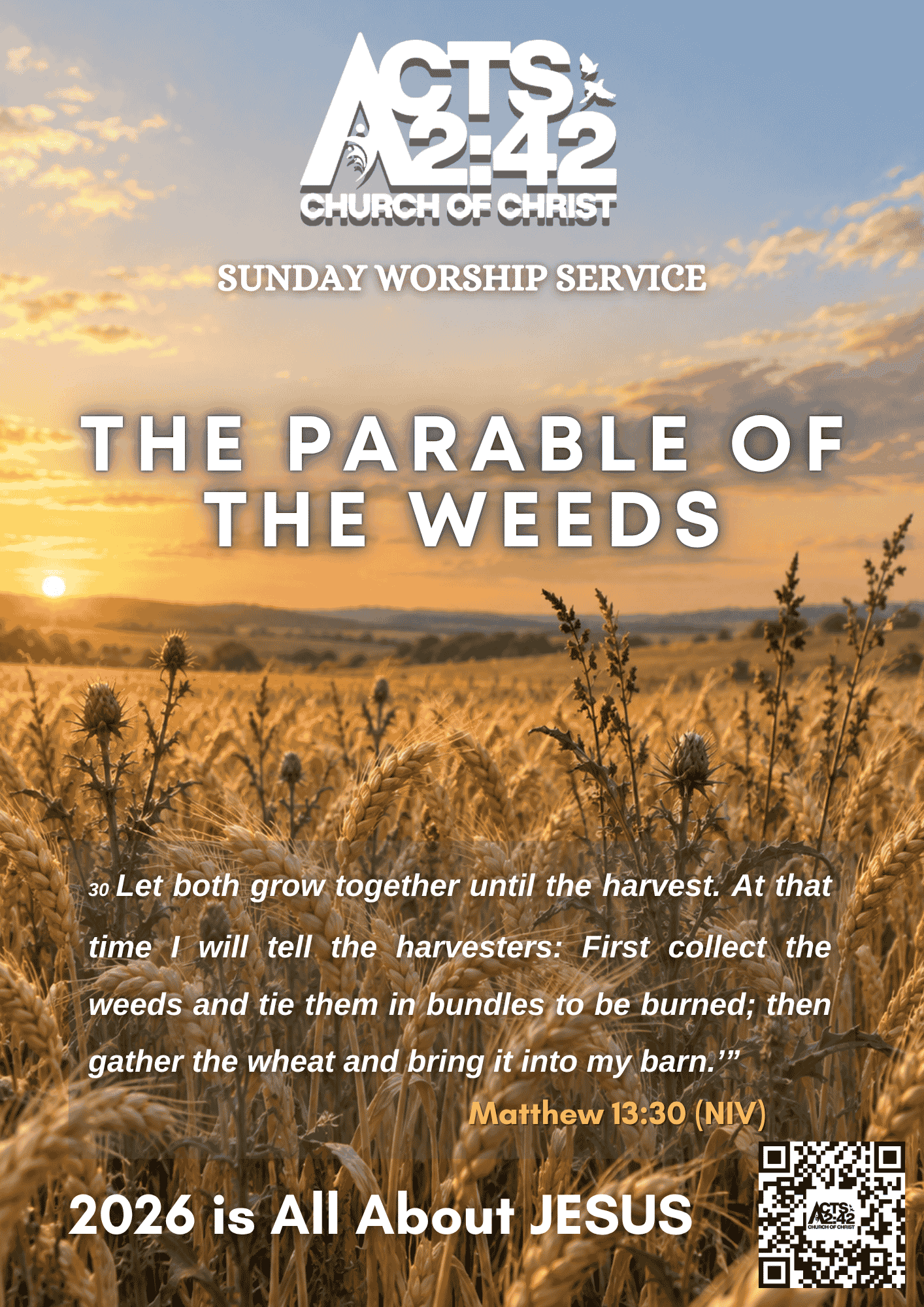
"Let both grow together until the harvest. At that time I will tell the harvesters: First collect the weeds and tie them in bundles to be burned; then gather the wheat and bring it into my barn." — Matthew 13:30
The Sentence Jesus Did Not Finish
There is a moment in the Gospel of Luke that most of us read straight past — and once you see it, you cannot unsee it.
Centuries before Christ, Isaiah prophesied about the coming Messiah: "The Spirit of the Sovereign Lord is on me, because the Lord has anointed me to proclaim good news to the poor. He has sent me to bind up the brokenhearted, to proclaim freedom for the captives and release from darkness for the prisoners, to proclaim the year of the Lord's favor and the day of vengeance of our God" (Isaiah 61:1–2).
Now watch what happens when Jesus stands up in His hometown synagogue.
"He went to Nazareth, where he had been brought up, and on the Sabbath day he went into the synagogue, as was his custom. He stood up to read, and the scroll of the prophet Isaiah was handed to him. Unrolling it, he found the place where it is written: 'The Spirit of the Lord is on me, because he has anointed me to proclaim good news to the poor'" (Luke 4:16–18a).
He keeps reading: "He has sent me to proclaim freedom for the prisoners and recovery of sight for the blind, to set the oppressed free, to proclaim the year of the Lord's favor."
And then: "Then he rolled up the scroll, gave it back to the attendant and sat down. The eyes of everyone in the synagogue were fastened on him. He began by saying to them, 'Today this scripture is fulfilled in your hearing'" (Luke 4:18b–21).
He stopped mid-sentence.
Isaiah wrote "the year of the Lord's favor and the day of vengeance of our God." Jesus read the first half — and closed the scroll. He did not read the vengeance.
Why? Because that day had not come. He came the first time to proclaim favor, to save, to set free. The day of vengeance belongs to another visit, still ahead of us.
And we are living inside the sentence He did not finish. We are living in the year of the Lord's favor — the long open season of mercy between the two halves of that verse. Which is exactly what the parable this morning is about.
The Parable
"Jesus told them another parable: 'The kingdom of heaven is like a man who sowed good seed in his field. But while everyone was sleeping, his enemy came and sowed weeds among the wheat, and went away. When the wheat sprouted and formed heads, then the weeds also appeared'" (Matthew 13:24–26).
Notice the timing — while everyone was sleeping. The enemy does not announce himself. He works quietly, at night, in a field that already belongs to someone else. And for a while nothing looks wrong. The problem only becomes visible when things start to grow.
"The owner's servants came to him and said, 'Sir, didn't you sow good seed in your field? Where then did the weeds come from?' 'An enemy did this,' he replied. The servants asked him, 'Do you want us to go and pull them up?'" (Matthew 13:27–28).
That is the honest question every believer eventually asks. Lord, didn't you plant good seed? Then where did all this come from? Why is there so much evil in a world that belongs to God? Why is there compromise inside the church? Where did the weeds come from?
And the answer is direct: an enemy did this.
Then comes the surprising part — the servants want to start pulling, and the owner tells them not to.
"'No,' he answered, 'because while you are pulling the weeds, you may uproot the wheat with them. Let both grow together until the harvest. At that time I will tell the harvesters: First collect the weeds and tie them in bundles to be burned; then gather the wheat and bring it into my barn'" (Matthew 13:29–30).
Let both grow together. That is the instruction that governs the age we are living in.
The Parable Explained
Thankfully we do not have to guess at the meaning, because the disciples asked and Jesus explained it.
"Then he left the crowd and went into the house. His disciples came to him and said, 'Explain to us the parable of the weeds in the field.' He answered, 'The one who sowed the good seed is the Son of Man. The field is the world, and the good seed stands for the people of the kingdom. The weeds are the people of the evil one'" (Matthew 13:36–38).
"'And the enemy who sows them is the devil. The harvest is the end of the age, and the harvesters are angels. As the weeds are pulled up and burned in the fire, so it will be at the end of the age. The Son of Man will send out his angels, and they will weed out of his kingdom everything that causes sin and all who do evil'" (Matthew 13:39–41).
"'They will throw them into the blazing furnace, where there will be weeping and gnashing of teeth. Then the righteous will shine like the sun in the kingdom of their Father. Whoever has ears, let them hear'" (Matthew 13:42–43).
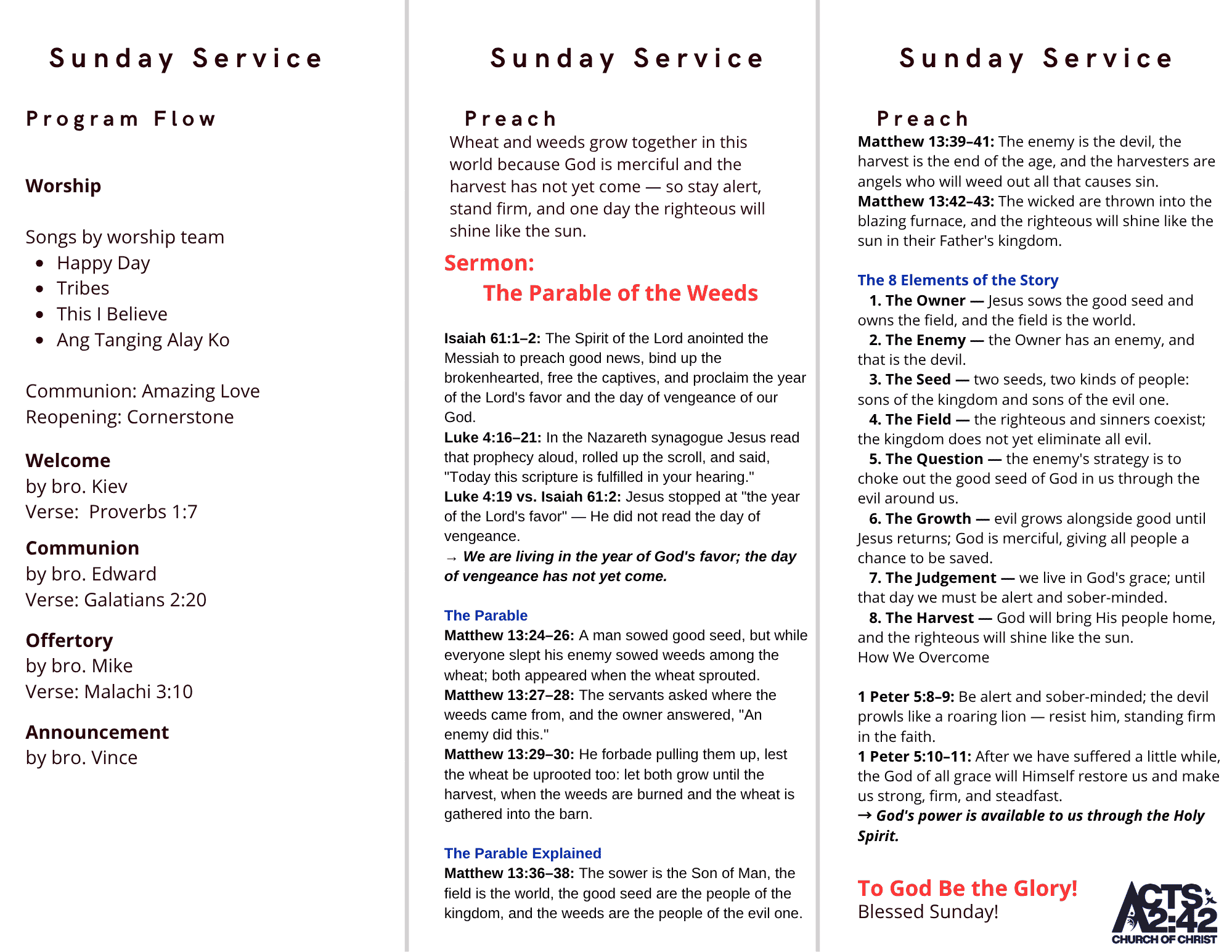
Now let us walk through the eight elements of the story.
1. The Owner
"The one who sowed the good seed is the Son of Man... the field is the world" (Matthew 13:37–38).
Our Lord Jesus sows the good seed, and He owns the field — and the field is the world.
Start here, because everything else depends on it. This world is not neutral territory and it is not the devil's property. It belongs to the Owner. The enemy is trespassing in a field he does not own.
2. The Enemy
"And the enemy who sows them is the devil" (Matthew 13:39).
The Owner has an enemy, and that enemy is the devil. He is not God's equal — he is God's enemy, which is a very different thing. He cannot create a field of his own, so he sneaks into this one at night and sows what he can.
3. The Seed
"The good seed stands for the people of the kingdom. The weeds are the people of the evil one" (Matthew 13:38).
There are two seeds because there are two kinds of people — the sons of the kingdom of God, and the sons of the evil one. And the enemy is the force working to destroy the harvest.
This is worth sitting with. The parable is not primarily about good and bad things, or good and bad choices. It is about people. Two plantings, growing in the same soil, in the same season, under the same sun.
4. The Field
"The field is the world" (Matthew 13:38).
The parable reminds us of a fact we would rather not accept: the righteous and sinners coexist in this world. The kingdom does not yet eliminate all evil and all opposition. That must await the harvest — God's own time of separation and judgment.
So do not be surprised that the world is mixed. Do not be surprised that there is evil in your workplace, in your neighborhood, in your family, even inside the church. That is precisely what Jesus said this age would look like.
5. The Question
"Sir, didn't you sow good seed in your field? Where then did the weeds come from?" (Matthew 13:27).
The servants' question exposes the enemy's strategy: to choke out the good seed of God in us through the evil that is prevalent around us.
That is how he works. He cannot uproot what God has planted, so he crowds it. He surrounds the wheat with weeds until the wheat is competing for light and soil. The pressure of a corrupt environment is one of his most effective weapons — and if we are not careful, the good seed in us is slowly choked.
6. The Growth
"Let both grow together until the harvest" (Matthew 13:30).
Evil will grow alongside the good until the return of Jesus — that is the nature of the world we live in. And it is a challenge for us to deal with sin in our own hearts, in our families, and in our own church.
But here is the reason for the delay, and it is beautiful. God is merciful, giving a chance for all people to be saved.
Think about what the servants were proposing. Pull them now. And what did the Owner say? You may uproot the wheat with them. God's patience with the weeds is, in part, His protection of the wheat — and His mercy toward people who are still weeds today but may not be weeds at the harvest.
Every one of us was once a weed. If God had answered the servants' request when we were young in our sin, none of us would be here. The delay is the mercy.
7. The Judgement
"At that time I will tell the harvesters: First collect the weeds and tie them in bundles to be burned; then gather the wheat and bring it into my barn" (Matthew 13:30).
We are living in God's grace. The day of judgment has not yet come — it is the second half of the verse Jesus did not read. And until that day, we need to be alert and of sober mind.
Notice also who does the sorting: the harvesters are angels. It is not our job to pull weeds. We are not appointed to decide who belongs in the barn and who belongs in the fire. That work is done at the end of the age, by angels, with perfect accuracy. Our job in the meantime is to grow.
How We Overcome
"Be alert and of sober mind. Your enemy the devil prowls around like a roaring lion looking for someone to devour. Resist him, standing firm in the faith, because you know that the family of believers throughout the world is undergoing the same kind of sufferings" (1 Peter 5:8–9).
Two commands: be alert, and resist him, standing firm in the faith. And notice the comfort attached — the family of believers throughout the world is going through the same thing. You are not uniquely targeted, and you are not fighting alone.
And we do not resist in our own strength: "And the God of all grace, who called you to his eternal glory in Christ, after you have suffered a little while, will himself restore you and make you strong, firm and steadfast. To him be the power for ever and ever. Amen" (1 Peter 5:10–11).
Look at the verbs — He Himself will restore you and make you strong, firm and steadfast. God's power is available to us through the Holy Spirit. And note the phrase after you have suffered a little while. Compared to eternity, the whole season of growing among weeds is a little while.
8. The Harvest
"Then the righteous will shine like the sun in the kingdom of their Father. Whoever has ears, let them hear" (Matthew 13:43).
God will harvest the wheat. He will bring His people home, and the righteous will shine like the sun.
That is the end of the story. Not the weeds. Not the crowding. Not the long uncomfortable season of growing side by side with what opposes God. The end of the story is light — the righteous shining like the sun in the kingdom of their Father.
Right now the wheat and the weeds look similar from a distance. At the harvest, no one will confuse them.
Challenge
"Therefore, my dear friends, as you have always obeyed — not only in my presence, but now much more in my absence — continue to work out your salvation with fear and trembling, for it is God who works in you to will and to act in order to fulfill his good purpose" (Philippians 2:12–13).
Let us continue to fear God and obey His commands.
This week, stop trying to pull weeds and start guarding your own growth.
Ask first: where is the good seed in me being choked? Not out in the world — in your own field. Which relationship, which habit, which environment is crowding out what God planted in you? Name it, and deal with it in your own heart, your family, and your church.
Then be alert. The enemy works while everyone is sleeping. Where have you been spiritually asleep — skipping the Word, skipping prayer, drifting through the week on autopilot? Wake up in that one area this week.
And be patient with the weeds. Do not appoint yourself a harvester. The person you have written off is someone God is still giving time to — the same mercy that once waited for you. Pray for them instead of pulling them.
We are living in the year of the Lord's favor — the half of the verse Jesus read aloud. The other half is coming. Until it does, grow.
Let both grow together until the harvest — and then the righteous will shine like the sun.