"So if the Son sets you free, you will be free indeed." — John 8:36
This is the story of two men in one room in Caesarea. One wore chains. The other sat on the governor's seat. By the end, only one of them was free — and it was not the one with the keys.
We all know the prisoner: the apostle Paul. But do we know the governor? His name was Felix. And his story is a warning for every one of us who thinks freedom is about our circumstances.
The Story
Paul had been seized in Jerusalem, and some of his own people were plotting to kill him. The Roman commander, Claudius Lysias, discovered Paul was a Roman citizen and sent him under heavy guard — two hundred soldiers, seventy horsemen and two hundred spearmen, at nine at night — to the governor in Caesarea, with a letter: the charges were about questions of their own law, "but there was no charge against him that deserved death or imprisonment" (Acts 23:29).
Five days later the high priest Ananias arrived with some elders and a lawyer named Tertullus, who opened his case by flattering the judge: "We have enjoyed a long period of peace under you, and your foresight has brought about reforms in this nation" (Acts 24:2). Then the accusation: Paul is a troublemaker, a ringleader of the Nazarene sect, who even tried to desecrate the temple.
Paul answered calmly. He had gone up to Jerusalem to worship. No one found him arguing or stirring up a crowd. He worshipped the God of his ancestors as a follower of the Way, believed everything in the Law and the Prophets, and shared their hope in the resurrection. And then: "So I strive always to keep my conscience clear before God and man" (Acts 24:16).
Felix adjourned the case. Some days later he came with his wife Drusilla and sent for Paul to hear him speak about faith in Christ Jesus.
"As Paul talked about righteousness, self-control and the judgment to come, Felix was afraid and said, 'That's enough for now! You may leave. When I find it convenient, I will send for you'" (Acts 24:25).
"At the same time he was hoping that Paul would offer him a bribe, so he sent for him frequently and talked with him. When two years had passed, Felix was succeeded by Porcius Festus, but because Felix wanted to grant a favor to the Jews, he left Paul in prison" (Acts 24:26–27).
Who Was Felix?
History fills in what Acts assumes we know.
Felix was a former slave. He had belonged to Antonia, the mother of Emperor Claudius, and was later freed. He became governor of Judea through his brother Pallas, another freed slave who had risen to great power in Rome.
The Roman historian Tacitus summed him up in one line: he held the power of a king with the mind of a slave. He had reached the top, but he still thought like someone owned.
According to the historian Josephus, he persuaded Drusilla, a daughter of King Herod Agrippa I, to leave her husband for him. And when he finally left office, the leading Jews of Caesarea went to Rome to accuse him anyway.
What Is Freedom to You?
So, what does freedom mean to you? Money — enough to do whatever you want? Travel — going wherever you like? Power — the kind that draws people and money toward you? Being above everyone else?
Felix had all of that. And he was still not free.
Part One · Felix and Paul
1 · Chains Do Not Decide Your Freedom
"The following night the Lord stood near Paul and said, 'Take courage! As you have testified about me in Jerusalem, so you must also testify in Rome'" (Acts 23:11).
Paul had planned his missions. Now he was locked up, and he could easily have concluded that his life's work was over. But the Lord Himself stood beside him and told him: take courage — I am not finished with you.
Chains do not decide your freedom. Your master does.
We all have chains. Some are life events: bankruptcy, debt you are drowning in, a credit card you cannot pay down, being falsely accused, losing your job, a partner who walked out, the death of a parent. Those are the moments we think, it's over; there's nothing I can do now.
And some chains are quiet. Every day the same. Earning exactly enough to get by, never enough to move. Lord, it's always just barely enough. I can't do anything, I can't go anywhere. Nakakapagod. Nakakasawa.
But plenty of people have been in prison, in shame, or buried in debt, and still came through, because they refused to let their circumstances set the limits of their freedom. Do not limit what God can do in your life. Paul's plans were interrupted, but the Lord's plan was not — Paul still reached Rome.
2 · Flattery Feels Like Freedom, but It Is a Net
"Those who flatter their neighbors are spreading nets for their feet" (Proverbs 29:5).
Tertullus opened with flattery, and flattery works because it feels good. But it traps us — usually through our image. We guard how people see us so carefully. I can't pray in front of all these people; what will they think of me? Some think a Christian is weak — a pushover who will not cheat back, who just says sorry when wronged.
So we do what our friends want, to look strong. We do something illegal to prove we are not a killjoy — KJ ka naman. We chase a title because we feel we need to be the vice president, the attorney, the businessman, at any cost.
That was Felix. A king with the mind of a slave, still worrying about what people would say. We can be the same: God already lives in us, His Word is already in our lives, and we still freeze over what other people think.
3 · I Can Feel It Without Obeying It
Watch Paul in the courtroom. He does not flatter back, and he does not explode.
"Better a patient person than a warrior, one with self-control than one who takes a city" (Proverbs 16:32).
People will insult you, provoke you, tempt you. I can feel it without obeying it. You do not have to obey it. You heard the gossip? Let it go — do not pass it on. And if you know you cannot resist joining in, do not stay and listen. The same goes for greed, gambling and lust, the thirst traps on your feed.
In this world we cannot avoid temptation. If you saw it, heard it, felt it, that is not your sin. The sin is obeying it. Money falls out of someone's pocket. A kickback is offered — just put your name here, there's a percentage in it for you. It is all right to feel the pull. Just do not obey it.
4 · A Clear Conscience Is Trained, Not Felt
"So I strive always to keep my conscience clear before God and man" (Acts 24:16).
The Greek word behind strive means to practice, to train; the King James renders it exercise myself. A clear conscience is trained, not felt. Becoming a Christian does not mean you are automatically clean in every thought. Every day we leave the house and mix with the world. Every day we feel things. How we handle them is where a clear conscience is built.
Paul met countless people, many of whom persecuted him or hated him. He had trained himself not to answer anger with anger.
Bro. Rovince shared how he has seen this in someone he knows, who often felt unappreciated, whose frustration kept growing until it was pulling them away from the Lord. They learned that the only way through was to stop harboring bitterness. If they appreciate it, good. If they don't, that's fine too. The bitterness left, and a clear conscience grew in its place.
Discipleship is serving the Lord, and serving the Lord means serving people. So when people do not thank you, remember who you were doing it for.
5 · You Can Know the Way and Still Not Walk It
"To the Jews who had believed him, Jesus said, 'If you hold to my teaching, you are really my disciples. Then you will know the truth, and the truth will set you free'" (John 8:31–32).
You may hear the Word twice a week. You may read your Bible and sing the songs. You can know the Way and still not walk it. The men who accused Paul knew what God wanted — and still lied, because their own agenda mattered more to them than His Word.
So it is not enough to hear a sermon. Take one thing from it and live it. Every time Bro. Rovince listens to a message, whoever is preaching, he prays: Lord, even just one thing — one phrase, one lesson. One lesson a week is fifty-two a year. In two years, that is a hundred habits — and a completely different person.
6 · The Fear Was an Open Door
When Paul spoke about righteousness, self-control and the judgment to come, Felix was afraid. And he said, that's enough for now.
Compare the crowd at Pentecost. They heard the same kind of truth and were cut to the heart: "Brothers, what shall we do?" (Acts 2:37).
The fear was an open door. Felix closed it. Felix's chance to come to God was the very man he had locked up. God reaches us in ways we do not expect — not only through someone from church. A sushi seller who shares the Bible with you. A water delivery man. A caterer. Someone you bump into who turns out to be a believer.
And this is not only for people outside the church. It is for believers who have grown cold. Sometimes God puts in front of us someone who went through the same struggle and found the way out — the gambling, the affair, the habit — and the answer is right there. When the door opens, do not say "that's enough for now."
7 · “Later” Is Still a Decision
Felix kept sending for Paul, hoping for a bribe. Two years passed, and nothing changed.
"Those who want to get rich fall into temptation and a trap and into many foolish and harmful desires that plunge people into ruin and destruction" (1 Timothy 6:9).
Paul was not going to pay. His conviction was simple: Jesus is my Savior, and He will provide for me.
We delay too. I'll become a serious Christian later. I'll serve in the church once my life is in order. I'll quit that job when the timing is right — the one that requires a little dishonesty to keep. I'll end that relationship eventually. “Later” is still a decision, especially the ones we are profiting from. And beware the shortcuts to wealth that God does not bless — scams, cheating, stealing.
8 · The Man in Chains Was Free
In his last act in office, Felix left Paul in prison to do the Jews a favor. And the prisoner went to Rome, just as God had promised.
The man in chains was free. The man on the seat was the slave.
Felix protected his image with the Jews, and in the end Jewish leaders still went to Rome to accuse him. We do the same with friends we try to impress, relatives we keep rescuing, bosses we always obey. When the time comes, they may forget us anyway.
Read the stories of people who truly succeed: their focus is on their calling, not on what others say. Paul was passionate about everything he did, and he did it for an audience of One.
Part Two · Living Free
Living as a Freed Man
"For the one who was a slave when called to faith in the Lord is the Lord's freed person; similarly, the one who was free when called is Christ's slave" (1 Corinthians 7:22).
Here is the deeper truth. Everyone serves a master. For some it is sin, for others money, temptation, a relationship, a business. Every person is a slave to something.
So to be free in this life, choose your master wisely. And the only Master who makes you free is Jesus Christ, our Lord and Savior. When He is your master, you are not dragged into ruin.
If what you serve right now is your business, or a person you love more than God — this is your invitation to change masters. And if what holds you back is fear of embarrassment, or fear of losing what you want in life, notice that both are about yourself and what other people think. That was Felix's whole problem.
A Freed Man Still Feels Everything
We are freed men and women. But a freed man still feels everything. He is just not ruled by it. Every temptation, every insult, every pull toward sin still comes. When we go too far, the Holy Spirit speaks to us: you're overdoing it — stop. And we let it go.
Felix had four chains: the approval he wanted from the Jews, the money he hoped to get from Paul, the fear that made him send the truth away, and the delay that kept him waiting for a convenient time. Here is how a freed man answers them.
Know Yourself First
"Let us examine our ways and test them, and let us return to the LORD" (Lamentations 3:40).
Look at how you actually live. Quick to anger? Quick to gossip? Cursing over small things? Thinking the worst of people? Then test it: Was I right to shout at that fast-food crew? To curse at that driver? And if you find a wrong, return to the Lord. Even if you cannot apologize to the person, you can say: Lord, forgive me. I was carried away by my emotions.
Take Every Thought Captive
"We demolish arguments and every pretension that sets itself up against the knowledge of God, and we take captive every thought to make it obedient to Christ" (2 Corinthians 10:5).
Bro. Rovince was honest about his own: anger and pride. As a chess player, he is always reading people and thinking about the next move — and he used to replay an offense and hold a grudge for a whole day. Now it is down to minutes, sometimes seconds.
The same with lust. The first look is not the sin. The second look is. Lord, sorry po — and look away. The same with money: you see it, you do not pocket it. And the same with sloth — the sleeping all day, the hours of YouTube, five seasons of a series in one sitting — when you could be praying, exercising, or doing something that changes a life, starting with your own.
Grace Teaches You to Say No
"For the grace of God has appeared that offers salvation to all people. It teaches us to say 'No' to ungodliness and worldly passions, and to live self-controlled, upright and godly lives in this present age" (Titus 2:11–12).
Grace does not only forgive you. It teaches you to say no. Mind, actions, and now the body: godliness is trained. The hardest enemy is often what we grew up with: habits do not leave easily — drinking, smoking, gambling, womanizing. Even the basics: reaching for your phone before you pray in the morning, cursing out of habit. You do not drop these because of one emotional sermon. Grace trains you slowly. If gossip used to wreck three families, maybe now it is down to one — and then none.
"They are not just idle words for you — they are your life" (Deuteronomy 32:47).
Obedience is not the cage. It is the key. The Bible is not a list of things that keep you from living. It is the answer key to the life God designed. It wants you healthy. It wants you financially wise — Solomon himself warns against putting everything into one venture (Ecclesiastes 11:2). Why is stealing forbidden? Because it wrecks other people's lives. Why is lying forbidden? Because a world full of lies has no truth left in it. So be honest, even when it hurts.
Life Was Meant to Be Conquered
"No, in all these things we are more than conquerors through him who loved us" (Romans 8:37).
Life was not meant to be escaped. It was meant to be conquered. We pray to escape: I just want this problem to be over. I just want this debt paid. I just want to survive the month. God wants more for you than escape. He wants you to face it, through Him, until it is no longer the thing controlling your life.
If you are drowning, panic only pulls you under. Lie back and float, and trust the One who will not let you sink.
Do not accept a life that is merely endured. If you are tired of where you are, pray it: Lord, I'm tired of this. I want change. Bro. Rovince prayed exactly that last year, and he believes he is watching God answer. There are still problems ahead, and he is not discouraged. When one door closes, God opens another.
Felix Waited for Convenient. God Says Now.
Felix said, "When I find it convenient, I will send for you." That convenient time never came. Felix waited for convenient. God says now.
"For he says, 'In the time of my favor I heard you, and in the day of salvation I helped you.' I tell you, now is the time of God's favor, now is the day of salvation" (2 Corinthians 6:2).
When you hear the Word, when your heart is opened, when a verse or a sermon or a song finds you — there is no more perfect time than now. God does not sleep. Every hour and every second is the right time to come to Him — even if you are tired, even if you feel like the worst of sinners.
What Are You Waiting For?
"And now what are you waiting for? Get up, be baptized and wash your sins away, calling on his name" (Acts 22:16).
Every one of us is a slave to the one we obey — either to sin, which leads to death, or to obedience, which leads to righteousness. But thanks be to God: those who obey from the heart have been set free from sin and have become slaves to righteousness (Romans 6:16–18).
Felix sat on a throne with the mind of a slave. Paul sat in chains with a free soul. Choose your Master, and you will be free indeed.
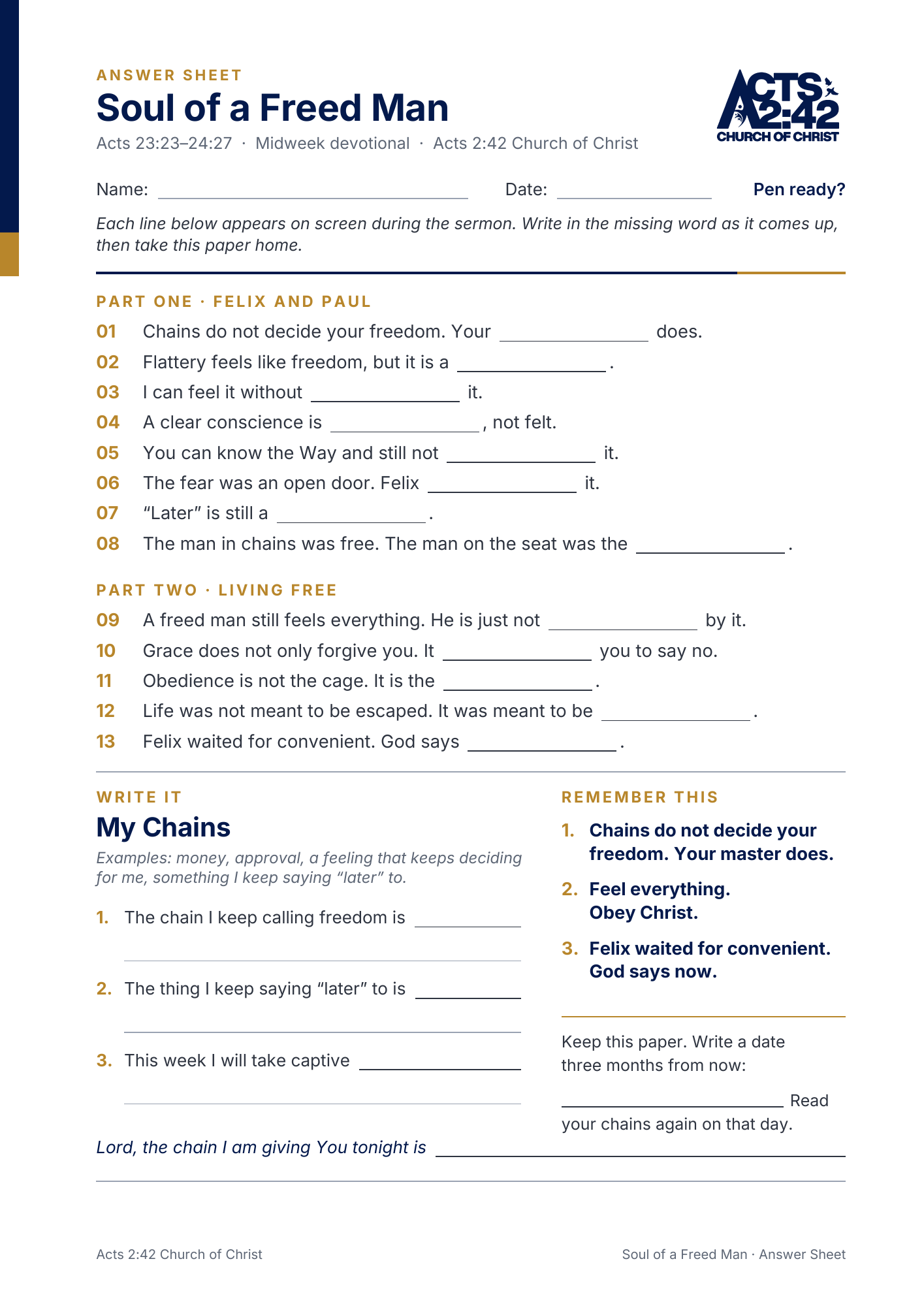
Answer Sheet
The handout from the devotional, with the answers filled in. Each bold word is the blank that appeared in red on the screen.
Part One · Felix and Paul
- Chains do not decide your freedom. Your master does.
- Flattery feels like freedom, but it is a net.
- I can feel it without obeying it.
- A clear conscience is trained, not felt.
- You can know the Way and still not walk it.
- The fear was an open door. Felix closed it.
- “Later” is still a decision.
- The man in chains was free. The man on the seat was the slave.
Part Two · Living Free
- A freed man still feels everything. He is just not ruled by it.
- Grace does not only forgive you. It teaches you to say no.
- Obedience is not the cage. It is the key.
- Life was not meant to be escaped. It was meant to be conquered.
- Felix waited for convenient. God says now.
Challenge
Take the handout home and finish the back page. Write down your chains. It could be money, approval, a feeling that keeps deciding for you, or something you keep saying “later” to.
- The chain I keep calling freedom is:
- The thing I keep saying “later” to is:
- This week I will take captive:
Then write a date three months from now on the paper, and read your chains again on that day.
Remember three lines:
- Chains do not decide your freedom. Your master does.
- Feel everything. Obey Christ.
- Felix waited for convenient. God says now.
And close with the prayer from the sheet:
Lord, the chain I am giving You tonight is…
Panginoon, ang kadenang isinusuko ko sa Inyo ngayong gabi ay…
And if you have never been baptized, the question is the one Ananias put to Paul: what are you waiting for?
To God be the glory!